
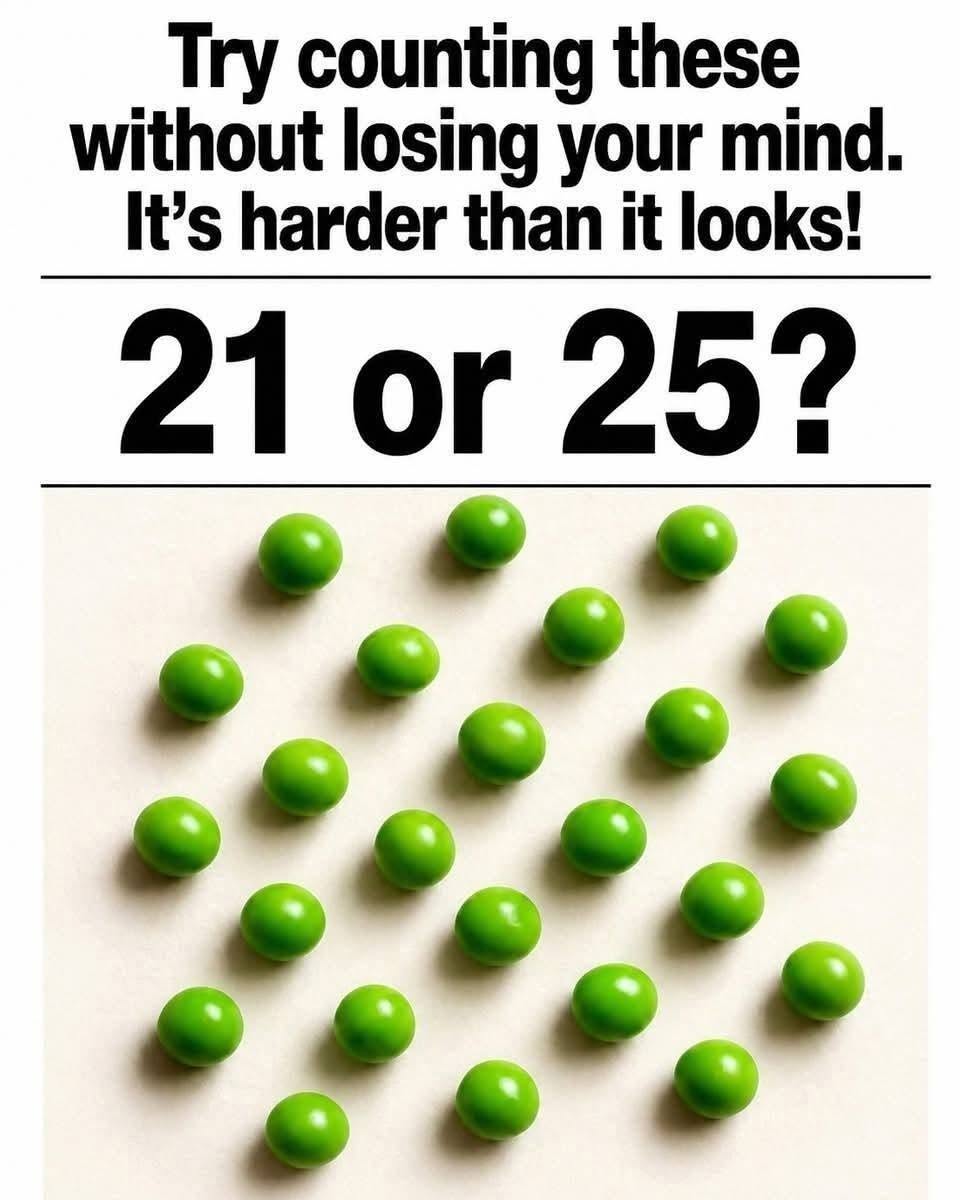
Optical illusions, counting puzzles, and brain teasers have exploded in popularity across social media platforms and online communities. At first glance, a simple image containing a collection of scattered green peas looks effortless to solve. However, as thousands of readers quickly realize, counting repeated, uniform objects arranged in staggered patterns is remarkably tricky for the human brain.
Visual puzzle challenges tap directly into human cognitive processing, spatial awareness, and visual attention mechanisms. Beyond serving as engaging entertainment, these viral visual tests highlight how our eyes and brains cooperate to process complex visual fields under pressure.
Deconstructing the Puzzle: How Many Peas Are There?
When faced with a grid or visual field of identical objects—such as green peas on a white background—the human brain attempts to shortcut the counting process by grouping items visually. This visual cognitive phenomenon, known in psychology as subitizing, allows us to instantly recognize small quantities (usually 1 to 4 items) without individually counting them.
However, once the number of items exceeds five or six, the brain must switch from instantaneous subitizing to sequential counting or visual mental grouping. When items are offset diagonally or spaced irregularly, visual tracking becomes significantly more difficult, often leading to miscounts.
🟢 🟢 🟢
🟢 🟢 🟢 🟢
🟢 🟢 🟢 🟢
🟢 🟢 🟢 🟢 🟢
🟢 🟢 🟢 🟢
🟢 🟢 🟢
🟢 🟢
The Accurate Count Breakdown
To determine whether the correct answer is 21, 25, or another number entirely, breaking the image down row by row or systematically using a structured grid reveals the precise layout:
Top Section: 3 green peas floating at the very upper tier.
Upper-Middle Section: 4 green peas positioned across the upper diagonal line.
Center-Upper Section: 4 green peas aligned through the mid-upper cluster.
Core Center Section: 5 green peas extending across the widest horizontal swath.
Lower-Center Section: 4 green peas arranged through the lower diagonal line.
Lower Section: 3 green peas forming the lower band.
Bottom Section: 2 green peas completing the lower tip of the diamond formation.
Summing up each row systematically: 3 + 4 + 4 + 5 + 4 + 3 + 2 = 25 total green peas.
Why Our Brains Get Tricked by Visual Counting Games
Why do so many people miscount these green spheres on their first attempt? The answer lies in the physiological way our eyes interact with repetitive visual stimuli.
Saccadic Eye Movements and Visual Fatigue
When looking at an image, our eyes do not glide smoothly; instead, they make rapid, microscopic jumps called saccades. When viewing identical green spheres against a neutral backdrop, the lack of distinct anchor points or color variation makes it easy for the eye to jump over an item or count the same item twice.
The Phenomenon of Visual Crowding
Visual crowding occurs when objects are placed close together in our peripheral vision. While your central vision focuses on counting one specific pea, peripheral vision blurs adjacent peas, causing the brain to estimate or skip over items situated near the visual edges.
Cognitive Benefits of Daily Brain Puzzles
Engaging with brain teasers, visual riddles, and counting challenges provides far more than short-term amusement. Neuroscience shows that regularly challenging your mind with visual puzzles offers key cognitive and mental health benefits.
Strengthening Cognitive Reserve
Just as physical exercise strengthens muscle tissue and cardiovascular efficiency, mentally stimulating tasks build cognitive reserve. Maintaining cognitive agility helps support memory preservation, focus, and mental sharpness as we age.
Improving Focus and Attention to Detail
In a fast-paced digital environment characterized by constant notifications and quick scrolling, visual counting puzzles force the brain to practice sustained attention. Focusing on a single static image trains visual discipline and attention to minute detail.
Financial and Education Investments: Gamified Learning
The overwhelming popularity of interactive visual puzzles has transformed modern educational technology and corporate training programs. Concepts once restricted to simple social media posts are now driving substantial economic growth in education technology, corporate cognitive testing, and digital media monetization.
Industry Sector Application of Visual Puzzles Economic & Value Impact
Education Technology Gamified math and spatial logic applications Increases student engagement and retention rates
Corporate Recruitment Cognitive aptitude and pattern recognition testing Evaluates candidate focus and problem-solving speed
Digital Media & Publishers Interactive quizzes and viral viral engagement tests Dramatically increases on-page user dwell time and session revenue
From investing in educational apps for children to exploring professional training tools, visual gamification has proven to be a high-value strategy across education, business, and technology sectors.
Health Insurance, Brain Wellness, and Preventative Care
As healthcare systems evolve, there is a growing emphasis on holistic wellness, preventative health, and mental longevity. Modern health insurance providers and medical wellness plans increasingly recognize that cognitive maintenance is an essential pillar of overall well-being.
Promoting brain health through cognitive exercises, balanced nutrition, daily movement, and adequate sleep helps reduce long-term medical risks associated with cognitive decline. Many health insurance programs now offer wellness perks, mental health incentives, and digital app subscriptions designed to keep minds active and sharp throughout life. Taking proactive steps to train your mind today serves as a vital investment policy for long-term health and vitality.
Practical Tips to Solve Counting Puzzles Effortlessly
If you want to ace every visual counting challenge that pops up on your feed, apply these simple, effective strategies:
Use the Grid Method: Mentally divide the image into four equal quadrants and count one section at a time.
Count by Rows or Diagonals: Never attempt to scan randomly. Pick a clear direction—left to right, or top to bottom—and stay consistent.
Use a Physical Anchor: Place your finger, stylus, or cursor on each item as you count it to eliminate duplicate counts.
Group by Threes: Instead of counting individual items one by one, group items into clusters of three (3, 6, 9, 12…) to boost speed and accuracy.
Conclusion
What appears to be a simple social media challenge is actually a brilliant demonstration of human visual perception and cognitive processing. While many guess 21 due to quick scanning, a systematic, step-by-step row count proves that there are indeed 25 green peas in the image.
Taking a few moments each day to solve brain teasers, challenge your perception, and exercise your visual attention is a fun, easy, and effective way to keep your mind sharp, focused, and ready for any puzzle life throws your way!
Frequently Asked Questions (FAQ)
What is the correct number of peas in the image?
The correct count is 25 green peas. Scanning systematically row by row reveals the complete set without missing offset items.
Why do so many people answer 21?
Many viewers scan quickly and miss the outer diagonal items or edge rows due to visual crowding and peripheral blurring, leading to an underestimate of 21.
What is subitizing in visual psychology?
Subitizing is the rapid, accurate, and confident judgment of numbers performed for small groups of items (typically 1 to 4) without counting each item individually.
Do counting puzzles help improve concentration?
Yes, regularly practicing visual puzzles strengthens sustained visual attention, pattern recognition, and focus, which are essential skills for daily productivity and memory health.
How can I practice visual training at home?
You can practice visual training using digital puzzle apps, traditional jigsaw puzzles, chess, word searches, and row-by-row image counting games.
