
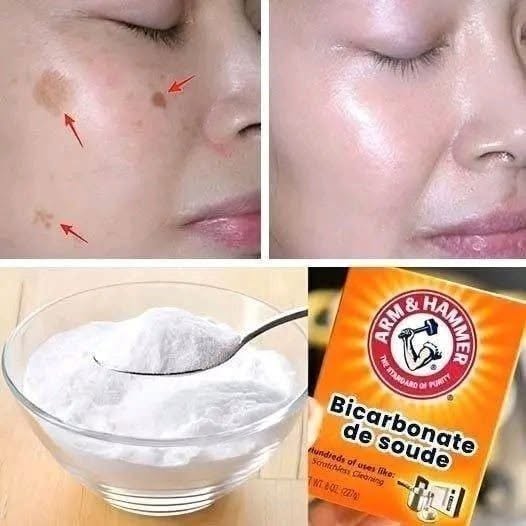
Social media infographics often promote household remedies for skin concerns, featuring striking before-and-after photos that suggest baking soda can erase dark spots, hyperpigmentation, or sun spots overnight.
While baking soda (sodium bicarbonate) is a staple household ingredient, dermatologists strongly advise against applying it directly to facial skin due to its potential to disrupt the delicate skin barrier.
Visual Breakdown: The Viral Remedy Graphic
The image uses a multi-panel collage comparing damaged skin to clear skin alongside household baking soda products.
+-----------------------------------------------------------------------+
|                    SKINCARE REMEDY GRAPHIC ANALYSIS                   |
|                                                                       |
|   [ Top Left Panel ]   ---> Close-up of cheek with dark spots & arrows|
|                                         |                             |
|                                         v                             |
|   [ Top Right Panel ]  ---> Clear, glowing, spot-free facial skin     |
|                                         |                             |
|                                         v                             |
|   [ Bottom Panels ]    ---> Bowl of white powder & Arm & Hammer box   |
+-----------------------------------------------------------------------+
Key Visual Components
- Before Panel (Top Left): Highlights dark spots and hyperpigmentation on the cheek using red arrows.
- After Panel (Top Right): Shows smooth, flawless, and luminous skin as an implied outcome.
- Product Panel (Bottom): Features a bowl of white powder and a box of Arm & Hammer Bicarbonate de soude (baking soda).
Why Baking Soda Can Damage Your Skin Barrier
- High pH Level: Healthy human skin has a slightly acidic natural pH (around 4.5 to 5.5). Baking soda is highly alkaline with a pH around 9, which strips away natural skin oils and disrupts the acid mantle.
- Skin Barrier Disruption: Applying alkaline substances can lead to dryness, irritation, redness, severe flaking, and heightened sensitivity to external pollutants.
- Risk of Worse Hyperpigmentation: Irritating delicate facial skin often triggers post-inflammatory hyperpigmentation (PIH), causing dark spots to darken further rather than fade.
Safe Dermatologist-Approved Ingredients for Dark Spots
| Ingredient | Primary Function | Ideal Skin Benefit |
| Vitamin C (L-Ascorbic Acid) | Antioxidant & melanin inhibitor | Brightens skin tone and fades hyperpigmentation |
| Niacinamide (Vitamin B3) | Reduces pigment transfer | Calms irritation and improves skin texture |
| Alpha Hydroxy Acids (AHAs) | Gentle chemical exfoliation | Sloughs off dead surface cells safely |
| Broad-Spectrum Sunscreen | UV protection | Prevents existing dark spots from worsening |
Frequently Asked Questions (FAQ)
1. Can baking soda lighten dark spots on the skin?
There is no scientific or clinical evidence supporting baking soda as a dark spot remover. Its abrasive nature can cause micro-tears and inflammation, leading to increased discoloration.
2. What is the best daily habit to prevent dark spots?
Wearing a broad-spectrum SPF 30+ sunscreen daily is the most effective way to prevent dark spots, sun spots, and premature skin aging caused by UV exposure.
Conclusion
Consulting board-certified dermatologists and opting for formulated, pH-balanced skincare products ensures safer and far more effective long-term results for treating hyperpigmentation.
