
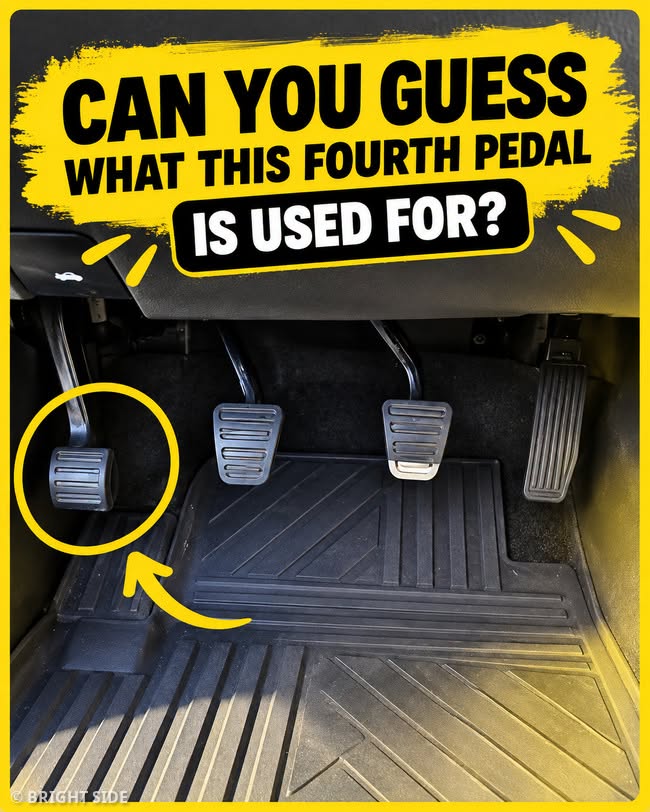
Most drivers are familiar with the standard two or three foot pedals in a motor vehicle: the gas pedal (accelerator), the brake pedal, and—in manual transmission vehicles—the clutch pedal. However, many modern and classic vehicles feature a small additional pedal located on the far left side of the driver’s footwell, leading drivers to ask: “Can you guess what this fourth pedal is used for?”
While first-time drivers often mistake this fourth pedal for a second brake or a manual clutch, its primary function in modern automatic vehicles is to operate the foot-operated parking brake (commonly known as the emergency brake or handbrake). In older classic vehicles, similar auxiliary foot pedals served specialized functions such as headlights dimmer switches or windshield washer pumps.
In this comprehensive automotive guide, we explain the function of the fourth pedal, how to operate foot-activated parking brakes safely, and how auxiliary driver controls have evolved over automotive history.
The Answer: What Is the Fourth Pedal Used For?
In the vast majority of modern automatic transmission cars, trucks, and SUVs, the fourth pedal on the far left operates the Foot-Operated Parking Brake (Emergency Brake):
+-------------------------------------------------------------------+
|                   PEDAL LAYOUT & FUNCTION MATRIX                  |
|                                                                   |
|  [ FAR LEFT PEDAL ]  → Parking / Emergency Brake (Press to lock)  |
|  [ LEFT PEDAL ]      → Clutch Pedal (Manual transmissions only)   |
|  [ MIDDLE PEDAL ]    → Primary Service Brake                      |
|  [ RIGHT PEDAL ]     → Accelerator / Gas Pedal                    |
+-------------------------------------------------------------------+
-
Primary Function: Pressing the pedal down firmly engages the vehicle’s parking brake mechanism, locking the rear wheels to prevent the vehicle from rolling when parked.
-
Release Mechanism: To release the parking brake, drivers either press the pedal down a second time until it clicks and springs back up (push-to-release), or pull a hand-lever located on the lower dashboard marked with a “P” symbol.
Historical Context: Other Uses for Far-Left Pedals in Classic Cars
Depending on the era and make of the vehicle, far-left foot controls have historically fulfilled a few different functions:
1. Foot-Engaged Parking Brake (Most Common Modern Usage)
Widely adopted by American automakers (such as Ford, General Motors, and Chrysler) and many Japanese truck/SUV models, foot-operated parking brakes replaced center-console handbrakes to clear space between the front seats for extra console storage or bench seating.
2. High-Beam Headlight Dimmer Switch (Classic Cars)
In vehicles built from the 1920s through the late 1980s, a small metal button or small pedal located on the floorboard to the left of the clutch was used to toggle between high-beam and low-beam headlights before controls were moved to the steering column stalk.
3. Manual Windshield Washer Pump (Vintage Models)
In certain vintage vehicles (such as early VW Beetles and trucks), pressing a small rubber floor button sprayed washer fluid manually onto the windshield via a mechanical diaphragm pump.
Best Practices: How to Use a Foot-Operated Parking Brake
Using your parking brake consistently prolongs the life of your transmission and ensures parking security:
-
Always Engage on Incline: Engage the parking brake before shifting into “Park” ($P$) to transfer vehicle weight onto the brake assembly rather than the transmission’s parking pawl pin.
-
Ensure Full Release Before Driving: Driving with an engaged parking brake causes rapid brake pad wear, friction heat, and mechanical damage. Always verify that the dashboard brake warning light is off before accelerating.
Conclusion
While seeing four pedals in a footwell might seem confusing at first glance, the small pedal on the far left is almost always a foot-operated parking brake. Understanding how your vehicle’s controls work ensures safer driving, better parking stability, and long-term vehicle maintenance!
Frequently Asked Questions (FAQ)
Is the fourth pedal a clutch?
No. In automatic transmission vehicles, there is no manual clutch pedal. The far-left pedal is dedicated to the parking brake mechanism.
How do you release a foot-operated parking brake?
Most foot-operated parking brakes are released either by pressing the pedal down firmly a second time (push-to-release) or by pulling a manual release handle located under the driver’s side dashboard.
Why do some cars have foot-operated parking brakes instead of handbrakes?
Automakers design foot-operated parking brakes to free up center console space for cup holders, storage compartments, and armrests.
