
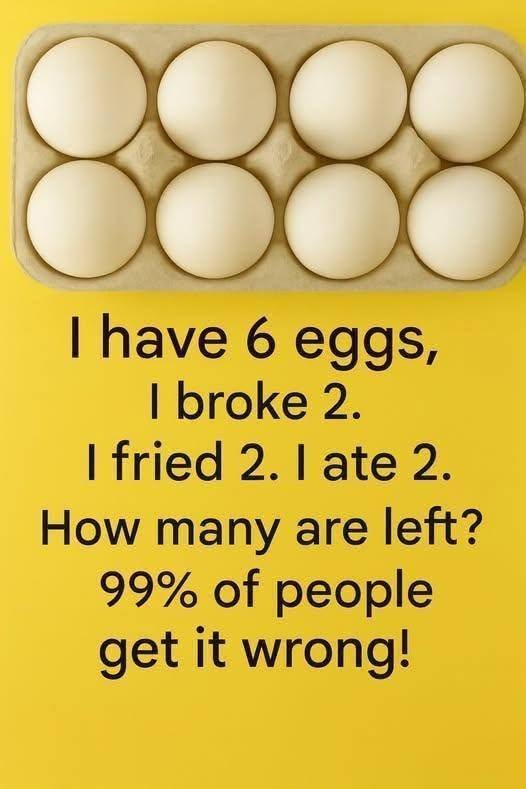
Brain teasers and logic riddles have captivated human minds for centuries. Every so often, a simple math puzzle resurfaces on social media, completely dividing comment sections and sparking endless debates among friends, family, and coworkers. One of the most viral examples to hit the internet involves a seemingly simple scenario with a carton of eggs.
At first glance, the problem seems like a basic arithmetic question designed for elementary school students. However, the unique phrasing and linguistic ambiguity lead hundreds of thousands of people to wildly different conclusions. Beyond being a fun distraction, these viral riddles offer incredible insights into cognitive psychology, human perception, linguistic interpretation, and how our brains process written information under dynamic conditions.
Deconstructing the Viral Egg Riddle
To truly understand why this puzzle trips up millions of people, we need to analyze the exact wording used in the statement:
“I have 6 eggs. I broke 2. I fried 2. I ate 2. How many are left?”
On the surface, it appears to be a sequential math problem where you start with a set amount and subtract items based on actions performed. However, the mystery lies in how you interpret tense, sequence, and the natural life cycle of preparing food.
The Math Behind the Logic
When people encounter this viral question, they generally fall into one of two major thinking camps: sequential action vs. cumulative action.
The Sequential Interpretation (The Most Common Answer: 4)In this scenario, the reader assumes that all three actions—breaking, frying, and eating—were performed on the exact same two eggs. You take two eggs out of the original six, crack them open, fry them up in a pan, and eat them. Because you only used two eggs total from your initial supply, you still have four raw, untouched eggs remaining in the carton.
The Subtractive Interpretation (The Alternate Answer: 0)In this mathematical interpretation, the reader treats each verb as a separate, distinct action applied to different eggs. You break two eggs, fry another two eggs, and eat the remaining two eggs. Under this approach: $6 – 2 – 2 – 2 = 0$.
The Present Tense Interpretation (The Alternate Answer: 6)A third, highly analytical perspective focuses heavily on grammar and verb tense. The first statement uses the present tense: “I have 6 eggs.” The following statements shift to the simple past tense: “I broke 2. I fried 2. I ate 2.” This suggests that the breaking, frying, and eating happened in the past, but right now, in the present moment, you still possess six eggs.
Why Brain Teasers Go Viral on Social Media
The psychology behind viral content is a fascinating field. Puzzles like this egg riddle perform exceptionally well across digital platforms because they tap into core psychological drivers of human interaction.
[ Viral Content Drivers ]
|
+————-+————-+
| |
[ Ego & Intellect ] [ Ambiguity & Debate ]
– Self-Validation – Multiple Interpretations
– Social Proof – High Engagement Rate
Social Validation and Self-Expression
When users solve a puzzle quickly, they feel a sense of cognitive accomplishment. Sharing the answer publicly serves as a form of social proof, showing their network that they possess sharp critical thinking skills. Conversely, when people realize they got an answer wrong, they often engage in friendly debate to justify their original reasoning.
The Power of Ambiguity
Content that leads to a single, undisputed factual answer rarely triggers massive comment sections. Highly shareable content thrives on ambiguity. When a question can be logically defended from two different angles, users are driven to comment, argue, and share the post to see how their peers react.
Cognitive Psychology: How Your Brain Processes Riddles
Why do so many smart individuals give incorrect answers to simple logic traps? The answer lies in cognitive heuristics—mental shortcuts our brains use to process information rapidly.
Fast vs. Slow Thinking
Psychologist Daniel Kahneman famously categorized human thought processing into System 1 (fast, intuitive, emotional) and System 2 (slow, deliberate, logical).
System 1 Thinking: When you first read the egg riddle, System 1 attempts to process it instantly as a rapid subtraction problem. It groups the numbers $2, 2, 2$ and compares them to $6$, jumping immediately to $0$.
System 2 Thinking: If you take a breath and pause, System 2 kicks in. You begin to analyze the practical real-world context of cooking. You don’t eat raw eggshells, and you usually break an egg before you fry it.
The Anchor Effect
The number $6$ serves as an initial anchor point. Because three subsequent actions mention the number $2$, our brain naturally wants to align $2 + 2 + 2 = 6$, convincing us that every single egg has been accounted for and consumed. Overcoming this cognitive anchor requires active reading comprehension rather than passive skimming.
Practical Lessons in Critical Thinking and Communication
While logic puzzles are entertaining, the lessons they teach extend far into daily life, professional communication, and decision-making frameworks.
Clear Communication Matters
The entire egg riddle exists because of ambiguous wording. In everyday business, legal agreements, and corporate management, ambiguity can lead to costly misunderstandings. Expressing thoughts clearly and avoiding dual-meaning statements is essential across all industries.
In Legal Services and Contracts: Precise terminology prevents disputes regarding responsibilities, liability, and terms.
In Corporate Finance and Loan Documentation: Exact phrasing ensures clarity around interest rates, investment timelines, and repayment schedules.
In Medical and Health Settings: Unambiguous instructions on prescriptions and treatment plans ensure patient safety and care quality.
Challenging Initial Assumptions
Before jumping to a conclusion in problem-solving, take a moment to evaluate the underlying premises. Ask yourself:
Am I assuming steps happened simultaneously or sequentially?
Is there missing context that changes the problem entirely?
What alternative interpretations exist?
Famous Viral Brain Teasers Throughout History
The egg puzzle is part of a rich tradition of brain teasers that have captivated the public. Here are a few other famous riddles that test human logic:
The Monty Hall Problem: A probability puzzle based on a game show scenario where changing your choice between three doors doubles your chances of winning a car. It notoriously stumped top mathematicians when it was first published.
The Bat and Ball Problem: “A bat and a ball cost $1.10 in total. The bat costs $1.00 more than the ball. How much does the ball cost?” (Intuitive System 1 answer: 10 cents. Correct System 2 answer: 5 cents).
The River Crossing Puzzle: Transporting a fox, a goose, and a bag of grain across a river using a boat that can only carry one item at a time without leaving left-alone items vulnerable.
Tips to Improve Your Logic and Analytical Thinking Skills
If you enjoy solving complex problems or want to sharpen your critical thinking abilities for work, investment planning, or education, consider these practical techniques:
Practice Slow Reading: Resist the urge to rush through text. Pay close attention to action verbs, tenses, and logical connectors.
Break Problems Down: Divide complex tasks into smaller, individual components to analyze each piece independently.
Question Your First Impression: Whenever an answer feels immediately obvious, pause and double-check for potential tricks or alternative perspectives.
Learn Basic Logic Rules: Familiarize yourself with deductive, inductive, and abductive reasoning principles.
Engage with Diverse Topics: Expand your knowledge base across technology, economics, psychology, and science to build broader mental models.
Frequently Asked Questions (FAQ)
What is the officially accepted answer to the egg riddle?
The most widely accepted logical answer is 4. This assumes that you broke, fried, and ate the exact same 2 eggs, leaving the remaining 4 eggs intact inside the carton.
Why do some people say the answer is 0?
People who answer 0 interpret the statement as three separate actions performed on three distinct pairs of eggs: breaking 2, frying a different 2, and eating the final 2 ($6 – 2 – 2 – 2 = 0$).
Can the answer technically be 6?
Yes! Grammatically, the statement opens with “I have 6 eggs” in the present tense, while the actions of breaking, frying, and eating are stated in the past tense. This implies you currently hold 6 eggs regardless of past actions.
Why are riddles like this good for cognitive health?
Engaging with logic puzzles stimulates neural pathways, improves working memory, enhances pattern recognition, and encourages flexible thinking strategies.
How can I use riddles to improve group problem-solving?
Using riddles during team icebreakers or workshops helps highlight how different people process identical information. It encourages active listening, diverse perspectives, and team collaboration.
Final Thoughts
The viral egg riddle is more than just a quick social media post; it is a masterclass in linguistics, cognitive psychology, and human engagement. By challenging our default thinking patterns and forcing us to look beyond immediate assumptions, simple puzzles keep our minds sharp and remind us of the beauty of human perception. The next time you encounter a viral puzzle online, take a moment to look past the surface—you might just discover a whole new way of seeing the world.
