
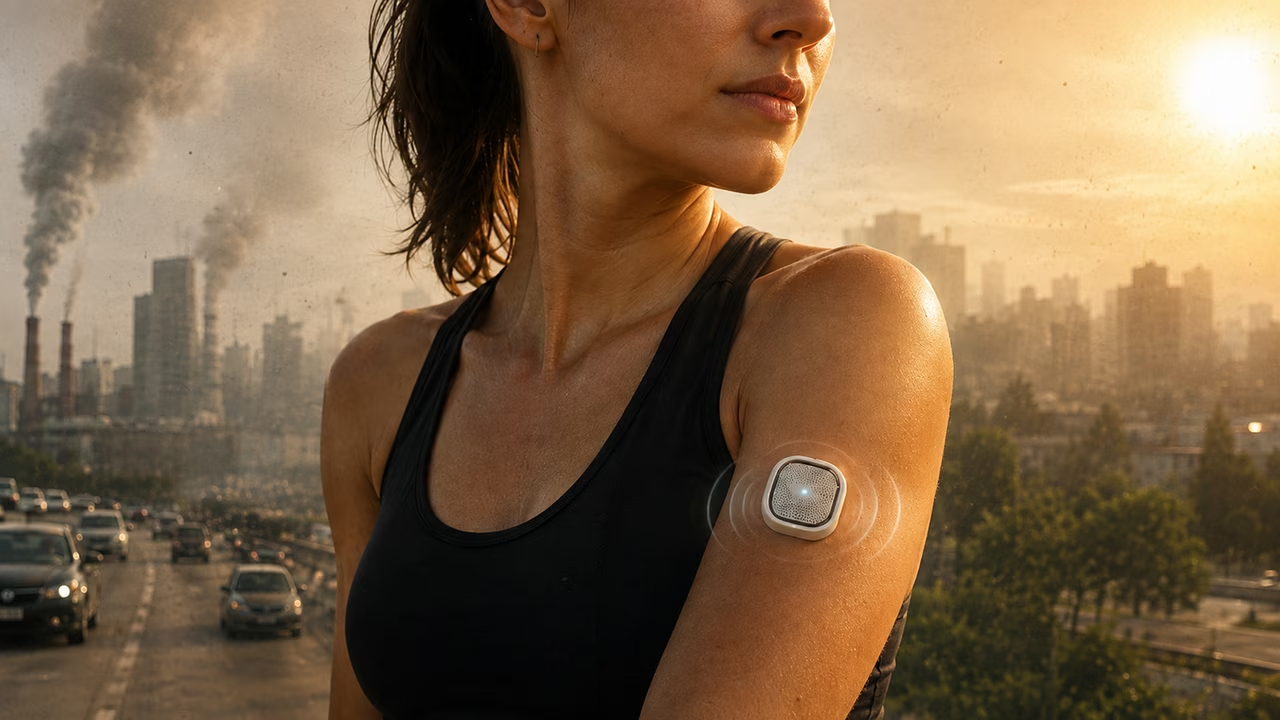
Introduction: The Hidden Threat in Our Daily Air
As more than half of the global population resides in urban areas, air quality has become one of the most pressing invisible health challenges of our time. While weather forecasts give us a general sense of temperature and humidity, they often fail to capture the localized particulate matter, smog, and pollutants we encounter during our daily commutes, workouts, or walks through the city. Traditional air monitoring relies on fixed government weather stations that can be miles away from your actual location, offering little insight into the specific air you are breathing right now.
Today, a new wave of wearable environmental technology is shifting the power into the hands of the individual. Compact, clip-on sensors and wearable monitors allow people to track real-time air pollution levels wherever they go. As urban wellness and preventative health gain momentum, understanding how personal environmental data intersects with modern health, technology, investment, and insurance is becoming essential. This article explores the science behind portable pollution sensors, their practical benefits for city dwellers, and how monitoring your environment safeguards long-term vitality.
The Science Behind Portable Air Quality Sensing
To appreciate how wearable monitors work, it is helpful to understand what they measure in the atmosphere. Urban air is a complex mixture of gases and microscopic solid particles known as particulate matter ($PM_{2.5}$ and $PM_{10}$), volatile organic compounds (VOCs), and nitrogen oxides emitted by vehicles, industry, and construction.
1. Optical Particle Counters
Most personal air monitors use laser-based optical scattering technology. As air is drawn into the device, a laser beam illuminates airborne particles. By analyzing how light scatters off these microscopic fragments, the sensor can instantly calculate the concentration and size distribution of pollutants in real time.
2. Gas and Chemical Sensors
Advanced wearables also incorporate electrochemical or metal-oxide semiconductor sensors designed to detect harmful gases like carbon monoxide, ozone, and nitrogen dioxide. These sensors undergo chemical reactions when exposed to target gases, producing a measurable electrical current that translates into an air quality index (AQI) reading.
3. Real-Time Mapping and Data Syncing
Equipped with Bluetooth or smartphone integration, these wearable gadgets sync continuous data to mobile apps, mapping your personal exposure levels throughout the day and alerting you when pollution spikes.
Practical Applications for Urban Residents
Integrating a personal environmental tracker into your daily routine offers several practical advantages:
-
Optimizing Outdoor Workouts: Helping runners and cyclists choose cleaner routes through parks or side streets, avoiding heavy traffic corridors during peak rush hours.
-
Managing Respiratory Health: Providing early warnings for individuals with asthma or allergies, allowing them to take preventative measures before symptoms flare up.
-
Commute Adjustments: Empowering commuters to alter their travel habits or use protective masks when passing through high-pollution transit hubs.
Navigating the Tech Market, Business, and Wellness
The rapid adoption of personal health and environmental gadgets highlights the dynamic intersection of consumer technology and commercial investment. For hardware manufacturers and startups, developing accurate, wearable monitoring devices represents a high-growth sector in the global business market. Furthermore, as individuals and employers place greater emphasis on preventative health and wellness, reviewing health insurance policies and consulting with legal professionals or attorneys regarding product liability and data privacy ensures a secure commercial ecosystem. Safeguarding personal well-being involves a holistic approach that bridges innovative technology with sound financial and legal planning.
Interesting Facts About Air Quality Technology
-
Microscopic Scale: $PM_{2.5}$ particles are roughly 30 times smaller than the width of a human hair, making them small enough to pass directly through the lungs into the bloodstream.
-
Hyper-Local Variations: Studies show that air pollution levels can change dramatically within a single city block depending on wind patterns, traffic density, and street canyon architecture.
-
Miniaturization Breakthroughs: Early air monitoring equipment required bulky laboratory carts, whereas modern consumer sensors fit easily inside a small clip-on device or smartwatch attachment.
-
Crowdsourced Mapping: Wearable sensors allow users to contribute anonymous data to global air quality maps, helping researchers track urban pollution trends in real time.
Conclusion: Taking Control of the Air You Breathe
The evolution of personal environmental monitors marks a significant shift toward proactive health management in modern cities. By providing accurate, real-time data about the air around you, wearable sensors empower you to make informed decisions that protect your respiratory health and overall well-being. Combining these innovative tools with smart business, investment, and lifestyle choices ensures a healthier, more transparent future. The most important health metric is the one you breathe every single second.
Frequently Asked Questions (FAQ)
Q: How accurate are wearable air quality monitors compared to government stations? A: While government stations use large, highly calibrated reference instruments, modern wearable monitors use advanced optical and electrochemical sensors that offer reliable, hyper-local trends for personal exposure tracking.
Q: Do these devices require regular calibration? A: Most consumer-grade wearable air monitors are pre-calibrated by the manufacturer, though some advanced models feature self-calibration algorithms or app-based maintenance guidelines to ensure long-term accuracy.
Q: Can personal monitors detect all types of pollution? A: They are typically designed to detect common urban pollutants such as $PM_{2.5}$, $PM_{10}$, and select gases, but they may not measure every rare chemical or specialized industrial toxin.
Q: How do wearable air monitors impact smartphone battery life? A: They generally use low-energy Bluetooth (BLE) protocols to sync data continuously with your smartphone, consuming minimal battery power throughout the day.
Q: Are these devices waterproof or suitable for intense workouts? A: Many fitness-focused environmental monitors are designed with sweat-resistant or weather-resistant casings, making them suitable for running, cycling, and outdoor exercise.
