
Algebra puzzles and simultaneous equation challenges frequently go viral across social media platforms, sparking lively debates in comment sections worldwide. While algebraic expressions appear deceptively simple at first glance, solving systems of linear equations requires foundational math skills that test logical deduction and systematic problem-solving.
Why do basic algebra puzzles generate such high engagement online? In this comprehensive guide, we explore the step-by-step breakdown of solving equations, the psychological reasons behind common mathematical errors, cognitive benefits of solving logic puzzles, and practical ways to improve everyday mental math skills.
Step-by-Step Mathematical Breakdown of the Puzzle
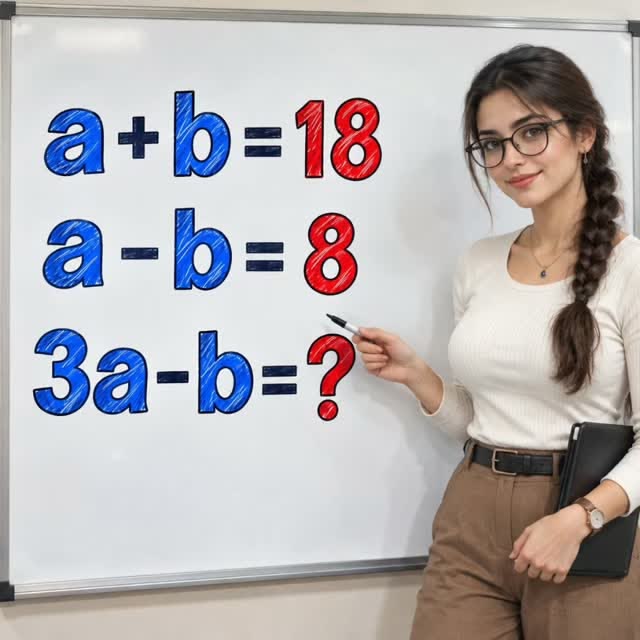
To solve the system of equations shown on the whiteboard:
-
$a + b = 18$
-
$a – b = 8$
-
Evaluate $3a – b = ?$
Step-by-Step Solution Using Elimination
Let’s find the values of $a$ and $b$ step by step:
-
Step 1 (Add both equations together to eliminate $b$):$(a + b) + (a – b) = 18 + 8$$2a = 26$$a = 13$
-
Step 2 (Substitute $a = 13$ back into the first equation):$13 + b = 18$$b = 18 – 13$$b = 5$
-
Step 3 (Evaluate the final expression $3a – b$): Substitute $a = 13$ and $b = 5$ into $3a – b$:$3(13) – 5 = 39 – 5 = 34$.
Therefore, the mathematically correct final answer is 34.
Why Math Puzzles Cause Social Media Debates
Algebraic brainteasers frequently divide commenters due to arithmetic slips or alternative solving methods.
The Appeal of Logical Verification
When users solve simultaneous equations using different methods—such as substitution versus elimination—they enjoy comparing their work and verifying results in the comments section.
The Power of Community Engagement
Debating solutions fosters a sense of shared community and playful intellectual competition, which explains why math puzzles consistently achieve massive viral reach.
Cognitive and Psychological Benefits of Brainteasers
Engaging in regular mental arithmetic and algebraic logic offers significant long-term cognitive and neurological benefits.
Enhancing Working Memory and Focus
Solving systems of equations requires holding multiple variables in mind while applying logical rules sequentially. This exercise strengthens working memory, concentration, and executive function in the brain.
Boosting Problem-Solving Confidence
Successfully working through logic puzzles triggers dopamine release in the brain’s reward pathways, creating feelings of accomplishment and building overall confidence in analytical problem-solving skills.
Practical Ways to Improve Your Mental Math Skills
If you want to sharpen your speed and precision when tackling everyday calculations or logic brainteasers, consider these practical techniques:
-
Master the Elimination Method: Practice adding or subtracting equations to quickly isolate single variables.
-
Double-Check Your Substitution: Always plug your solved values back into the original equations to verify accuracy.
-
Practice Daily Logic Games: Spend 5 to 10 minutes daily solving number puzzles or digital math challenges to keep your mind sharp.
-
Write Down Intermediate Steps: Break complex expressions down on paper to avoid mental slips during calculation.
-
Teach Others: Explaining math rules to friends or children reinforces your own conceptual understanding and mastery.
Fascinating Facts About Algebra and Mathematics History
-
Origin of Algebra: The word “algebra” comes from the Arabic book Al-Kitab al-mukhtasar fi hisab al-jabr wal-muqabala, written in the 9th century by Persian mathematician Al-Khwarizmi.
-
The Power of Brain Games: Studies show that adults who regularly participate in number and logic puzzles retain higher cognitive processing speeds as they age compared to those who do not.
-
Viral Algorithmic Reach: Simple visual puzzles leverage human curiosity and the desire to share solutions, making them a staple of modern digital content creation.
Conclusion
Algebra puzzles serve as a fun, engaging way to challenge our analytical thinking and refresh foundational mathematics skills. By setting up the elimination method ($2a = 26 \rightarrow a = 13$, then $b = 5$) and evaluating $3(13) – 5$, you can successfully solve whiteboard equations and reach the correct answer of 34 every single time!
Frequently Asked Questions (FAQ)
1. What are the values of $a$ and $b$ in the puzzle?
Adding both equations gives $2a = 26$, so $a = 13$. Substituting $a$ back in gives $b = 5$.
2. How do you solve the final expression $3a – b$?
Substitute $a = 13$ and $b = 5$ into the expression: $3(13) – 5 = 39 – 5 = 34$.
3. Do math puzzles help improve brain function?
Yes! Regularly solving logic and algebraic puzzles enhances working memory, cognitive flexibility, and analytical problem-solving skills.
4. What is the best strategy for solving simultaneous equations?
The elimination method is often the fastest approach when one variable has opposite coefficients in the two equations.
