
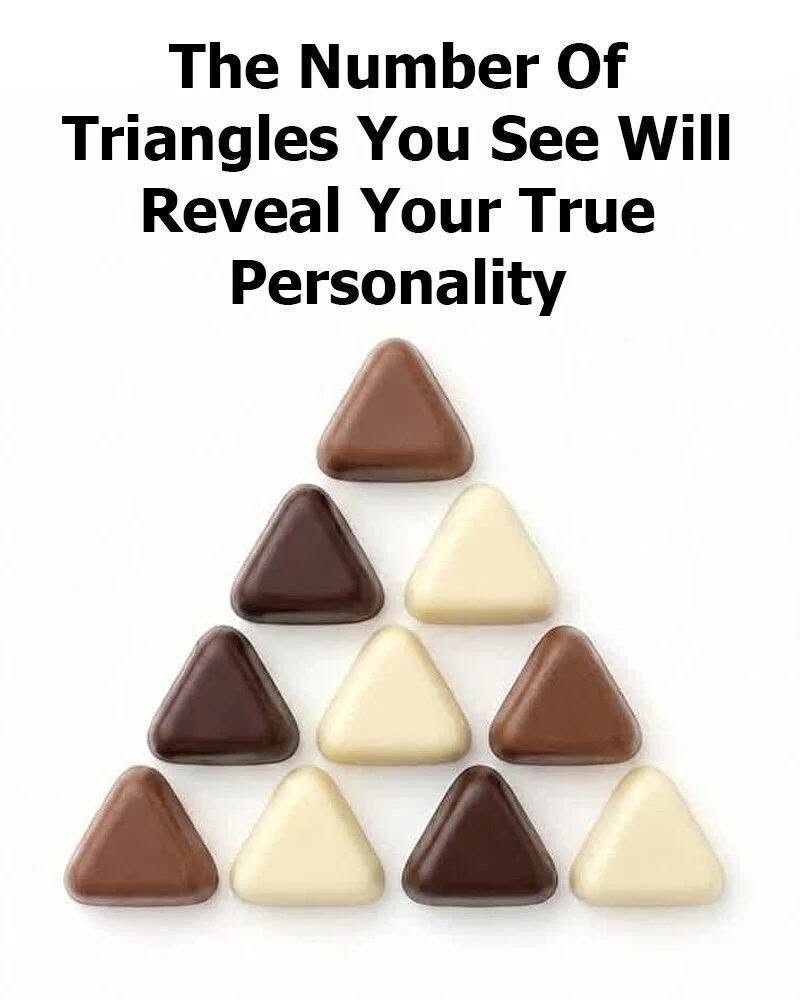
Visual puzzles and optical illusions have long captivated people online, sparking lively debates over what seems at first glance to be a simple counting question. One such puzzle that frequently circulates across social media features a pyramid arrangement of rounded triangular chocolates with the bold claim: “The Number Of Triangles You See Will Reveal Your True Personality.”
While personality tests attached to visual brain teasers are strictly playful social games, counting the total number of triangles formed by this arrangement provides a fun exercise in geometry, visual perception, and spatial reasoning. By breaking down the image layer by layer, you can discover both the direct count and the hidden composite shapes formed by the negative space and groupings.
Direct Count: Individual Chocolate Triangles
When looking at the physical objects (the individual chocolates themselves), we can count them row by row from top to bottom:
Row 1 (Top): 1 chocolate triangle
Row 2: 2 chocolate triangles
Row 3: 3 chocolate triangles
Row 4 (Bottom): 4 chocolate triangles
Summing the individual chocolate pieces gives:
$$1 + 2 + 3 + 4 = 10 \text{ individual chocolate triangles}$$
Composite Count: Larger Triangular Formations
In visual puzzles of this type, viewers often look beyond individual units to count larger composite triangles formed by grouping adjacent pieces, as well as inverted triangles created by the gaps between them.
1. The Large Overall Pyramid (1 Triangle)
The entire arrangement of 10 chocolates forms a single large triangular structure containing 4 levels.
2. Medium Composite Triangles (3 Triangles)
Look for smaller sub-pyramids consisting of 3 or 6 individual pieces:
Top 3-Piece Triangle: The top piece together with the two pieces directly beneath it in Row 2 form a smaller triangular pyramid (1).
Lower Left 3-Piece Triangle: The leftmost piece of Row 2 combined with the two pieces below it in Row 3 form a 3-piece triangle (1).
Lower Right 3-Piece Triangle: The rightmost piece of Row 2 combined with the two pieces below it in Row 3 form a 3-piece triangle (1).
3. Inverted Triangles in the Negative Space (3 Triangles)
If you count the white gaps between the upright chocolates, the arrangement creates upside-down (inverted) triangular spaces:
Row 2–3 Gap: The empty space bounded between the two pieces in Row 2 and the center piece in Row 3.
Row 3–4 Gaps: The two empty spaces formed between the pieces in Row 3 and Row 4.
Breakdown Table of All Identifiable Triangles
Category / Type Description / Location Quantity
Individual Chocolates Single rounded triangular pieces (Rows 1–4) 10
Overall Structure The complete 4-tier pyramid outline 1
3-Piece Sub-Pyramids Groups of 3 upright adjacent pieces 3
Inverted Negative Space Upside-down triangular gaps between pieces 3
Total Visual Triangles Combined total count of all layers 17
Visual Perception and Cognitive Psychology
Why do different people see different numbers of triangles in the same picture? The answer lies in cognitive psychology and Gestalt principles of visual grouping.
+———————————————————————–+
| GESTALT VISUAL PERCEPTION |
| |
| [ Individual Shapes ] —> Law of Proximity —> [ Grouped Units ] |
| | | |
| v v |
| (Literal 10 Chocolates) (17 Composite Count) |
+———————————————————————–+
The Law of Closure and Proximity
When humans view closely grouped objects, the brain automatically fills in missing lines and projects larger geometric forms. Linear thinkers often stop after counting the literal 10 physical pieces, whereas highly visual or pattern-oriented observers group elements together to identify composite and inverted shapes, leading to counts of 11, 14, or 17.
Frequently Asked Questions (FAQ)
1. What is the standard answer to this puzzle?
The literal count of physical chocolate pieces is 10. However, including composite sub-pyramids, negative space inverted triangles, and the overall outer border brings the maximum spatial count to 17.
2. Does the number of triangles actually reveal your personality?
No. These claims are engaging viral marketing hooks designed to drive social media comments and shares. Visual counting tests reflect visual attention and pattern recognition rather than psychological traits.
3. How are the chocolates arranged mathematically?
The chocolates are arranged in triangular numbers ($T_n$). The row counts ($1, 2, 3, 4$) form the 4th triangular number:
$$T_4 = \frac{4 \times (4 + 1)}{2} = 10$$
Conclusion
Whether you counted 10 literal chocolates or found up to 17 composite shapes and negative-space gaps, this classic chocolate pyramid puzzle is a fun reminder of how our brains interpret geometry and visual patterns.
