
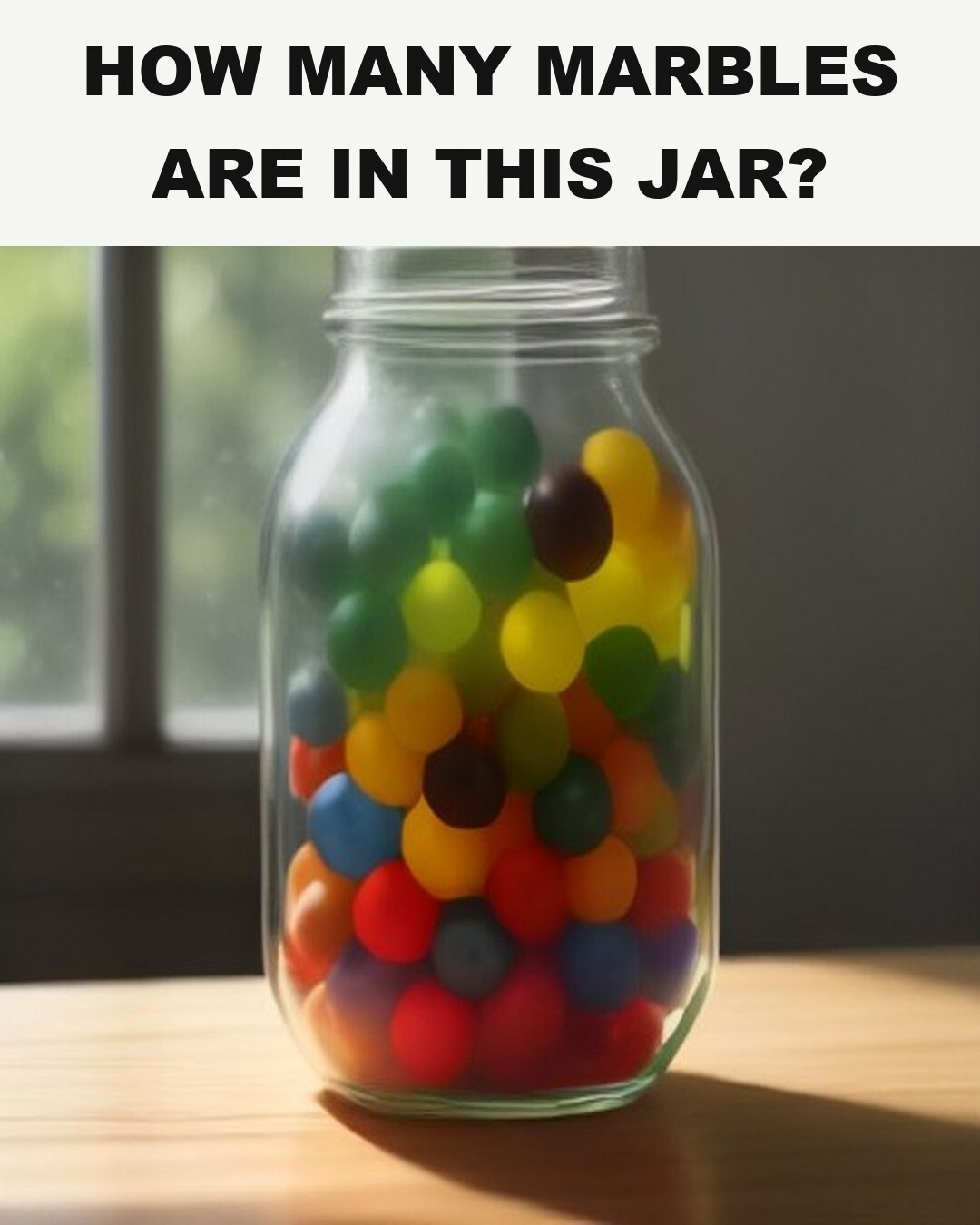
“Guess how many items are in the jar” is one of the most classic guessing games in carnival history, county fairs, and viral social media challenges. A vibrant engagement post asking “HOW MANY MARBLES ARE IN THIS JAR?” presents a glass container packed with colorful spherical marbles (or gumballs) resting on a sunlit wooden table.
While exact counts require opening the container, mathematical principles of volume and packing density allow us to estimate the total surprisingly accurately.
Visual & Mathematical Estimation Breakdown
To estimate the contents of a cylindrical or jar-shaped container without counting each marble individually, mathematicians use volume estimation and packing fractions.
+-----------------------------------------------------------------------+
|                    MARBLE JAR ESTIMATION STEPS                        |
|                                                                       |
|   Step 1: Count visible marbles along the base diameter (~5-6)        |
|                                     |                                 |
|                                     v                                 |
|   Step 2: Count visible vertical layers from top to bottom (~7-8)     |
|                                     |                                 |
|                                     v                                 |
|   Step 3: Calculate volume & adjust for packing efficiency (~64%)    |
+-----------------------------------------------------------------------+
Layer-by-Layer Visual Count
- Base Layer Diameter: The jar is approximately 5 to 6 marbles wide at its thickest cross-section.
- Vertical Height: The jar holds roughly 7 to 8 layers of marbles vertically.
- Estimated Total Range: Depending on internal packing, a jar of this proportion generally holds between 80 and 120 marbles.
The Math Behind “Wisdom of the Crowd”
- Random Sphere Packing: Spheres do not fill 100% of a container’s space. Random close packing of equal-sized spheres leaves about 36% air space, meaning marbles occupy approximately 64% of the jar’s total volume.
- Wisdom of the Crowd: Statistician Francis Galton famously discovered that while individual guesses vary wildly, the average (mean or median) of hundreds of crowd guesses is almost always remarkably close to the actual total.
- AI vs. Real Image Generation: Many viral guessing images circulating today are digitally rendered or AI-generated artwork, making the internal distribution uniform and ideal for visual puzzles.
Jar Estimation Formula Quick Guide
| Metric | Estimated Value | Mathematical Function |
| Visible Diameter ($d$) | ~5 marbles | Establishes container width |
| Visible Height ($h$) | ~8 marbles | Establishes vertical stacking layers |
| Estimated Cylinder Volume | $\pi \times r^2 \times h \approx 150$ spheres | Theoretical solid volume |
| Packing Fraction Factor | $\times 0.64$ | Accounts for air gaps between spheres (~90–110 total) |
Frequently Asked Questions (FAQ)
1. What is the best strategy to win a “guess the jar” contest?
Count the number of items along the bottom diameter and multiply it by the height in layers to get a cylinder estimate, then multiply by $0.64$ to account for empty space between spheres.
2. Does marble size affect the packing fraction?
No! As long as all marbles are uniformly sized, the packing fraction remains roughly 64% regardless of whether the spheres are small or large.
Conclusion
Whether testing your mathematical estimation skills or leaving a quick guess in the comments, guessing games prove how fun simple visual challenges can be.
