
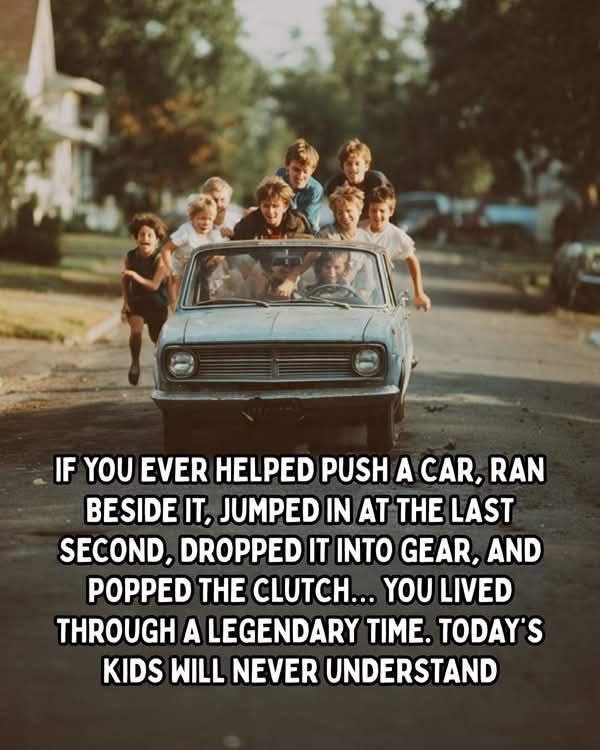
The Legendary Art of Popping the Clutch and Push-Starting Cars in Generations Past
In an era before automatic ignitions, digital diagnostics, and roadside assistance apps, keeping an older vehicle running often required a bit of hands-on mechanical teamwork. For generations of drivers growing up when manual transmissions were standard, a failing starter motor or a weak battery didn’t mean calling a tow truck. Instead, it called for a classic maneuver: getting a group of friends or family members to help push the car down a street, sprinting alongside it, jumping in at the last possible second, dropping the transmission into gear, and popping the clutch to force the engine to turn over.
This unforgettable rite of passage represents a vanished era of automotive self-reliance, mechanical resourcefulness, and unscripted outdoor adventure. Examining the history and mechanics of push-starting manual cars highlights why this shared memory remains so iconic today.
The Mechanics Behind Popping the Clutch
To understand why push-starting worked, one has to look at the direct mechanical connection of manual transmissions. In a manual car, the clutch pedal physically connects and disconnects the engine from the transmission.
When a battery is completely dead, turning the ignition key cannot send electrical current to the starter motor. However, by rolling the car forward in neutral and then quickly engaging a gear (usually second gear) while releasing the clutch pedal suddenly—”popping” it—the momentum of the rolling vehicle forces the wheels to spin the driveshaft, which in turn forces the engine crankshaft to rotate. This mechanical force sparks the engine cylinders into firing, bringing the vehicle to life without any electrical starter assistance.
Kinetic Energy: The physical momentum of pushing the car substitutes for the electrical power of a starter motor.
Timing and Coordination: The driver had to coordinate smoothly with helpers outside, timing the gear shift precisely as the car gained momentum down a hill or driveway.
Self-Sufficiency: Drivers learned basic mechanical troubleshooting skills out of necessity, mastering vehicle operation under all conditions.
Automotive History and the Decline of Manual Transmissions
The prevalence of push-starting vehicles is deeply tied to the evolution of the automobile industry throughout the 20th century. For decades, manual gearboxes (commonly called stick shifts) were standard equipment because they were simpler to manufacture, more fuel-efficient, and less expensive than early automatic transmissions.
As automotive technology progressed, automatic transmissions became smoother, more efficient, and eventually dominant in the global market. Today, modern push-button ignitions, computerized sensors, and electric vehicles have made manual transmissions rare specialties. Consequently, the shared cultural memory of troubleshooting a finicky vehicle with physical muscle has faded into automotive history.
Financial Wisdom and Practical Resourcefulness
The resourcefulness required to keep older cars running also reflected broader lessons in financial stewardship and practical maintenance. In past decades, vehicle owners prioritized repairing, maintaining, and understanding their automobiles rather than replacing them at the first sign of mechanical trouble.
Applying traditional self-reliance to modern personal finance yields lasting benefits:
Prioritize Maintenance: Regular upkeep and preventative maintenance prevent minor mechanical issues from escalating into expensive emergency repairs.
Understand Major Assets: Whether maintaining a vehicle, managing a home mortgage, or overseeing insurance policies, taking the time to understand your financial commitments prevents costly mistakes.
Avoid Unnecessary Debt: Keeping items—from cars to household appliances—running efficiently through personal care and minor repairs preserves capital for long-term investments and savings.
Practical Tips for Keeping Classic Driving Skills Alive
While modern cars rarely allow for manual clutch-popping, appreciating automotive heritage and maintaining hands-on problem-solving skills remains valuable:
Learn Basic Car Care: Familiarize yourself with basic vehicle maintenance, such as checking tire pressure, changing fluids, and understanding how different mechanical systems operate.
Preserve Vintage Vehicles: If you own a classic manual car, take it out for periodic drives to keep the engine, transmission, and clutch mechanisms well-lubricated and fully operational.
Share Stories Across Generations: Pass down stories of classic roadside fixes and neighborhood adventures to younger family members to keep automotive history alive.
Fascinating Facts About Automotive Gearboxes
The Origin of the Clutch: Manual clutches evolved from early belt-driven machinery used in 19th-century factories, eventually being adapted into automotive transmissions to manage power delivery from internal combustion engines.
The Hill Start Advantage: Skilled manual drivers mastered “hill starts” using the handbrake to prevent rolling backward on steep inclines—a technique that required exceptional coordination.
Global Popularity: While automatic transmissions dominate the American market, manual transmissions remain standard in many parts of Europe, Asia, and Latin America due to fuel efficiency and lower initial vehicle costs.
Conclusion
The memory of sprinting alongside a rolling car, jumping through an open door, and popping the clutch is more than just a funny anecdote—it is a symbol of a time when life required teamwork, grit, and hands-on participation. While modern technology has made driving effortless, the camaraderie and resourcefulness of those legendary moments remain unmatched.
FAQ Section
What does “popping the clutch” mean?
Popping the clutch refers to quickly releasing the clutch pedal in a manual-transmission vehicle while the car is moving, which forces the engine to engage with the drivetrain and start running without a functioning starter motor.
Can you push-start an automatic car?
No. Automatic transmissions rely on hydraulic fluid pressure generated by an engine-driven pump to engage gears, meaning an automatic car cannot be started by pushing or towing it.
Why don’t modern cars have manual transmissions anymore?
Modern automatic and dual-clutch transmissions have advanced to offer superior fuel efficiency, faster shifting times, and seamless integration with hybrid and electric vehicle systems.
