
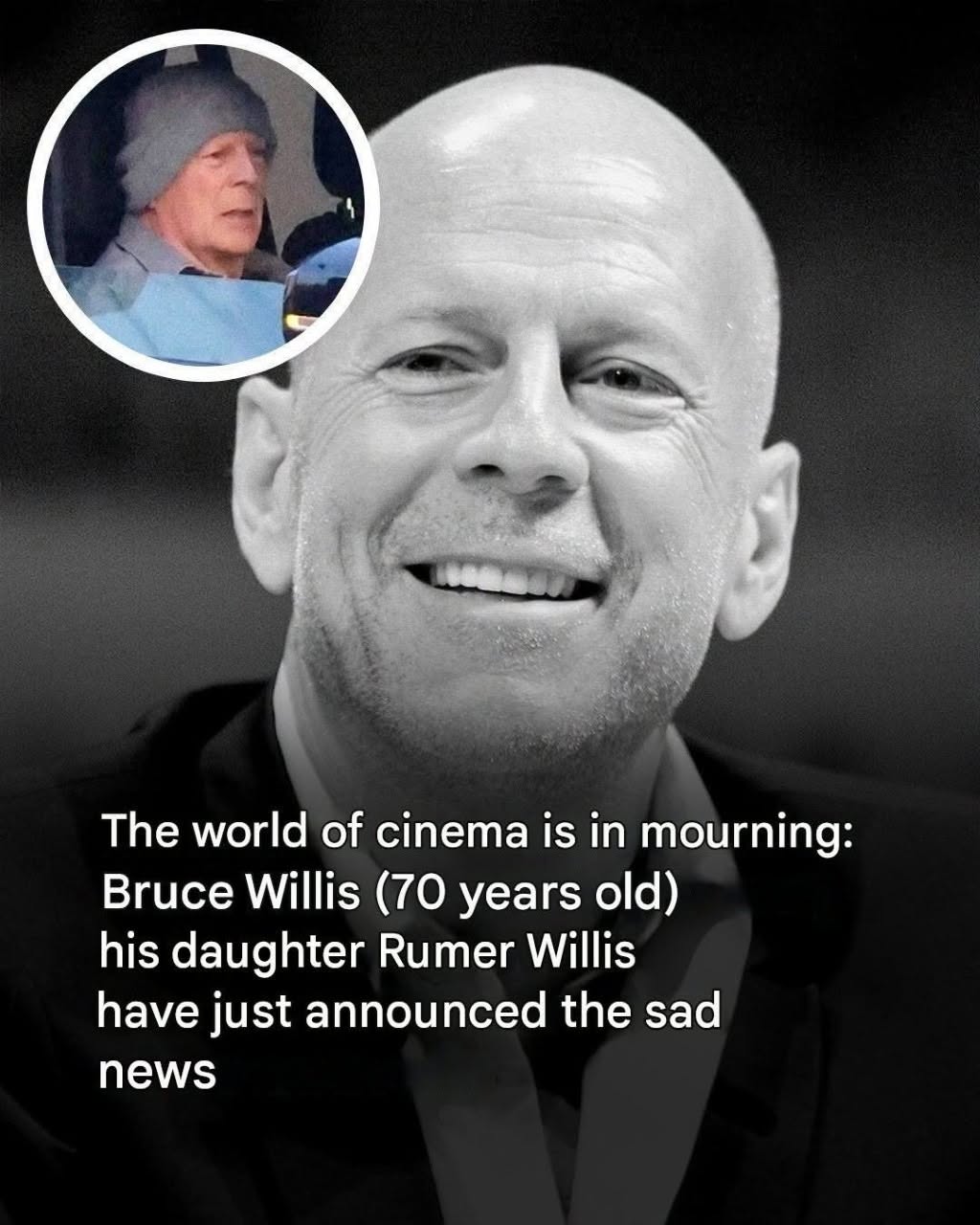
Bruce Willis’ Family Shares an Emotional Update as Rumer Willis Opens Up About Her Father’s Dementia Journey
The image circulating online may give the impression that Bruce Willis has died, but that is not supported by current reporting. As of October 2, 2026, Bruce Willis is alive, while his family continues to speak publicly about his experience with frontotemporal dementia (FTD). Recent comments from his wife, Emma Heming Willis, and his daughter Rumer Willis have focused on family, caregiving, love, and the importance of making meaningful moments count.
The emotional nature of these updates has understandably led to concern among fans around the world. Bruce Willis has been one of Hollywood’s most recognizable actors for decades, and news about his health continues to attract enormous attention. But separating verified information from dramatic social-media captions is especially important when discussing a living person’s health.
Bruce Willis Remains Surrounded by His Family
Bruce Willis became a household name through an extraordinary film career that included some of the most recognizable movies of the late 20th and early 21st centuries. From Die Hard to Pulp Fiction, The Sixth Sense, Armageddon and many other films, he established himself as an actor capable of combining action, humor and emotional depth.
His career changed significantly in 2022, when his family announced that he was stepping away from acting after being diagnosed with aphasia, a condition that can affect language and communication.
In February 2023, his family announced that his condition had progressed and that doctors had given him a more specific diagnosis: frontotemporal dementia, commonly known as FTD. The family statement was signed by Emma Heming Willis, Demi Moore and Bruce’s five daughters.
Since then, his family has increasingly tried to explain what life looks like away from the Hollywood spotlight.
Rather than focusing only on the actor audiences remember from his films, they have emphasized the person behind the public image: a father, husband and family member whose daily life has changed dramatically.
Rumer Willis Has Spoken Honestly About Her Father
Rumer Willis, Bruce’s oldest daughter with Demi Moore, has offered some of the most personal reflections about her father’s condition.
In 2026, she discussed the complicated emotions that come with watching someone you love change because of dementia. She explained that she misses a version of her father who is no longer the same as before, while also trying to remain present with the father she has today.
That distinction is important.
Dementia does not simply create one dramatic moment. For families, it can involve a long period of adjustment in which familiar routines, communication styles and relationships gradually change.
Rumer has described this as a form of grief that can exist while the person is still physically present. She has also emphasized the importance of appreciating the moments she can still share with her father.
In another 2026 interview, she described Bruce as being “OK in the context of what his reality is,” while acknowledging that their relationship cannot be exactly what it once was. She said she still loves visiting him and spending time with him.
Her comments provide a much more nuanced picture than the dramatic headlines sometimes circulating online.
What Is Frontotemporal Dementia?
Frontotemporal dementia is a group of disorders associated with changes in the frontal and temporal regions of the brain.
Unlike some forms of dementia that are initially associated primarily with memory loss, FTD can significantly affect language, behavior, personality, decision-making and other aspects of functioning.
Bruce’s family has previously explained that communication difficulties were an important part of his condition. The Association for Frontotemporal Degeneration published the family’s 2023 statement explaining that his aphasia had progressed into a more specific FTD diagnosis.
The disease can be particularly difficult for families because the changes may affect the very characteristics that once defined a person’s everyday interactions.
For an actor whose career depended heavily on communication, performance and public interaction, the impact can be especially poignant.
But Bruce Willis’ family has repeatedly encouraged people to see beyond the diagnosis.
Emma Heming Willis Continues to Speak About Caregiving
Bruce’s wife, Emma Heming Willis, has become an important voice in discussions about dementia caregiving.
Recent reporting shows that she has focused not only on Bruce’s condition but also on the emotional demands placed on caregivers and families. She has spoken about learning to adapt, accepting help and finding meaningful moments despite the difficulties created by the disease.
On October 2, 2026, reports highlighted Emma’s continuing advocacy around frontotemporal dementia. She has said that she does not want Bruce’s diagnosis to be meaningless and has worked to turn the family’s experience into greater awareness and support for others facing FTD.
This represents an important shift in the way the family discusses Bruce’s health.
Instead of treating dementia solely as a tragic story, Emma has tried to encourage conversations about caregivers, research, support networks and the realities faced by families.
A Rare Family Moment Captured the Public’s Attention
The Willis family has also continued to share occasional personal moments.
In September 2026, Bruce’s daughter Tallulah Willis shared a tender photograph showing herself affectionately kissing her father on the forehead. The image was shared after Bruce had made a rare public appearance at Tallulah’s wedding earlier in the year.
For fans, the photograph was emotional precisely because Bruce has largely withdrawn from public life.
The picture did not represent an announcement of his death. Instead, it offered a glimpse of a father and daughter sharing a private family moment during an extraordinarily difficult period.
These kinds of photographs can be meaningful because they show that a diagnosis does not erase relationships.
