
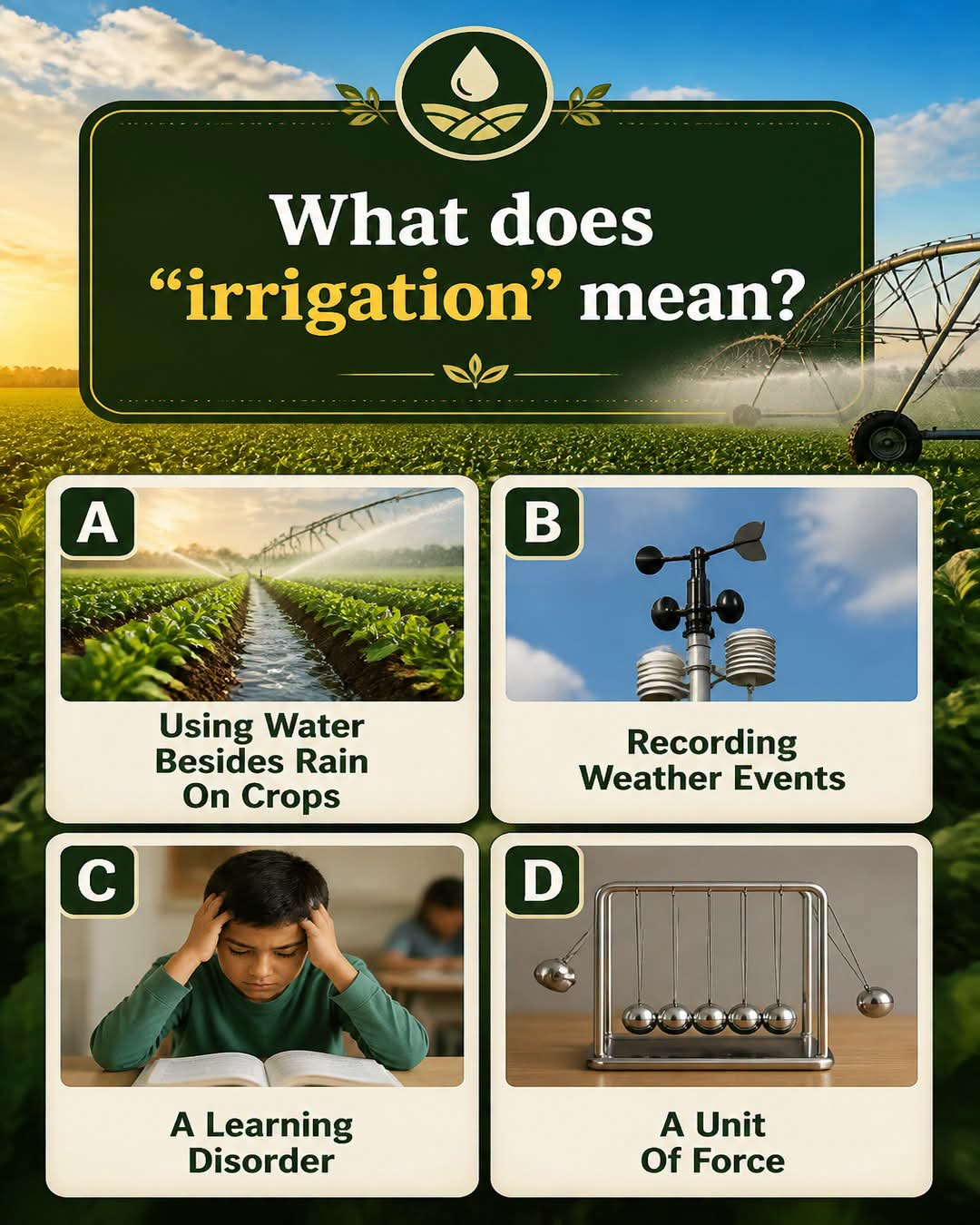
Understanding fundamental agricultural terms helps us appreciate how food and crops are grown around the world. Among these vital agricultural concepts, irrigation plays a crucial role in modern farming, water management, and crop production.
Whether you are brush-up on general knowledge, testing your vocabulary, or helping students with earth science concepts, this simple quiz highlights an essential practice in farming.
Below, we reveal the correct answer along with the importance of irrigation in modern agriculture.
Quiz Answer & Definition Matrix
+-------------------------------------------------------------------+
|                    TRIVIA ANSWER & KEY DETAILS                    |
|                                                                   |
|  [ QUESTION ]      • What does "irrigation" mean?                 |
|  [ CORRECT ANSWER ]• A) Using Water Besides Rain On Crops          |
|  [ DOMAIN ]        • Agriculture, Hydrology & Farming Science     |
|  [ MAIN METHODS ]  • Drip, Sprinkler, Center-Pivot, Surface/Furrow |
+-------------------------------------------------------------------+
Key Highlights of Irrigation in Agriculture:
-
The Correct Answer: A) Using Water Besides Rain On Crops. Irrigation refers to the artificial application of water to land or soil to assist in the growth of agricultural crops.
-
Supplementing Rainfall: It ensures crops receive consistent moisture during dry spells or in regions with insufficient natural rainfall.
-
Core Modern Techniques: Includes center-pivot sprinklers, drip systems, canals, and furrow irrigation.
-
Global Impact: Irrigation enables arid regions to sustain agriculture, boosting worldwide food supply and crop yields.
Understanding Agricultural Irrigation
1. What Is Irrigation?
In farming and agriculture, irrigation is the process of applying controlled amounts of water to plants at needed intervals. Instead of relying solely on direct precipitation (rain), farmers use water pipes, canals, sprinklers, or drip tubes to nourish fields.
2. Common Types of Irrigation Systems
-
Center-Pivot Irrigation: Large overhead sprinklers mounted on wheeled towers rotate around a central point, creating circular crop fields.
-
Drip Irrigation: Water drips slowly directly to the roots of plants through networks of tubing, minimizing evaporation and conserving water.
-
Surface/Furrow Irrigation: Water flows over the soil surface by gravity along channels or furrows between crop rows.
3. Why Irrigation Matters
Proper water application promotes healthy plant growth, prevents crop failure during severe droughts, and allows farmers to cultivate land in semi-arid and desert environments.
Conclusion
The correct answer to this agricultural vocabulary quiz is A) Using Water Besides Rain On Crops! From ancient canal networks to modern automated pivot systems, irrigation remains a cornerstone of global food production.
Frequently Asked Questions (FAQ)
What is the primary purpose of irrigation?
The primary purpose of irrigation is to supply crops with the necessary water needed for growth, especially in areas with limited or unpredictable rainfall.
What is the difference between rainfed and irrigated agriculture?
Rainfed agriculture relies entirely on natural rainfall to supply soil moisture, whereas irrigated agriculture uses controlled artificial water sources like wells, rivers, and reservoirs.
