
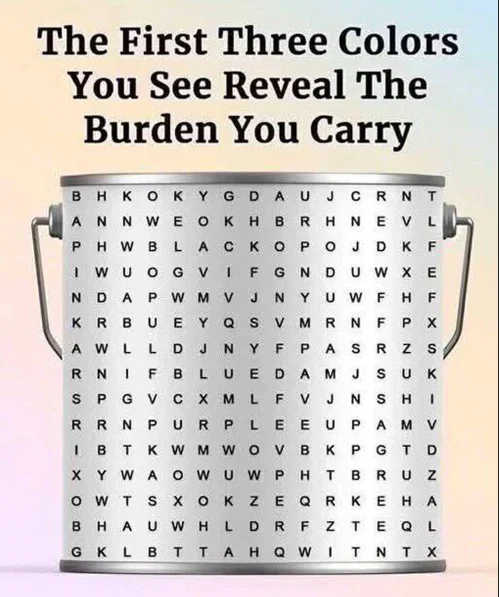
Word search puzzles and visual games have taken social media by storm, blending lighthearted entertainment with personality exploration. One popular viral puzzle features a grid of letters printed across a paint can, challenging scrollers with a intriguing prompt: “The First Three Colors You See Reveal The Burden You Carry.”
As users scan the letter grid, words like BLACK, BLUE, PURPLE, and PINK pop out from the random letter arrangements. But can a simple visual puzzle really offer insight into your emotional state, stress levels, or personal challenges? Here is a breakdown of how these visual word search tests work, the psychological science behind visual attention, and what your results actually mean.
The Hidden Words: What Colors Are in the Grid?
The letter grid is engineered to contain several common color names hidden horizontally, vertically, and diagonally among random letters:
-
BLACK: Located horizontally in the third row near the top (
B-L-A-C-K). -
BLUE: Located horizontally in the eighth row (
B-L-U-E). -
PURPLE: Located horizontally in the tenth row near the middle (
P-U-R-P-L-E). -
PINK: Hidden vertically down the far-left column (
P-I-N-K). -
RED / GREEN / YELLOW: Additional short color words scattered across diagonal and vertical paths.
The Science of Visual Attention: How Your Brain Picks Words
While social media captions frame these puzzles as mystical personality tests, the reason your eye lands on specific words first comes down to cognitive processing and visual mechanics:
1. Selective Visual Attention
Your eyes do not scan a graphic randomly; they automatically gravitate toward areas of high contrast, familiar character clusters, and word lengths your brain recognizes quickly. Longer words with prominent consonants like PURPLE or bold positioning like BLACK naturally draw visual focus faster.
2. The Priming Effect
If you recently read the word “blue” or saw a blue image while scrolling, your visual cortex is primed to recognize that specific sequence of letters before others.
3. The Forer (Horoscope) Effect
In psychology, the Forer Effect (or Barnum Effect) explains why people feel personal tests are eerily accurate. When a puzzle claims a color represents a “hidden burden,” readers automatically apply generic meanings—such as stress, fatigue, or responsibilities—to their own life situations.
Engaging with online brain teasers, visual puzzles, and cognitive games connects to broader everyday wellness, mental agility, self-reflection practices, and lifestyle health management.
Frequently Asked Questions (FAQ)
Do word search personality tests scientifically measure emotional health?
No. These viral visual puzzles are designed purely for social media entertainment and engagement. They do not serve as scientific or clinical diagnostic tools for emotional or psychological health.
Why do different people see different words first?
Variations in eye movement patterns, screen brightness, visual processing speed, and recent mental associations influence which word sequence an individual notices first.
Conclusion: A Fun Spark for Self-Reflection
Whether your eyes instantly spotted BLACK, BLUE, or PURPLE, word search visual tests offer a fun, engaging break from daily scrolling. While they may not provide a scientific diagnosis of your daily worries, taking a moment to pause, play, and reflect on your stress levels is always a healthy habit. Which three colors did you spot first?
