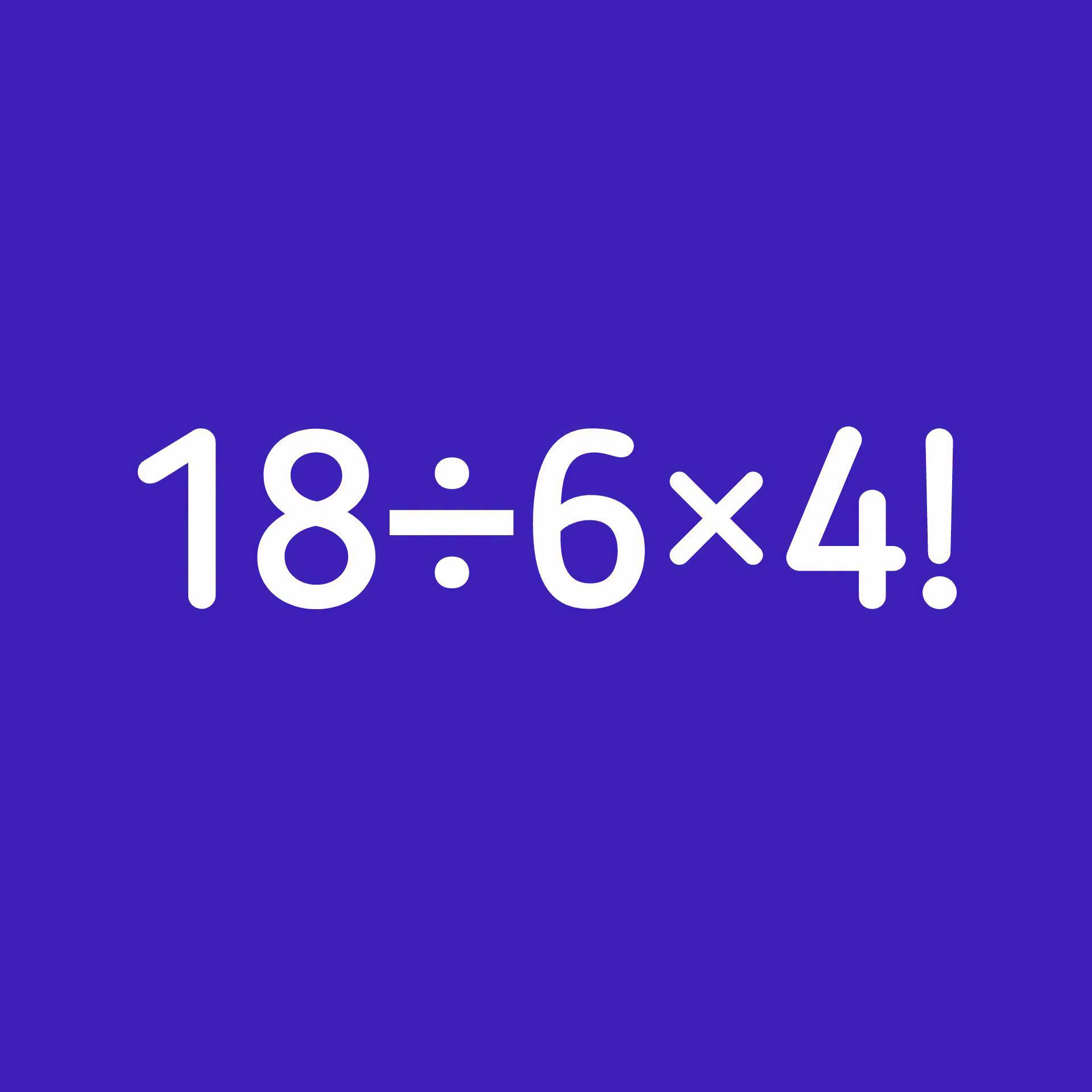
Every few days, a deceptively simple arithmetic expression appears on social media, sparking fierce debates, thousands of comments, and conflicting answers from users worldwide. Equations combining standard division, multiplication, and factorials—such as $18 \div 6 \times 4!$—look straightforward at first glance, yet they consistently divide internet audiences because people apply different rules for the order of operations or misunderstand advanced mathematical notations like factorials.In this comprehensive guide, we examine the fundamental mathematical rules governing arithmetic operations, the role of factorials in standard notation, the common pitfalls that cause people to fail basic calculations, and practical strategies to sharpen your analytical thinking. Furthermore, we explore how modern technology, education, and digital media platforms leverage viral brain teasers to encourage critical reasoning and lifelong learning.The Order of Operations: PEMDAS, BODMAS, and Factorial RulesWhen multiple operations appear in a single mathematical expression, mathematicians rely on a universal set of rules to ensure that everyone arrives at the exact same correct answer. These rules are commonly remembered using acronyms such as PEMDAS (Parentheses, Exponents, Multiplication and Division, Addition and Subtraction) or BODMAS (Brackets, Orders, Division and Multiplication, Addition and Subtraction).1. Evaluating Factorials First (Orders/Exponents)In mathematics, an exclamation mark (!) denotes a factorial. The factorial of a non-negative integer $n$ is the product of all positive integers less than or equal to $n$:Calculating $4!$: $4! = 4 \times 3 \times 2 \times 1 = 24$.Substituting this back into our original expression transforms it from $18 \div 6 \times 4!$ into $18 \div 6 \times 24$.2. Parentheses and BracketsAny calculations enclosed within parentheses or brackets would be evaluated next, but none are present in this simplified expression.3. Multiplication and Division (Left to Right)This is where the majority of online errors occur. Multiplication and division share the exact same level of mathematical precedence. Therefore, when both appear in an expression without parentheses, you must evaluate them strictly from left to right.Step-by-Step Breakdown:First, evaluate the division moving left to right: $18 \div 6 = 3$.Next, substitute that result back into the expression: $3 \times 24$.Then, perform the multiplication: $3 \times 24 = 72$.4. Final CalculationThus, the correct mathematical answer is 72. Anyone who mistakenly performs multiplication before division or misinterprets the factorial notation will often arrive at an incorrect conclusion, which explains why viral math posts generate such massive engagement and debate.The Psychology of Viral Math PuzzlesWhy do millions of people engage with and argue over basic arithmetic problems online? The phenomenon taps into several powerful psychological triggers:The Illusion of Simplicity: Because the numbers appear small and familiar, people assume the answer is obvious, lowering their guard against technical rules.The Desire to Be Right: Seeing hundreds of conflicting comments motivates users to calculate, double-check, and defend their personal answers in the discussion thread.Algorithmic Amplification: Social media algorithms heavily favor posts with high comment volumes, pushing debate-heavy puzzles to the feeds of millions of users.Practical Ways to Sharpen Your Math and Logic SkillsMaintaining cognitive sharpness and numerical fluency requires regular practice:Review Foundational Rules: Periodically refresh your understanding of algebraic rules, order of operations, and mathematical symbols like factorials.Practice Mental Math: Challenge yourself to calculate totals, percentages, or sequences without relying on a smartphone calculator.Engage with Logic Puzzles: Solve Sudoku grids, number sequences, and riddles to strengthen working memory and analytical reasoning.Teach Others: Explaining mathematical concepts to children or peers reinforces your own comprehension and exposes gaps in your reasoning.The Role of Education, Technology, and Professional GrowthThe popularity of viral math problems highlights broader trends in digital technology and modern education. Educators increasingly utilize gamified challenges to make mathematics approachable and engaging for students.Analytical Thinking in the WorkplaceIn today’s data-driven professional landscape, strong analytical skills are essential across numerous industries, including business strategy, financial investment, legal services analysis, and technology development. Professionals who pay meticulous attention to detail and process rules methodically are exceptionally valuable in technical fields.Financial Planning, Insurance, and Long-Term WellnessWhile solving social media math puzzles is primarily a fun mental exercise, maintaining a secure and stable life requires careful planning across personal finance, healthcare, and risk management.Investing in Continuous LearningAllocating time toward continuous education and professional skill-building enhances your career trajectory and supports sound decision-making regarding long-term wealth accumulation and retirement planning.Healthcare and Insurance ProtectionProactive wellness management includes taking care of your physical and mental health. Ensuring you maintain comprehensive health insurance coverage allows you to access professional medical evaluations or specialist care whenever needed. Additionally, consulting with qualified professionals regarding personal insurance policies safeguards your family’s financial security against unexpected life events.Fascinating Facts About Mathematical NotationHistory of Factorials: The factorial notation (!) was introduced in 1808 by the French mathematician Christian Kramp.Growth Rate of Factorials: Factorials grow extremely fast; for instance, while $4!$ is only 24, $10!$ jumps to 3,628,800.The Calculator Difference: Older basic four-function calculators execute operations strictly in the order entered, whereas scientific calculators correctly follow standard algebraic order of operations and factorial functions.Universal Language: Mathematics transcends spoken language barriers, making mathematical puzzles universally engaging across global cultures.ConclusionViral math puzzles like $18 \div 6 \times 4!$ are fantastic reminders of the importance of precise rules and advanced notations in mathematics. By evaluating the factorial first ($4! = 24$) and then adhering strictly to the order of operations—evaluating division and multiplication from left to right—we arrive at the definitive answer of 72. Engaging with these puzzles exercises your brain, sparks lively community discussions, and sharpens analytical thinking.Frequently Asked Questions (FAQ)1. What does the exclamation mark mean in math?In mathematics, an exclamation mark (!) denotes a factorial, which means multiplying an integer by every positive integer below it down to 1 (e.g., $4! = 4 \times 3 \times 2 \times 1 = 24$).2. Why do people get different answers to this equation?People often get different answers because they misunderstand factorial notation, forget the left-to-right rule for multiplication and division, or perform multiplication before division out of habit.3. Does multiplication always come before division?No. Multiplication and division have equal priority in the order of operations. When both appear consecutively in an expression without parentheses, you must evaluate them strictly from left to right.4. Does health insurance cover educational or cognitive training programs?Standard health insurance typically does not cover recreational math puzzle books or general brain-training software, but it often covers cognitive therapy when prescribed by a physician to treat neurological conditions or injuries.
The Mathematics of Order of Operations and Factorials: Why Viral Math Puzzles Spark Endless Debates Online