
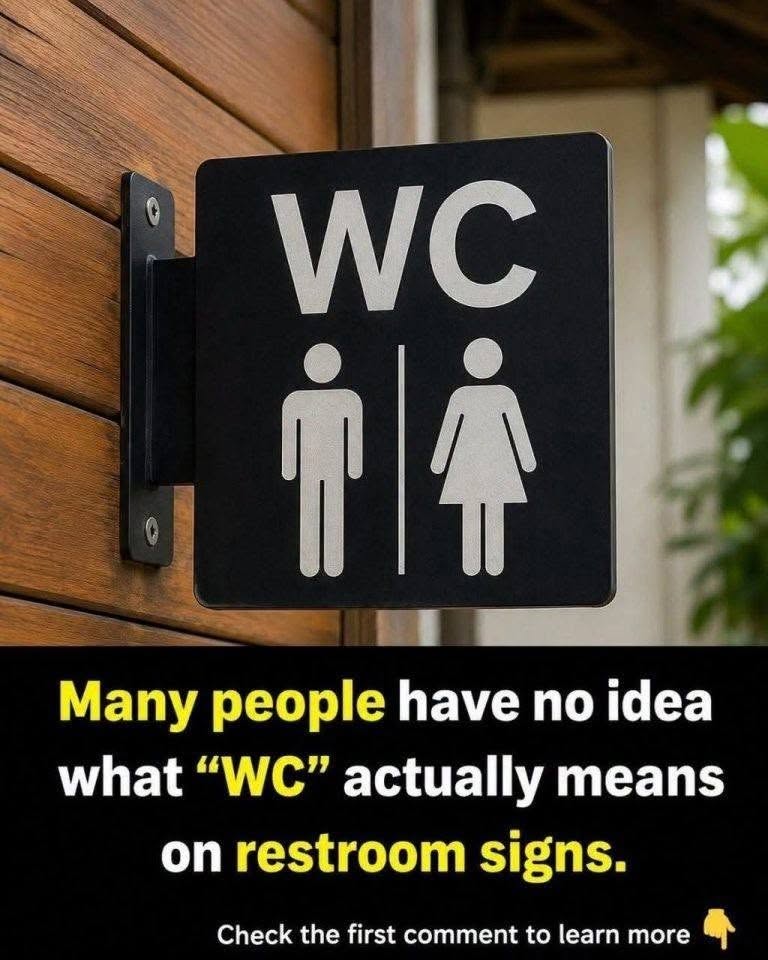
Many people have no idea what “WC” actually means on restroom signs.
When traveling across Europe, Asia, or South America, you have likely encountered the simple black and white letters WC displayed proudly above restroom doors. While almost everyone intuitively recognizes that the sign marks a toilet or bathroom, surprisingly few people know what those two letters stand for.
The abbreviation WC stands for Water Closet. While the term sounds formal, antiquated, or almost industrial to modern ears, it played a revolutionary role in public health, indoor plumbing, and urban architecture during the nineteenth century. Understanding the origin of the water closet reveals a fascinating journey through history, technology, and cultural etiquette.
The Historical Origins of the Water Closet
Before the widespread adoption of modern indoor plumbing, sanitation was vastly different from what we experience today. For centuries, people relied on outhouses, privy pits, or simple chamber pots kept under bed frames. Chamber pots had to be manually emptied every morning, creating unsanitary conditions and foul odors inside homes and across city streets.
In the late sixteenth century, Sir John Harington, a godson of Queen Elizabeth I, designed an early version of a flushing toilet. However, the technology was largely ignored for nearly two hundred years. It was not until the late eighteenth century, when Scottish inventor Alexander Cumming patented the S-trap pipe in 1775, that flush toilets became practical. The S-trap used trapped water to block sewer gases from rising back up through the pipe, eliminating foul odors.
As inventors refined flush toilet mechanics, affluent homeowners began converting small storage closets or under-stair pantries into private indoor washing rooms. Because these tiny rooms housed a water-based flushing mechanism inside a compact, closet-like space, people began calling them water closets.
How the Term Spread Globally
During the Victorian era in the nineteenth century, Britain experienced rapid urbanization and industrial growth. To combat cholera outbreaks and improve public sanitation, major British cities installed centralized municipal sewer systems. With working sewers in place, indoor plumbing moved from a luxury reserved for the elite to a standard feature in residential homes and public venues.
As the British Empire expanded its trade networks and cultural influence across the globe, the term Water Closet traveled along with its plumbing infrastructure. European countries adopted the term WC as a neutral, polite way to indicate a toilet without using crude or overly descriptive language.
Over time, localized languages absorbed the English acronym. Today, you can see the letters WC on signage in France, Germany, Italy, Spain, Poland, and dozens of other nations, where it remains the standard international symbol for a public restroom.
Why the United States Dropped the Term
While WC remains ubiquitous across Europe and Latin America, it virtually disappeared from common usage in North America.
In the United States and Canada, cultural norms led consumers toward softer, more indirect euphemisms. Instead of referring directly to the plumbing fixture (the water closet or toilet), Americans preferred terms that emphasized rest, washing, or personal comfort. This cultural preference gave rise to terms like restroom, bathroom, and washroom.
In commercial buildings, hotels, and restaurants across North America, architectural blueprints might still list small toilet compartments as WCs, but public facing signage almost exclusively uses Restroom or Washroom.
The Legacy of WC in Modern Architecture
Even in modern architecture and construction, the distinction between a bathroom and a water closet remains important. Technically, a bathroom refers to a room containing a bathtub or shower, whereas a water closet specifically refers to an enclosed room or compartment housing only a flush toilet and sink.
Luxury home builders frequently incorporate private water closets inside large master bathrooms, enclosing the toilet behind a dedicated door to offer privacy while another person uses the bathroom counter or shower.
Frequently Asked Questions
What does WC stand for on bathroom doors? WC stands for Water Closet, an early technical term for an indoor room equipped with a flush toilet connected to a drainage system.
Why is WC used internationally instead of Restroom or Bathroom? Because early flush toilet technology and municipal plumbing systems were standardized in 19th-century Britain, the English term Water Closet was exported worldwide. The abbreviation WC became an easily recognizable international symbol that crosses language barriers.
Is WC still used in English-speaking countries? In the United Kingdom, Ireland, Australia, and New Zealand, people understand the term, though everyday speech often uses terms like loo, toilet, or lavatory. In the United States and Canada, the term WC is rarely used in daily conversation, where restroom or bathroom is preferred.
Is a water closet different from a bathroom?
Yes. Architecturally, a bathroom is a space designed for bathing and usually contains a shower or bathtub. A water closet refers specifically to a small room or enclosed compartment housing just a toilet and sink.
When was the term Water Closet first used?
The term began gaining popular usage in the late 1700s and early 1800s as homeowners started installing newly invented flush toilets inside small converted indoor closets.
