
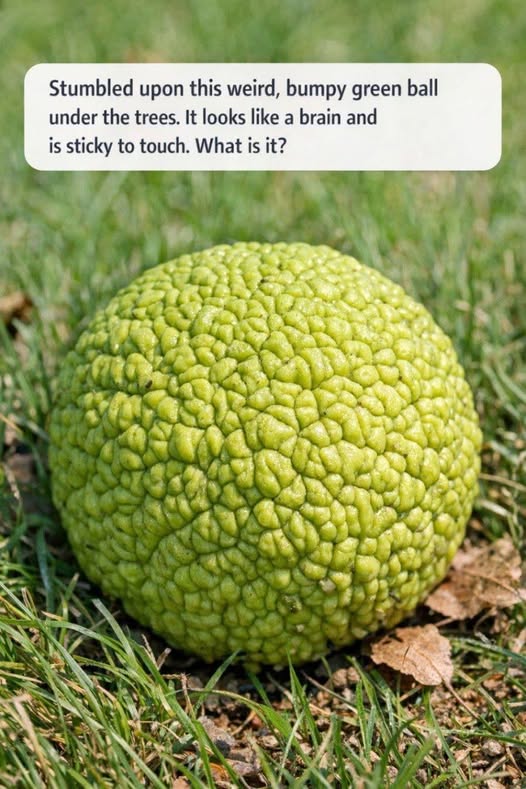
If you have ever been walking through a park, forest edge, or rural property in North America during late summer or autumn, you may have encountered a strange sight: large, lime-green, brain-like balls scattered across the grass under dense trees. These bumpy, grapefruit-sized growths often evoke immediate curiosity, with many wondering if they are exotic fruits, alien flora, or poisonous plants.
Commonly known as Osage oranges, hedge apples, monkey balls, or brain fruit, these unique growths are the syncarp fruit of the Maclura pomifera tree. Despite their strange appearance and sticky white sap, Osage oranges have a rich evolutionary history, valuable historic uses, and a permanent place in North American forestry traditions.
What Is the Osage Orange Tree (Maclura pomifera)?
The Osage orange tree belongs to the mulberry family (Moraceae). Native to a small region of North America—primarily the Red River drainage basin in Texas, Oklahoma, and Arkansas—the tree owes its common name to the Osage Nation, who historically inhabited those ancestral lands.
[ Osage Orange Profile ]
|
+———————–+———————–+
| |
[ Historical Legacy ] [ Physical Features ]
– Osage Nation Bow Wood – Bumpy Syncarp Fruit
– “Living Fences” / Hedgerows – Sticky Milky Latex Sap
– Rot-Resistant Timber – Dense Yellow-Orange Wood
The Unmistakable Fruit
The “green brain ball” itself is actually a multiple fruit (syncarp) composed of hundreds of small, tightly packed individual drupelets, each containing a seed.
Size and Weight: Typically measures 3 to 6 inches in diameter and can weigh up to several pounds.
Texture and Secretions: The outer rind is deeply convoluted, resembling a human brain. When punctured, bruised, or cut, the fruit secretes a thick, sticky, milky-white latex sap that can cause mild skin irritation for sensitive individuals.
Scent: Fresh Osage oranges emit a faint, pleasant citrusy aroma, though the fruit is inedible to humans.
An Evolutionary Mystery: An Evolutionary Anachronism
One of the most fascinating aspects of the Osage orange is its ecological relationship with extinct ice-age megafauna.
In evolutionary biology, the Osage orange is classified as an evolutionary anachronism. Millions of years ago, massive prehistoric mammals such as giant ground sloths (Megatherium), mammoths, and mastodons devoured the large fruit whole, digesting the fleshy exterior and dispersing the seeds across vast territories through their dung.
When these megafauna went extinct thousands of years ago, the Osage orange lost its natural seed dispersers. As a result, its natural geographic range shrank dramatically to a tiny pocket of the south-central United States until human intervention expanded it once again.
Historical Uses: From Native Archery to Living Fences
Despite its fruit being inedible, the Maclura pomifera tree became one of the most widely planted tree species in American history due to its incredible structural properties.
1. Superior Bow Wood for Native Americans
The wood of the Osage orange tree is extraordinarily dense, flexible, and decay-resistant. The Osage Nation and neighboring tribes favored this golden-yellow heartwood above almost all other materials to craft high-performance hunting and war bows. French trappers called the tree bois d’arc, meaning “bow-wood,” which eventually evolved into the colloquial nickname “Bodark.”
2. Nature’s Barbed Wire (“Living Fences”)
During the 19th century, before the widespread invention and manufacture of steel barbed wire in the 1870s, American homesteaders planted dense rows of Osage orange saplings along farm boundaries.
Hedge Barriers: When pruned closely, the tree’s sharp thorns and interlocking branch networks created impenetrable living hedges capable of containing cattle, horses, and livestock.
Windbreaks: During the Dust Bowl era of the 1930s, hundreds of thousands of Osage orange trees were planted as part of the Great Plains Shelterbelt project to prevent severe soil erosion.
3. Rot-Resistant Posts and Railroad Ties
Because the heartwood contains natural antifungal and preservative compounds, Osage orange wood resists rot far longer than most native timber. Farmers routinely used the wood for fence posts, railroad ties, wagon wheel rims, and tool handles—many of which remain intact in the ground today after more than a century of exposure.
Urban Legend vs. Fact: Do Osage Oranges Repel Spiders and Pests?
A popular folklore belief claims that placing fresh Osage oranges in basements, closets, or around home foundations keeps spiders, roaches, and insects away.
The Scientific Reality: Chemical research has identified compounds within the fruit—specifically isoflavones such as osajin and pomiferin—that exhibit mild natural insect-repellent qualities in concentrated laboratory settings.
Practical Application: In real-world conditions, placing whole, intact hedge apples around a room does not release a high enough concentration of these chemicals to act as an effective pest barrier. While they won’t harm your home, relying on them as a primary pest control method yields limited results.
Frequently Asked Questions (FAQ)
Are Osage oranges toxic or poisonous to humans and pets?
Osage oranges are not considered deadly toxic, but they are completely inedible to humans due to their tough, fibrous interior, extremely bitter taste, and sticky sap. Livestock, livestock animals, and squirrels occasionally eat the seeds, but the tough rind can present a choking hazard for cattle if swallowed whole.
Why is the sap sticky?
The milky juice inside the fruit and stems is a specialized plant latex containing resins and defense compounds designed to deter insects and herbivores from damaging the tree.
Can you plant the seeds inside an Osage orange?
Yes! If you cut open a mature Osage orange in late autumn, you can harvest the flat seeds inside. After a period of cold stratification (keeping them damp in the refrigerator for 30 to 60 days), the seeds can be planted in soil to germinate into saplings.
Final Thoughts
The next time you spot a strange, green “brain ball” lying on the ground beneath a tree, you can admire it not as a bizarre anomaly, but as a living piece of American natural history. From feeding prehistoric giant sloths to helping build the American frontier, the humble Osage orange remains one of nature’s most durable and fascinating creations.
