
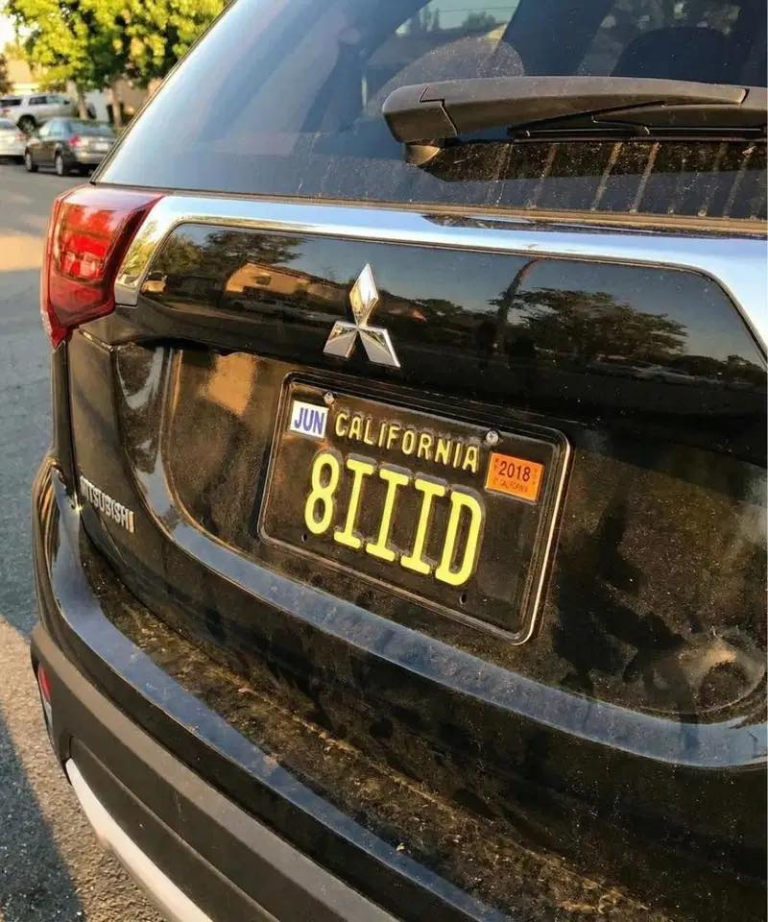
Vanity license plates are designed to give drivers a chance to showcase their personality, humor, or business on the open road. From clever puns to personalized nicknames, custom registration plates are a staple of American highway culture. However, every so often, a vehicle owner creates a custom plate so intentionally confusing that it leaves law enforcement, speed cameras, and fellow drivers staring in absolute bewilderment.
A viral photo of a black SUV featuring a black-and-yellow California vanity plate has been sparking intense debates across social media. At first glance, the plate appears to be a dizzying visual mess of repeating numbers and letters that seem almost impossible to read at a glance. But behind this perplexing arrangement lies a classic highway optical illusion engineered to confuse the eyes. Here is a breakdown of what this viral license plate actually says and the clever strategy behind its creation.
Decoding the Illusion: What Does the License Plate Say?
When looking at the custom black California plate, the combination of characters appears to blend together into a single, repetitive pattern. This visual effect is known in design and security circles as a character mask or optically confusing sequence.
Upon closer inspection, the plate sequence consists of visually identical characters designed to trick the human eye and camera sensors:
The Number 8: Positioned at the far left, the number 8 acts as an anchor.
The Letters I and 1: Flanked between the outer numbers are repeating uppercase Is and numbers that look identical in the official California Department of Motor Vehicles (DMV) font.
The Letter D or Number 0: The far-right character completes the frame with a rounded shape that mirrors the left side.
When driving behind a vehicle traveling at high speeds, the combination of 8, I, 1, B, and D creates a strobing optical effect. To an untrained observer, discerning where one character ends and the next begins is nearly impossible within a split second.
Why Drivers Create Confusing License Plates
While some vanity plate enthusiasts choose confusing sequences purely for artistic humor or tech-geek novelty, the practice originally gained popularity in sports car and automotive enthusiast communities for very tactical reasons.
1. Evading Automated Traffic Enforcement
Automated license plate readers (ALPRs), red-light cameras, and toll bridge scanners rely on optical character recognition (OCR) software to scan and record license plates automatically. Sequences made entirely of 8s, Bs, 0s, Os, 1s, and Is frequently confuse OCR algorithms, leading to scanning errors or unreadable ticket records.
2. Eyewitness Misdirection
In situations where a driver is reported for aggressive driving or traffic violations, law enforcement relies heavily on eyewitness descriptions. A witness attempting to memorize a plate like 8IIID or 8B8B8B under stress will almost certainly misreport the exact sequence, making identification challenging.
Despite the clever design, state agencies and transport authorities have updated DMV guidelines, real estate traffic safety laws, and automated camera technology to flag and restrict overly confusing character combinations during the registration approval process.
Practical Lessons for Custom Vanity Plate Selection
If you are planning to order a custom vanity plate for your vehicle, keeping these practical guidelines in mind will ensure your application gets approved smoothly:
Avoid Repeating Optical Characters: Combinations consisting exclusively of I, 1, O, 0, B, and 8 are frequently rejected by DMV screening committees due to enforcement guidelines.
Ensure Clear Spacing: Use natural word breaks or numbers to make your custom message readable to avoid unnecessary traffic stops by patrol officers.
Verify Local DMV Rules: Every state has strict standards regarding offensive language, hidden meanings, and confusing optical sequences.
Frequently Asked Questions (FAQ)
Is it legal to have an intentionally confusing vanity plate?
If the state DMV officially approves and issues the custom plate sequence during registration, it is legally valid. However, traffic officers still have the authority to inspect plates if they suspect deliberate alteration, obscured characters, or illegal frame covers.
Why does California issue black and yellow license plates?
The black plate with yellow lettering is known as California’s “1960s Legacy Plate.” Introduced as a nostalgic specialty design, it allows vehicle owners to pay an additional annual fee to support state environmental and infrastructure funds.
Conclusion: A Masterclass in Visual Confusion
Whether created as a lighthearted joke or a clever trick for automated road cameras, this California vanity plate is a masterclass in optical design. It highlights how simple combinations of letters and numbers can completely trip up human perception. The next time you find yourself stuck in highway traffic behind a bizarre license plate, take a second look—you might just be looking at a deliberate optical illusion on wheels!
