
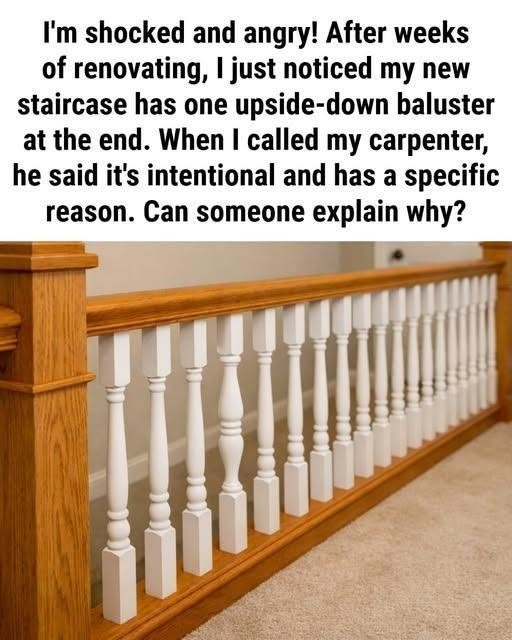
Homeowners undergoing stair renovations are occasionally surprised to spot a single upside-down baluster installed among an otherwise flawless row of spindles. While it may look like an accidental oversight at first glance, placing one inverted baluster is a storied tradition in classical woodworking and architectural folklore.
Often referred to as a “humility spindle” or “carpenter’s mark,” this deliberate imperfection carries rich history rooted in craft philosophy, spiritual tradition, and artisan pride.
Below is a detailed guide exploring the cultural origins, symbolic meanings, and practical reasons behind the inverted baluster phenomenon.
Traditional Carpentry & Symbolism Matrix
+-------------------------------------------------------------------+
|            UPSIDE-DOWN BALUSTER TRADITION MATRIX                  |
|                                                                   |
|  [ HUMILITY ]        • Symbolizes that only the divine is perfect |
|  [ ARTISAN MARK ]    • Serves as a unique signature of the maker  |
|  [ WARD OFF BAD LUCK]• Folklore belief to protect against hubris  |
|  [ AUTHENTICITY ]    • Distinguishes handcraft from mass production|
+-------------------------------------------------------------------+
Key Highlights of the Inverted Baluster Tradition:
-
The Concept of Humility: Rooted in historical artisan philosophy, incorporating a small flaw acknowledges human imperfection and avoids claims of divine perfection.
-
Craftsman’s Signature: Master carpenters often left subtle, unique variations in structural work as an informal signature before factory standardization.
-
Folklore & Protection: In traditional folklore, perfection was believed to invite bad luck or envy, whereas an intentional flaw offered symbolic protection.
-
Conversation Starter: In modern home architecture, a humility spindle adds historical intrigue and a personal narrative to interior design.
4 Reasons Behind the “Humility Spindle”
1. The Humility Principle & Religious Tradition
In many ancient woodworking and architectural cultures—ranging from Amish furniture makers to Persian rug weavers and Victorian craftsmen—flawless perfection was reserved for the Creator alone. Placing an upside-down spindle expressed humility and respect for divine creation.
2. Protecting Against Bad Luck
Traditional superstition held that achieving complete physical perfection in a house would tempt fate or invite misfortune. Incorporating a single intentional mistake was thought to break the spell of vanity and keep the home safe.
3. The Maker’s Unique Signature
Before blueprints and digital branding, carpenters used subtle structural quirks to identify their work. An inverted baluster at a prominent corner or near the newel post served as a lasting, identifiable mark of the woodworker’s hand.
4. Celebrating Handcrafted Artistry
In an era dominated by mass-produced, factory-molded furniture, small intentional details emphasize the human element in craftsmanship. It reminds homeowners that their staircase was built by hand rather than assembled on an automated line.
Conclusion
Far from being a careless error, an upside-down baluster is a charming piece of architectural history that celebrates artisan tradition, humility, and the timeless beauty of handcrafted home design.
Frequently Asked Questions (FAQ)
Can an upside-down baluster be fixed easily?
Yes. If a homeowner prefers uniform symmetry, a carpenter can remove the top or bottom railing trim, detach the single baluster, flip it right-side up, and secure it back in place within a few minutes.
Are there other examples of intentional flaws in craftsmanship?
Yes! Persian rug weavers historically included a deliberately mismatched thread (“Persian flaw”), and traditional quilt makers often incorporated a mismatched fabric patch to honor the same principle of humility.
