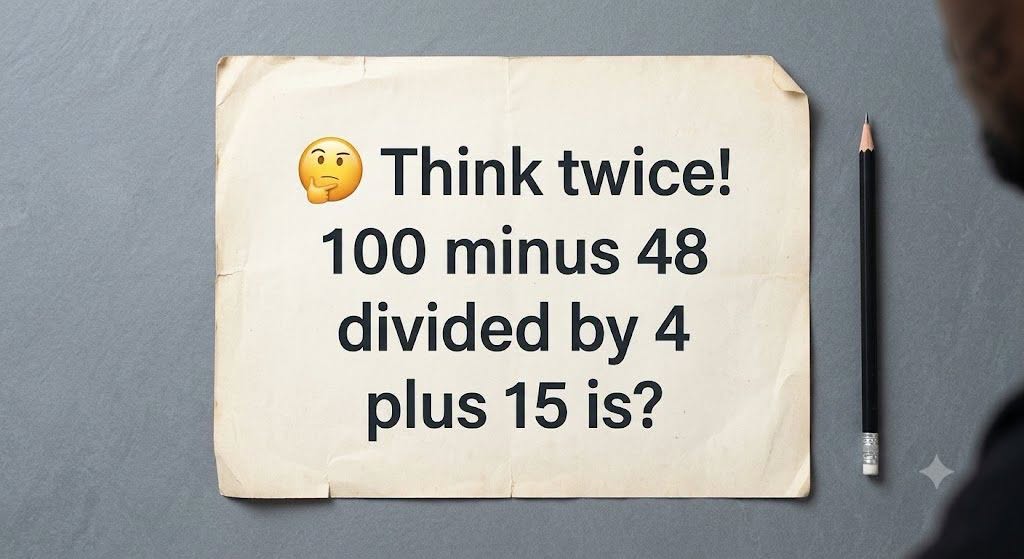
Viral math riddles and brain teasers capture the attention of millions across social media every single day. When an image appears featuring a trick question written out in words—such as “100 minus 48 divided by 4 plus 15 is?”—thousands of people jump into the comments section to debate the correct answer. While these puzzles seem simple at first glance, they often expose common misconceptions about basic arithmetic rules and the standard order of operations.Whether you are brushing up on fundamental math skills to help children with their education homework, keeping your brain sharp as part of a daily cognitive wellness routine, or simply enjoying the challenge of a viral riddle, mastering the order of operations is essential. Here is a comprehensive guide to solving word-form algebraic expressions, avoiding common calculation pitfalls, and boosting mental agility.The Mathematics Behind the Puzzle: Step-by-Step BreakdownLet’s carefully translate the written word puzzle into a numerical mathematical expression and solve it using standard mathematical conventions.Step 1: Translating the Words into an ExpressionThe puzzle states:”100 minus 48 divided by 4 plus 15″Expressed mathematically, this translates to:$$100 – \frac{48}{4} + 15$$Step 2: Applying the Order of Operations (PEMDAS / BODMAS)The universal order of operations dictates that division and multiplication must be performed before addition and subtraction, moving from left to right.Perform the Division First:Divide $48$ by $4$:$$\frac{48}{4} = 12$$The expression now simplifies to:$$100 – 12 + 15$$Perform Addition and Subtraction from Left to Right:Next, subtract $12$ from $100$:$$100 – 12 = 88$$Finally, add $15$ to $88$:$$88 + 15 = 103$$The correct final answer to the puzzle is 103.Why Do So Many People Get This Wrong?The reason these puzzles go viral is that many adults instinctively calculate the expression purely from left to right without applying operational precedence:The Incorrect Left-to-Right Mistake: If someone mistakenly calculates $100 – 48 = 52$, then divides by $4$ to get $13$, and then adds $15$ to get $28$, they arrive at an incorrect answer.The Importance of Rules: Standardizing the order of operations prevents ambiguity in mathematics, ensuring that the same expression always yields one definitive answer worldwide.Cognitive Benefits of Regular Mental Math ExercisesEngaging with math puzzles, logic riddles, and numerical calculations offers substantial neurological advantages for adults of all ages.1. Strengthening Working Memory and Processing SpeedWorking through mathematical expressions mentally requires your brain to hold intermediate numbers in temporary storage while executing operational steps. This active mental processing builds neural pathways and improves cognitive speed.2. Promoting Neuroplasticity and Brain HealthJust as physical exercise maintains cardiovascular fitness, regular mental workouts stimulate neuroplasticity—the brain’s capacity to form new connections and adapt. Engaging in daily puzzles supports long-term cognitive health and mental sharpness.3. Reducing Stress and Improving FocusFocusing intently on solving a self-contained math puzzle creates a mental state of “flow,” temporarily distracting the mind from daily stressors, screen fatigue, and anxiety.Practical Tips for Mastering Mental CalculationsYou do not need an advanced degree in mathematics to excel at quick mental math. Practicing a few simple strategies can dramatically improve your calculation confidence.Isolate Operations First: Always scan the entire expression to locate multiplication and division signs before tackling addition or subtraction.Break Down Numbers: When handling larger numbers, break them into manageable components (e.g., dividing $48$ by $4$ can be thought of as $(40 / 4) + (8 / 4) = 10 + 2 = 12$).Practice Daily: Spend 5 to 10 minutes each day solving logic puzzles, Sudoku, or mental math challenges to keep your analytical skills sharp.Fascinating Facts About Mathematical Rules and NotationThe Origin of PEMDAS: The acronyms PEMDAS (Parentheses, Exponents, Multiplication, Division, Addition, Subtraction) and BODMAS (Brackets, Orders, Division, Multiplication, Addition, Subtraction) became widely standardized in educational curricula during the 19th and 20th centuries to streamline global mathematical communication.The Invention of Division Symbols: The obelus ($\div$), commonly used as a division sign in elementary arithmetic, was first introduced by Swiss mathematician Johann Rahn in his 1659 algebra book Teutsche Algebra.Brain Energy Consumption: Although the human brain accounts for only about 2% of total body weight, it consumes roughly 20% of the body’s total energy, working exceptionally hard when engaged in logical reasoning and problem-solving.ConclusionWhether you solved this trick puzzle instantly or needed a moment to work through the order of operations, engaging with brain teasers is a wonderful way to keep your mind agile and sharp. By combining educational math practice with regular mental exercise, you can boost your cognitive performance and enjoy the timeless satisfaction of cracking a viral puzzle.Frequently Asked Questions (FAQ)What is the correct order of operations?The standard order of operations follows the sequence: Parentheses/Brackets, Exponents/Orders, Multiplication and Division (evaluated left to right), and Addition and Subtraction (evaluated left to right). This rule is often memorized using acronyms like PEMDAS or BODMAS.Why do division and multiplication take precedence over addition and subtraction?Division and multiplication are higher-level operations representing repeated multiplication and scaling, whereas addition and subtraction represent basic aggregation. Establishing a universal hierarchy ensures mathematical expressions have only one correct interpretation globally.How can I improve my mental math skills?You can improve mental math by practicing calculations without a calculator daily, mastering multiplication and division tables, and intentionally pausing to check for operational precedence before computing numbers in order.Do brain teasers actually improve cognitive health?Yes. Regular cognitive challenges stimulate neural pathways, enhance working memory, and encourage neuroplasticity, which contributes to long-term mental sharpness and cognitive resilience as you age.
The Ultimate Guide to Order of Operations: Solving Viral Math Puzzles Without Making Common Mistakes