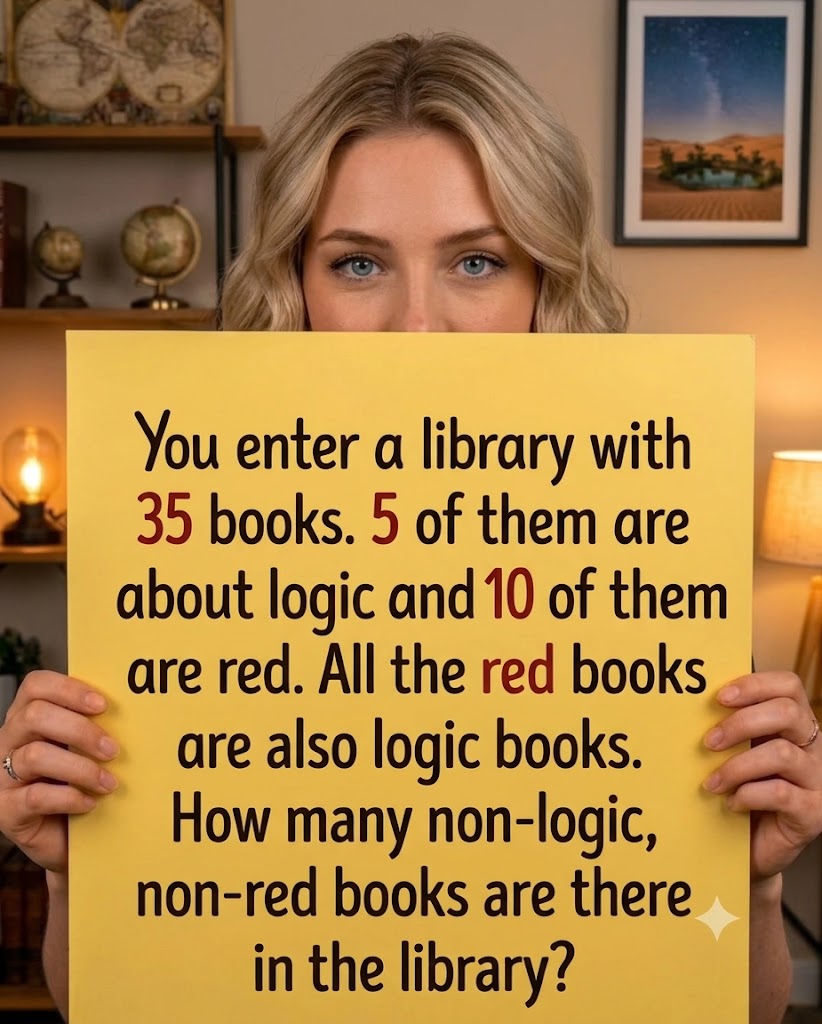
Logic puzzles, mathematical riddles, and brain teasers have captivated human curiosity for centuries. Whether shared across social media feeds, tested in academic environments, or used in professional assessments, viral puzzles like the library book challenge frequently spark intense debate. At first glance, these riddles appear simple, yet they often contain deliberate paradoxes, conflicting constraints, or linguistic tricks designed to test our cognitive flexibility and attention to detail. Understanding how our brains process complex logical statements, set relationships, and problem-solving frameworks sheds light on broader aspects of human intelligence. Beyond mere entertainment, engaging in regular cognitive exercises improves critical thinking, sharpens decision-making skills, and enhances mental agility across personal, educational, and professional domains.The Mechanics of Logical Reasoning and Set TheoryAt the core of many classic riddles lies formal logic and set theory—a branch of mathematical logic that studies collections of objects. When presented with a scenario involving multiple overlapping categories, such as books classified by subject and color, the human brain attempts to construct a mental model to reconcile the numbers. However, when a puzzle introduces conflicting parameters—such as stating that a subset (red books) is larger than its parent category (logic books)—it creates a cognitive illusion. This discrepancy forces the analytical mind to pause, re-evaluate the premises, and recognize whether the riddle relies on strict mathematical consistency or a lateral thinking trick. [ Logical Premise Analysis ]
│
┌───────────────────────┴───────────────────────┐
▼ ▼
[ Mathematical Rigor ] [ Lateral Thinking ]
• Set intersection analysis • Identifying paradoxes
• Quantitative verification • Linguistic interpretation
│ │
└───────────────────────┬───────────────────────┘
▼
[ Problem Resolution ]
Key Components of Analytical Problem SolvingCritical Evaluation: Carefully reading each premise rather than skimming over numbers and descriptive labels.Pattern Recognition: Identifying familiar structures from mathematics, logic, and formal reasoning.Cognitive Flexibility: Being willing to abandon initial assumptions when a contradiction arises within the data.Error Detection: Spotting logical fallacies or impossible mathematical constraints embedded within casual word problems.Cognitive Health, Education, and Lifelong LearningKeeping the mind active through structured problem-solving offers profound psychological benefits. Educational psychologists and neuroscientists emphasize that lifelong learning and mental stimulation contribute significantly to cognitive reserve—the brain’s resilience to neuropathological damage and age-related cognitive decline.Whether pursuing formal higher education, studying specialized technology certificates, or engaging in daily brain training apps, continuous mental engagement supports overall health and well-being. Furthermore, strong analytical skills directly translate into better career management, effective business leadership, and sound financial decision-making.Cognitive ActivityPrimary BenefitTarget AudienceProfessional ImpactLogic Puzzles & RiddlesEnhances working memory and focusGeneral public, studentsImproves quick problem-solvingFormal Higher EducationBuilds deep domain expertiseStudents, career professionalsAdvances technical and leadership rolesData Analysis TrainingStrengthens quantitative reasoningBusiness owners, analystsOptimizes corporate strategy and financeApplying Logical Thinking to Financial, Legal, and Business DecisionsThe same rigorous analytical framework used to untangle complex riddles is vital when navigating high-stakes real-world scenarios. In personal finance, corporate management, and legal planning, avoiding logical fallacies can save individuals and businesses significant time and capital.When evaluating investment portfolios, reviewing mortgage agreements, taking out personal loans, or consulting with legal services and attorneys, clear logical reasoning ensures that all underlying risks and contractual conditions are fully understood.Essential Areas Where Logic Protects AssetsFinancial Planning: Assessing compound interest rates, retirement funds, and investment risks requires objective quantitative analysis rather than emotional guesswork.Insurance and Risk Management: Reviewing policy exclusions and coverage limits demands meticulous attention to detail and conditional logic.Business Operations: Entrepreneurs must apply first-principles thinking to market analysis, operational budgeting, and resource allocation.Contractual Compliance: Understanding legal documents, loans, and credit agreements prevents costly misunderstandings and protects personal credit health.Practical Tips to Sharpen Your Analytical and Problem-Solving SkillsImproving your cognitive agility does not require hours of complex study. Incorporating simple, structured habits into your daily routine can dramatically enhance your mental sharpness.Actionable Steps for Daily Brain FitnessTackle Diverse Puzzles: Mix up your routine by solving crosswords, Sudoku, chess problems, and lateral thinking riddles to challenge different neural pathways.Break Down Complex Problems: When faced with a difficult challenge at work or home, deconstruct it into smaller, manageable sub-components.Practice Mindfulness: Reducing mental clutter through meditation or focused breathing improves concentration and working memory capacity.Invest in Continuous Education: Read books on philosophy, mathematics, behavioral economics, and strategic management to expand your intellectual horizons.Fascinating Historical Facts About Logic Puzzles and ParadoxesThe history of logic and recreational mathematics is filled with brilliant minds who transformed puzzles into foundational scientific principles.Ancient Roots of Recreational Math: Puzzles dating back to ancient Egyptian papyri and ancient Chinese texts demonstrate that humanity has enjoyed testing intellectual limits for thousands of years.Lewis Carroll as a Logician: Beyond writing classic literature, author Lewis Carroll (Charles Lutwidge Dodgson) was a mathematics lecturer at Oxford University who published formal treatises on symbolic logic and playful word puzzles.The Evolution of Computer Logic: Early pioneers of computer science utilized formal logic puzzles and binary truth tables to lay the theoretical groundwork for modern computing and digital technology.Frequently Asked Questions (FAQ)What makes certain logic puzzles so difficult to solve?Puzzles often exploit cognitive biases—such as assuming that all numbers presented in a word problem must fit neatly into a standard mathematical formula without contradictions.How does solving brain teasers benefit adults and seniors?Regular mental stimulation helps maintain cognitive flexibility, supports memory retention, and fosters neuroplasticity, which is essential for healthy cognitive aging.Are logic skills innate, or can they be improved over time?Logical reasoning is a learned cognitive skill. Like physical exercise, consistent practice with puzzles, mathematics, and critical thinking strengthens analytical pathways in the brain.How do analytical skills apply to everyday financial management?Strong analytical thinking helps individuals evaluate interest rates, compare loan offers, manage credit scores, and budget effectively, reducing the likelihood of costly financial mistakes.ConclusionLogic puzzles and brain teasers serve as delightful reminders of how intricately our minds process information. Whether navigating a tricky riddle about library books or managing complex financial, legal, and business decisions, the ability to think critically and analytically is an invaluable asset. By embracing mental challenges, practicing lifelong learning, and maintaining rigorous problem-solving habits, you can sharpen your cognitive agility and approach every challenge with confidence.
The Psychology of Logic Puzzles: Why Brain Teasers Trick Our Minds and Boost Cognitive Health