
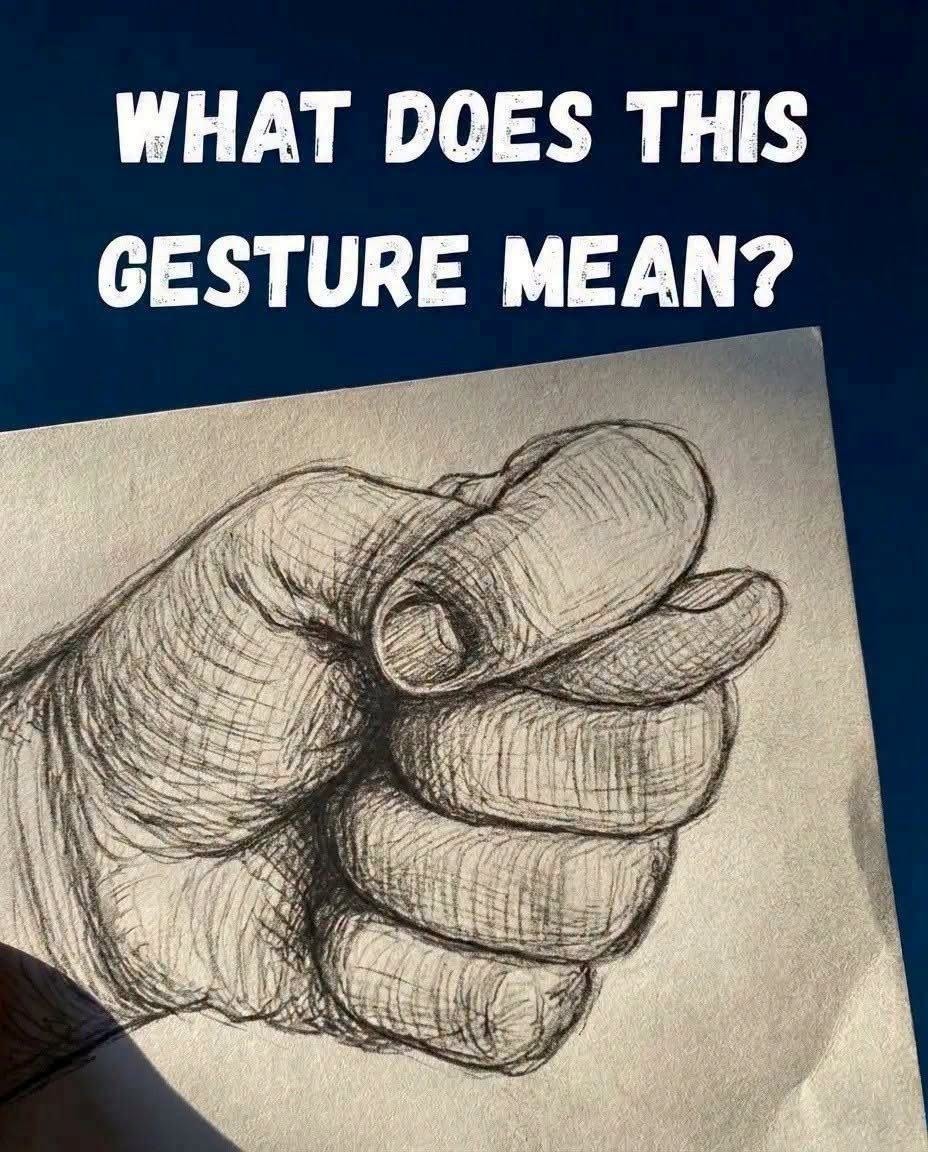
At first glance, the fig hand gesture looks harmless. The thumb barely peeks through two curled fingers, creating a small movement that might go unnoticed by anyone who does not know its meaning. Yet across different cultures and historical periods, this simple gesture has carried surprisingly complex associations with protection, rejection, luck, and defiance.
Known in English as the fig sign or fig hand gesture, the gesture is made by closing the fingers into a fist and placing the thumb between the index and middle fingers. Its meaning has varied considerably depending on the region, the historical period, and the circumstances in which it was used.
ADVERTISEMENT
For some people, it represented a quiet insult or a way of refusing a demand. For others, it was associated with folk beliefs about warding off misfortune, envy, or the evil eye. What looked like an ordinary movement of the hand could therefore communicate a message that words alone might not express.
An Ancient Gesture With a Complicated History
Hand gestures have served as a form of communication for thousands of years. Long before modern communication technology, people used movements, symbols, and familiar signs to express emotions, establish social relationships, and communicate ideas without speaking.
ADVERTISEMENT
The fig gesture belongs to this long tradition of symbolic communication. It has historical associations with parts of Europe and the Mediterranean, although its precise meaning and use have changed across cultures.
The gesture’s name is commonly connected to the resemblance between the thumb placed between the fingers and the shape of a fig. In some historical contexts, it also acquired an insulting or suggestive meaning.
It is important to recognize that there was never one universal interpretation. A gesture considered offensive in one place might be understood as a protective folk sign in another. Its meaning depended on shared cultural knowledge.
A Silent Way to Express Defiance
In communities where social hierarchy was strongly enforced, openly challenging a powerful person could carry serious consequences. Depending on the circumstances, people might risk damaging relationships, losing opportunities, or facing punishment for expressing their disagreement.
Symbolic gestures offered another way to communicate.
The fig sign could be used in some traditions as a gesture of rejection, contempt, or defiance. Because it was small and easy to conceal, it could also serve as a private expression of frustration.
Imagine a person who feels unable to answer an unfair demand directly. A discreet hand movement might provide a moment of emotional release, even if nobody else noticed it.
This does not mean that the gesture was universally used as a secret form of resistance. Rather, it illustrates a broader feature of human communication: people often develop indirect ways to express feelings that cannot easily be spoken aloud.
Sometimes, a small gesture can communicate an attitude that a person chooses not to put into words.
The Fig Gesture and Beliefs About the Evil Eye
Beyond its insulting associations, the fig gesture has also been connected with traditional beliefs about protection from misfortune and the evil eye.
The evil eye is a folk belief found in various cultures, including communities around the Mediterranean, the Middle East, and other parts of the world. According to these traditions, envy or an ill-intentioned gaze may bring bad luck or harm.
Different communities developed different customs intended to provide protection. These included amulets, spoken blessings, symbolic objects, and hand gestures.
In certain traditions, the fig sign was among the gestures associated with protection or the rejection of harmful influences. Its use could reflect the belief that a symbolic action might help protect a person, a child, or a household from unwanted attention.
These customs are part of cultural and religious folklore, not scientifically established methods of preventing misfortune. Nevertheless, they offer insight into how people have historically responded to uncertainty and sought reassurance in everyday life.
Why the Hand Became a Symbol of Protection
Hands are among the most expressive parts of the human body. They can welcome, warn, comfort, threaten, bless, or reject someone without a single word being spoken.
Across cultures, hand gestures have also become symbols of identity and belief. Some are used during religious ceremonies, while others appear in traditional healing practices, celebrations, or protective customs.
The fig gesture fits into this wider history of symbolic hand movements. For those who associated it with protection, the gesture could act as a small reminder of familiar beliefs and traditions.
Its significance did not necessarily depend on whether it changed external events. The gesture could offer comfort because it connected people with customs they had learned from family and community.
In this sense, the hand became more than a physical tool. It became a way to express an idea, preserve a tradition, or communicate a feeling.
How Folk Customs Passed From One Generation to Another
Many traditional gestures survived because they were easy to learn and repeat.
Children often encountered folk customs through parents, grandparents, neighbors, and community celebrations. They might see an adult make a particular gesture before a journey, during a moment of concern, or in response to a situation believed to involve envy or bad luck.
The child might imitate the movement long before understanding its historical background.
Over time, repeated use helped preserve the gesture, even as its original meaning changed. In one family, it might be remembered primarily as a playful sign. In another, it could retain a stronger connection to superstition or protection.
This process explains why the same traditional gesture can carry different meanings across generations. Customs do not remain frozen in the past; they are continually interpreted and adapted by the people who practice them.
Why Its Meaning Can Be Misunderstood Today
In a world where people communicate across cultures every day, familiar gestures can easily be misinterpreted.
Someone may recognize the fig sign as an old-fashioned insult, while another person may associate it with folk protection. Others may have encountered it only in historical illustrations, stories, or discussions of body language.
Context is therefore essential.
A gesture’s meaning can depend on the person’s intention, the relationship between the people involved, and the cultural setting. It is rarely possible to determine someone’s message from a hand movement alone.
For travelers, language learners, and anyone interested in cultural history, learning about traditional gestures can help prevent misunderstandings. It also offers a reminder that nonverbal communication is not universal: the same movement can carry different meanings in different places.
More Than a Simple Movement
The history associated with the fig hand gesture reveals something interesting about human behavior. People have long used small, symbolic actions to express emotions, preserve traditions, and respond to situations they find difficult to control.
Sometimes the gesture communicated rejection. Sometimes it reflected a folk belief about protection. In other contexts, it may have been little more than a familiar custom passed down through generations.
Its significance lies not in one definitive meaning, but in the range of meanings people have attached to it.
A closed hand and a partly hidden thumb may seem insignificant at first. Yet the stories surrounding this gesture show how even the smallest movements can become part of a culture’s shared language.
The Bottom Line
The fig hand gesture is a fascinating example of how body language, folklore, and social history can overlap. Across different traditions, it has been associated with insult, defiance, and attempts to ward off misfortune or the evil eye.
Although its meanings have never been identical everywhere, the gesture illustrates a lasting human habit: finding symbolic ways to communicate feelings, express resistance, and seek reassurance.
Sometimes, a gesture that appears almost meaningless to an outsider carries generations of cultural memory for the people who understand it.
