
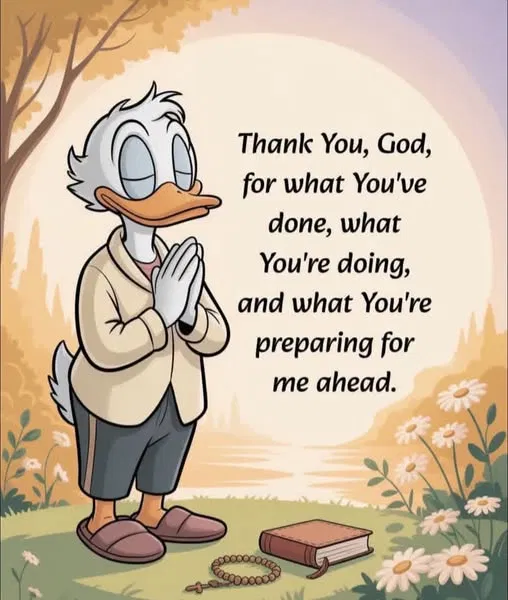
Gratitude is often the simplest prayer and the hardest to remember. This illustration captures it beautifully: an elderly duck stands outdoors at what looks like sunrise or sunset, eyes closed and hands pressed together, in slippers and a soft cardigan. Beside the duck on the grass lie a closed book and a string of prayer beads. Behind, a glowing sun lights a calm river, and daisies bloom at the edge of the frame. The speech bubble reads:
“Thank You, God, for what You’ve done, what You’re doing, and what You’re preparing for me ahead.”
Three kinds of thanks in one sentence
This short prayer covers all of time, and each part does something different for the heart.
“For what You’ve done.” This is gratitude for the past: the difficulties we survived, the doors that opened, the people who showed up, and even the lessons that only made sense later. Looking back with thanks turns our history from a list of scars into a story of being carried.
“What You’re doing.” This is gratitude for the present, and it is the hardest one. Right now, we may not feel that anything good is happening. To thank God for what He is doing in the middle of an unfinished chapter is an act of trust. It says, “I can’t see the whole picture, but I believe work is being done on my behalf.”
“What You’re preparing for me ahead.” This is gratitude for the future, offered before it arrives. It replaces anxiety about tomorrow with expectation. Instead of asking “What if it goes wrong?”, the prayer assumes that something good is being prepared.
Why thanking before seeing matters
Most of us thank people after we receive a gift. This prayer thanks God for the gift still being wrapped. That is a different posture, one of confidence rather than worry. It doesn’t deny that hard things may come. It simply holds that they will not be the end of the story.
Researchers and thinkers across many traditions have noted that regular gratitude tends to improve mood, sleep, and resilience. Whatever one’s beliefs, a habit of thanks trains the mind to notice what is present rather than only what is missing.
Reading the details of the picture
The scene is full of small signs. The sun glows softly rather than blazing, suggesting a peaceful hour, either a fresh beginning or a gentle close to the day. The river in the distance seems to flow toward the horizon, much like a life moving toward what lies ahead. The daisies, simple and unforced, remind us that beauty grows without effort in the places we are planted.
On the ground, the book and prayer beads show that this moment of thanks is part of a regular rhythm of faith, not a one-time event. The duck’s slippers and relaxed clothing suggest that gratitude doesn’t need a special occasion or formal setting. It can happen in the garden, the kitchen, or on the way to work.
How to make gratitude a daily habit
- Start small. Each morning, name three things you are thankful for, however ordinary.
- Include the hard parts. Try thanking God for a difficulty that is teaching you something, even if you can’t yet feel glad about it.
- Say thanks for the future. End your prayer by trusting that something good is in preparation, even if you can’t picture it.
- Write it down. A short journal of thanks becomes, over time, proof of how much has been given.
- Share it. Telling someone what you are grateful for spreads the feeling and strengthens your own.
Conclusion
This simple image invites us to widen our gratitude until it covers everything: yesterday’s blessings, today’s quiet work, and tomorrow’s promise. When we stand like the duck, hands folded and eyes closed, we are not pretending life is perfect. We are choosing to trust that we are held across every part of our story.
This is the third article in the series, so I kept the same structure. I can combine all three images into one longer article, shorten this one, or translate it into Arabic or Darija if you prefer.
