
There are few summer disappointments quite like cutting open a beautiful watermelon, taking that first bite, and discovering that it is pale, watery, or almost completely lacking in sweetness.
You choose the biggest one. You tap it a few times. You examine the color. You bring it home with confidence—and then discover that the inside isn’t nearly as delicious as you expected.
The good news is that you don’t need to be a professional farmer to become better at choosing watermelon.
While there is no single trick that can guarantee a perfectly sweet melon every time, several visual and physical clues can help you make a more informed choice at the market or grocery store.
The key is to look at the watermelon as a whole rather than relying on just one feature.
Here are five simple things to check before putting that watermelon in your shopping cart.
1. Look for a Large, Creamy Yellow Field Spot
One of the first things worth checking is the pale patch on the underside of the watermelon.
This is called the field spot. It develops where the watermelon rested against the ground while growing.
The color can provide a useful clue about the fruit’s development.
A watermelon with a creamy yellow or deeper yellow-orange field spot is generally more encouraging than one with a very pale white or greenish-looking spot.
Why?
The field spot indicates the portion of the melon that was in contact with the ground rather than exposed to sunlight. A pronounced yellow spot is often associated with a watermelon that remained on the plant long enough to develop.
But there is an important distinction: the field spot is a helpful clue, not a guarantee of sweetness.
A yellow spot doesn’t allow you to measure the sugar content of the fruit. Different varieties, growing conditions, and farming practices can affect the appearance.
Still, when you’re standing in front of several watermelons, a well-developed creamy-yellow field spot can be one useful feature to consider.
If the underside is almost completely white or greenish, you might choose another melon if comparable options are available.
2. Don’t Automatically Reject Brown Webbing
Here’s one of the most misunderstood watermelon clues.
You may see a watermelon covered with rough brown markings that look almost like scratches, scars, or a web.
Your first instinct might be to choose the smoothest, cleanest-looking fruit.
But appearance isn’t everything.
These markings can develop as the fruit grows and the rind experiences minor stress or scarring. Some shoppers associate pronounced webbing with sweeter fruit.
However, it’s important not to turn that observation into a hard rule.
There isn’t a simple scientific formula saying that more brown webbing equals more sugar.
So don’t reject a watermelon simply because its skin isn’t perfectly smooth—but don’t assume that heavy webbing guarantees sweetness either.
Think of it as another visual clue rather than a secret sweetness detector.
The best approach is to combine it with the other characteristics.
3. Look for a Well-Developed, Even Shape
Now take a step back and look at the entire watermelon.
Does it have a reasonably uniform shape?
Whether it is round, oval, or elongated depends partly on the variety, so you shouldn’t assume that one shape is automatically sweeter than another.
Instead, look for a melon that appears well-developed and reasonably symmetrical for its type.
Be cautious about fruit with major dents, severe irregularities, deep damage, soft-looking areas, or unusual deformities.
An uneven watermelon isn’t necessarily bad. Natural growing conditions can influence shape.
But when choosing between two similar melons, the one that appears healthy, firm, and evenly developed may be the more sensible choice.
The important thing is not perfection.
A watermelon doesn’t need to look like it belongs in a beauty contest.
You’re looking for signs of a healthy, intact fruit rather than judging it purely by appearance.
4. Pick It Up and Compare the Weight
This is one of the easiest tricks—and one of the most useful.
Pick up the watermelon.
Now pick up another watermelon that appears to be about the same size.
Which one feels heavier?
The heavier one may be worth considering.
Watermelon contains a very large amount of water, so a fruit that feels heavy for its size can be a good indication that it is well hydrated and juicy.
This doesn’t necessarily tell you exactly how sweet it will be, but it can help you avoid fruit that feels unusually light compared with similar-sized melons.
Think of it as a simple comparison rather than a precise measurement.
If two watermelons look almost identical in size and one feels noticeably heavier, that’s the one I’d be more interested in examining further.
You can combine that clue with the field spot, shape, and overall appearance.
And because this test costs nothing and takes only a few seconds, it’s an easy habit to develop.
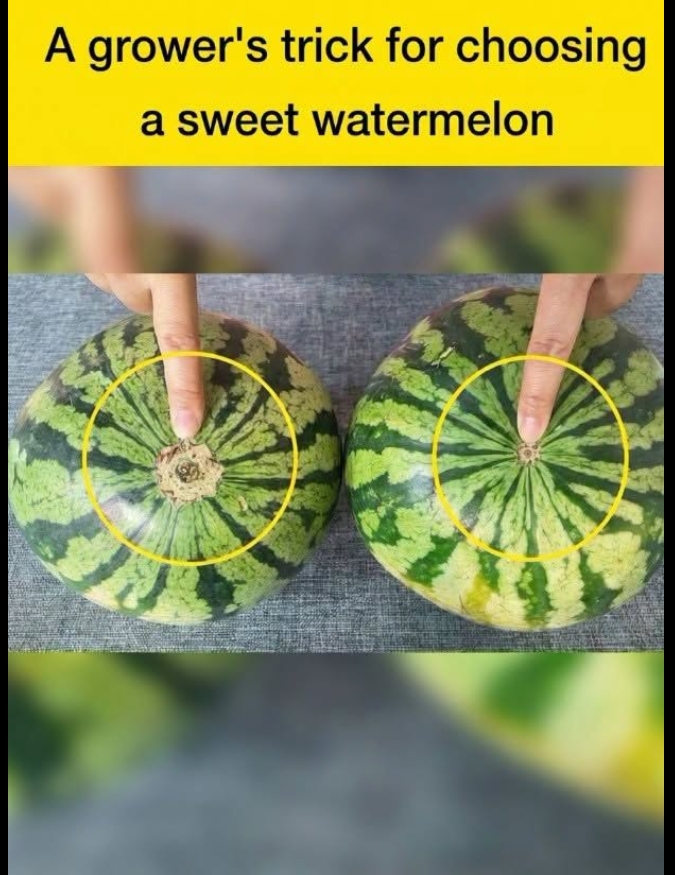
5. Examine the Stem Area—But Don’t Treat It as a Guarantee
The stem end can sometimes provide additional information, although this clue is less reliable than many people online suggest.
You may hear that a dry, brown stem automatically means the watermelon was allowed to ripen fully on the vine, while a green stem proves it was picked too early.
The reality is more complicated.
The appearance of the stem can be influenced by harvesting, handling, storage, and time since harvest. A dry stem can be consistent with a mature fruit, but it isn’t a foolproof test of sweetness.
So if you’re choosing a watermelon, consider the stem—but don’t make your entire decision based on it.
Instead, use it as one piece of the puzzle.
A watermelon with a good field spot, healthy appearance, appropriate weight, and no obvious damage may be a more promising choice than one that simply happens to have a dry stem.
What About Tapping the Watermelon?
You’ve probably seen people knocking on watermelons at the market.
Tap one.
Listen.
Tap another.
Listen again.
People often say that a deep, hollow sound indicates a juicy, ripe watermelon.
There may be some useful information in the sound and firmness of the fruit, but this isn’t a dependable scientific test that can tell you exactly how sweet the watermelon will be.
Different varieties can sound different.
The thickness of the rind can vary.
The fruit’s condition and internal structure also affect the sound.
So if you like tapping watermelons, there’s nothing wrong with using it as another observation—but don’t let the sound override stronger clues such as the overall condition and weight.
Don’t Judge a Watermelon by Its Beauty
This may be the most useful lesson of all.
A perfectly smooth, glossy watermelon can be disappointing.
A watermelon covered in scratches or irregular markings can sometimes be delicious.
The outside isn’t a direct window into the sugar content inside.
That’s why experienced shoppers often examine several characteristics instead of searching for one magical sign.
You’re essentially collecting clues.
Field spot?
Check.
Weight?
Check.
Overall condition?
Check.
Shape?
Check.
Stem?
Take a look.
Then make your decision.
Does Watermelon Become Sweeter After You Buy It?
This is another important point.
Unlike fruits such as bananas or pears, watermelon generally does not continue to increase in sweetness after it has been harvested.
That means choosing a good watermelon at the store really does matter.
The fruit can become softer or change in texture during storage, but that doesn’t mean it will suddenly transform from bland to extremely sweet.
So if you’re hoping to “ripen” a disappointing watermelon on the kitchen counter, don’t expect a dramatic improvement in sweetness.
This is another reason those shopping clues can be useful.
What Should You Do Once You Get It Home?
If you’re not planning to cut your watermelon immediately, keep the whole fruit in an appropriate location away from direct sunlight and excessive heat.
Once you cut it, refrigeration becomes important.
Place cut watermelon in a clean, covered container or wrap it appropriately and refrigerate it.
For best quality, enjoy cut watermelon within a few days and follow food-safety guidance for storage.
If the fruit develops an unusual smell, slimy texture, mold, or other obvious signs of spoilage, don’t eat it.
A Simple Summer Recipe
Once you’ve found a juicy watermelon, you don’t need to do anything complicated with it.
One of my favorite combinations is a simple watermelon, feta, and mint salad.
Cut chilled watermelon into bite-sized cubes.
Add crumbled feta cheese.
Tear a handful of fresh mint leaves over the top.
Gently toss everything together and serve cold.
The sweetness of the watermelon contrasts beautifully with the salty feta, while the mint adds a refreshing finish.
For an extra touch, you can add a small squeeze of fresh lime juice.
It’s simple enough for a family meal but attractive enough to serve at a summer gathering.
The Five-Clue Shopping Checklist
The next time you’re standing in front of a pile of watermelons, remember these five clues:
1. Field spot: Look for a developed creamy-yellow spot rather than relying on a very pale one.
2. Webbing: Don’t automatically reject brown, web-like markings, but remember that they aren’t a guaranteed indicator of sweetness.
3. Shape: Choose a healthy-looking, reasonably uniform fruit without major damage.
4. Weight: Compare similarly sized melons and consider the one that feels heavier.
5. Stem: Examine it as an additional clue, but don’t treat its color or dryness as a guaranteed ripeness test.
And there’s one final rule that may be more important than all the others:
Don’t look for perfection. Look for the best combination of clues.
There is no secret button you can press or magical tapping technique that guarantees a sweet watermelon every time.
But by slowing down for a few seconds and examining the fruit carefully, you can make a more informed choice.
The next time you’re shopping, don’t automatically grab the prettiest watermelon.
Turn it over.
Look at the field spot.
Compare the weight.
Examine the rind.
Check for damage.
Look at the stem.
Then make your choice.
You might just come home with the watermelon everyone wants another slice of.
And when you finally cut it open and see that beautiful, juicy flesh, you’ll know that choosing carefully was worth those extra few seconds.
