
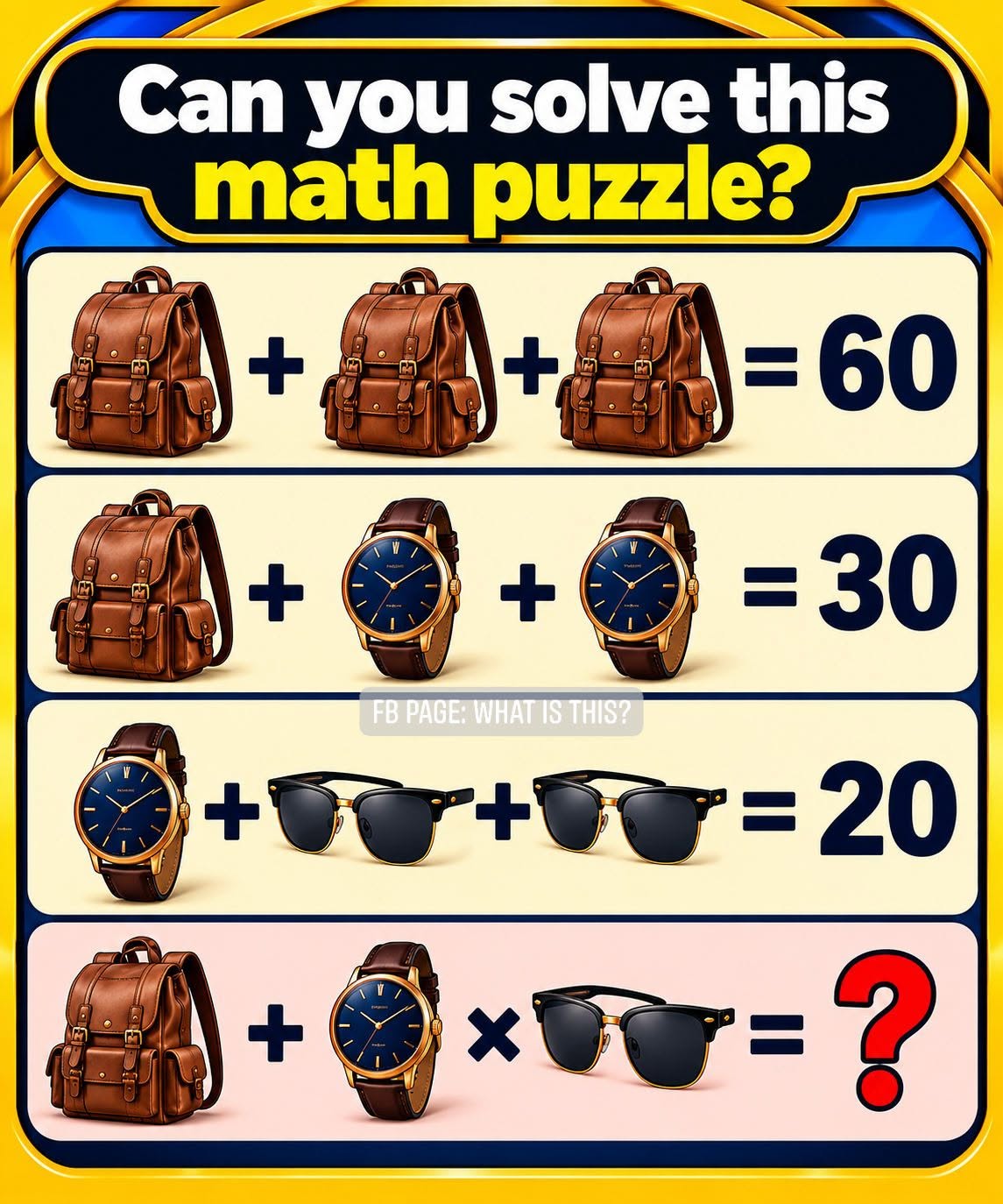
Visual math puzzles and algebraic brain teasers have become an internet favorite for testing quick thinking, attention to detail, and mathematical logic. The puzzle presented here, titled “Can you solve this math puzzle?”, features a series of equations using everyday items: brown leather backpacks, wristwatches, and sunglasses. While these viral puzzles look simple at first glance, they are designed with clever visual traps that catch many people off guard.
In this comprehensive article, we will break down each equation step-by-step, reveal the hidden details in the final equation, explore the cognitive benefits of math puzzles, and discuss how careful analysis applies to everyday problem-solving and financial planning.
Step-by-Step Algebraic Breakdown
To arrive at the correct answer, let’s solve each equation systematically:
Equation 1: Finding the Value of the Backpack
-
The Equation: Backpack + Backpack + Backpack = 60
-
The Calculation: 3 backpacks equal 60, so $60 \div 3 = 20$.
-
Value: One Backpack = 20.
Equation 2: Finding the Value of the Watch
-
The Equation: Backpack + Watch + Watch = 30
-
The Calculation: Substitute the backpack value (20) into the equation: $20 + 2 \times \text{Watch} = 30$. This leaves 10 for the two watches, meaning $10 \div 2 = 5$.
-
Value: One Watch = 5.
Equation 3: Finding the Value of the Sunglasses
-
The Equation: Watch + Sunglasses + Sunglasses = 20
-
The Calculation: Substitute the watch value (5) into the equation: $5 + 2 \times \text{Sunglasses} = 20$. This leaves 15 for the two pairs of sunglasses, meaning $15 \div 2 = 7.5$.
-
Value: One Pair of Sunglasses = 7.5.
+-------------------------------------------------------------------+
|               MATH PUZZLE ITEM VALUES MATRIX                      |
+-------------------------------------------------------------------+
| Item                  | Calculated Numerical Value                |
+-----------------------+-------------------------------------------+
| Brown Backpack        | 20                                        |
| Wristwatch            | 5                                         |
| Pair of Sunglasses    | 7.5                                       |
+-------------------------------------------------------------------+
The Final Equation and Common Traps
Now let’s examine the final equation: Backpack + Watch × Sunglasses = ?
Before rushing to calculate, remember the strict rules of order of operations (PEMDAS/BODMAS), which dictate that multiplication must be performed before addition:
-
Multiplication First: Watch (5) × Sunglasses (7.5) = 37.5
-
Addition Second: Backpack (20) + 37.5 = 57.5
(Note: Always check the image for hidden visual modifications, such as different times on the watch face or missing accessories, which are common tricks in viral math riddles!)
The Cognitive Benefits of Math Puzzles
Engaging with algebraic brain teasers and logic challenges provides proven benefits for mental agility:
-
Sharpening Logical Reasoning: Math puzzles train your brain to follow structured rules, such as the order of operations.
-
Improving Focus and Concentration: Solving puzzles requires undivided attention, which helps build mental endurance and patience.
-
Providing Stress Relief: Immersing yourself in a lighthearted challenge offers a refreshing, low-stakes break from daily responsibilities.
Financial Planning, Asset Management, and Risk Control
While solving math puzzles is a fun way to exercise your brain, careful calculation and analytical thinking are equally vital in the real world.
Managing Personal Budgets and Investments
Just as following the correct order of operations ensures the right mathematical outcome, following structured financial principles—such as budgeting, tracking expenses, and compounding investments—ensures long-term economic stability.
Reviewing Financial Documents
Meticulous attention to detail prevents costly oversights when reviewing contracts, loan agreements, or investment portfolios.
Conclusion
This multi-item math puzzle is a fantastic and entertaining way to test your algebra and observation skills. Whether you solved it in seconds or double-checked your order of operations, brain teasers keep your mind sharp and engaged.
Did you find the correct answer right away? Share this puzzle with your friends and family to test their math skills!
Frequently Asked Questions (FAQ)
What is the correct answer to the final math equation?
Following the standard order of operations (multiplication before addition), the calculation is $20 + (5 \times 7.5) = 57.5$.
Why do people often get these puzzles wrong?
Many people make mistakes by either ignoring the order of operations (performing addition before multiplication) or missing subtle visual changes in the final row’s icons.
How do math puzzles improve cognitive health?
Math puzzles stimulate analytical thinking, reinforce working memory, and improve problem-solving speed across all age groups.
