
Visual puzzles, hidden object games, and brain teasers have captivated people across generations. From classic illustrations in children’s magazines to viral image challenges on social media, these visual tests offer far more than just quick entertainment. They engage complex cognitive networks in the human brain, stimulating problem-solving abilities, visual discrimination, working memory, and mental agility.
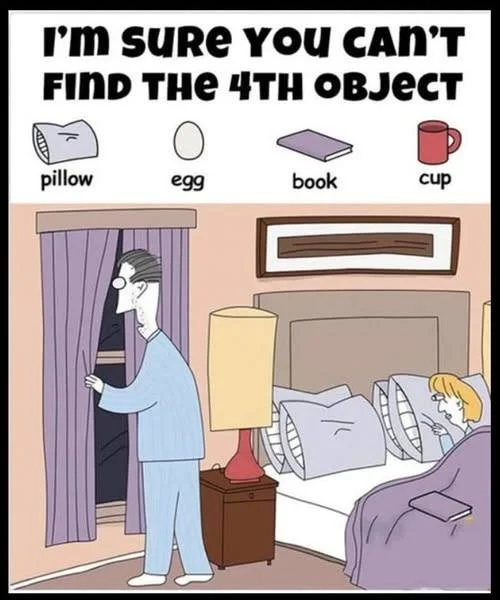
When presented with an image challenge—such as finding a set of hidden items like a pillow, egg, book, or cup within a cozy bedroom scene—your brain instantly kicks into high gear. Visual perception mechanisms work alongside attention control centers to filter out background noise and identify subtle shapes embedded within everyday objects.
In this comprehensive guide, we explore the science behind optical puzzles and brain teasers, examine how visual discrimination works, detail the complete step-by-step solution to this viral puzzle, and highlight the cognitive benefits of incorporating daily brain exercises into your routine.
The Neuroscience of Visual Perception and Hidden Object Puzzles
To understand why visual riddles can be deceptively tricky, it is helpful to look at how the brain processes complex visual scenes.
When you look at a busy image, light signals travel from your eyes to the primary visual cortex in the occipital lobe. From there, visual processing splits into two main cognitive pathways:
The Dorsal Stream (The “Where” Pathway): Processes spatial awareness, locations, and structural relationships between objects in the scene.
The Ventral Stream (The “What” Pathway): Identifies forms, colors, patterns, and shapes, matching what you see with long-term memory stores to recognize specific objects.
Figure-Ground Perception
A primary reason hidden object puzzles pose a challenge is a psychological principle known as figure-ground perception. The brain automatically tries to distinguish the main focal point (the figure) from the background environment (the ground). Puzzle creators intentionally camouflage hidden items by blending their outlines into structural background details, such as lamp bases, curtain folds, hair strands, or furniture contours. This tricks your brain into dismissing the hidden object as part of the background environment.
Detailed Puzzle Solution: Finding All 4 Hidden Objects
If you have been searching the bedroom scene in the puzzle to locate every target item, here is the exact step-by-step breakdown of where each hidden object is located within the illustration:
+——————–+——————————————————————–+
| Hidden Object | Exact Location in the Bedroom Illustration |
+——————–+——————————————————————–+
| 1. Pillow | Located on the bed behind the woman, supporting her back |
| 2. Book | Resting clearly on top of the purple bed covers near the bottom |
| 3. Egg | Hidden in plain sight on top of the nightstand lamp bulb fixture |
| 4. Cup | Formed by the red base of the bedside nightstand lamp |
+——————–+——————————————————————–+
1. The Pillow
The pillow is the easiest object to spot. Multiple pillows are positioned on the bed supporting the sleeping woman and propped against the headboard, matching the shape shown in the key above.
2. The Book
The book is resting visibly on top of the purple blanket near the lower right corner of the bed, placed right near the woman’s feet.
3. The Egg
The egg is cleverly hidden in the middle of the room as the white light bulb/fixture atop the table lamp sitting on the nightstand between the man and the bed.
4. The Cup
The elusive fourth object—the red cup—is camouflaged in plain sight! The red ceramic lamp base sitting on the dark wood nightstand is inverted and shaped to form the body and handle of the red mug listed in the clue key.
Cognitive Benefits of Regular Brain Teasers and Puzzles
Engaging with visual challenges, crosswords, and logic riddles daily provides tangible benefits for brain health across all age groups.
+—————————+——————————————————-+
| Cognitive Skill | Psychological Improvement |
+—————————+——————————————————-+
| Selective Attention | Enhances ability to focus amidst visual distractions |
| Pattern Recognition | Speeds up visual processing and detail identification |
| Working Memory | Exercises short-term retention during complex tasks |
| Dopamine Release | Boosts mood and satisfaction upon solving problems |
+—————————+——————————————————-+
1. Strengthening Selective Attention
In a world filled with constant digital notification noise and divided attention, practice with hidden object puzzles exercises your selective attention span. It forces the prefrontal cortex to filter out irrelevant visual details and remain focused on specific target shapes.
2. Enhancing Pattern Recognition and Visual Processing
Regularly scanning complex images sharpens pattern recognition skills. This improved visual acuity helps in everyday real-world tasks, such as navigating busy traffic environments, reading complex charts, or finding misplaced keys in a cluttered room.
3. Boosting Mood and Mental Wellness
Solving a puzzle triggers a small release of dopamine—a key neurotransmitter associated with reward, motivation, and positive mood. That sudden “aha!” moment when you discover a hidden item delivers an enjoyable sense of cognitive accomplishment.
Educational and Life Applications: From Childhood to Healthy Aging
Brain exercises play a vital role at every stage of human development and lifelong learning.
Educational Value for Children
For young children, visual search puzzles enhance early childhood cognitive development. They build foundational skills in spatial orientation, vocabulary acquisition, object recognition, and hand-eye coordination essential for early reading and writing comprehension.
Cognitive Reserve for Older Adults
For seniors, challenging the brain with novel visual puzzles, memory games, and logic problems helps build and maintain cognitive reserve. Maintaining an active brain through continuous mental stimulation supports long-term neuroplasticity and overall cognitive vitality as you age.
Financial Considerations: Educational Games and Mind Training
Prioritizing mental fitness does not require expensive tools or subscription services.
Free & Accessible Mental Exercise: Millions of high-quality optical illusions, brain teasers, and visual logic puzzles are available online for free through educational websites, digital magazines, and mobile application stores.
Flex Spending for Cognitive Therapy Tools: In certain medical situations involving stroke recovery, cognitive rehabilitation, or vision therapy, specialized brain training software recommended by a doctor or occupational therapist may qualify for Health Savings Account (HSA) or Flexible Spending Account (FSA) reimbursement.
Preventive Health Care Value: Investing a few minutes each day in low-cost or free brain-stimulating activities is one of the easiest, most accessible preventive habits for maintaining mental sharpness throughout life.
Fascinating Facts About Human Vision and Visual Puzzles
Rapid Visual Processing: The human brain can process full visual images in as little as 13 milliseconds—faster than the blink of an eye!
The Saccade Phenomenon: When searching for a hidden object, your eyes make quick, jerky movements called saccades, jumping between focal points up to three times per second.
Origins of Hidden Object Games: Hidden object illustrations were popularized in mainstream culture by Highlights magazine in 1946 through their famous “Hidden Pictures” section, designed to encourage focused attention in young readers.
Practical Tips to Solve Visual Puzzles Faster
If you want to improve your puzzle-solving speed and accuracy, try these proven visual search strategies:
Use a Structured Grid Search: Instead of scanning randomly, divide the image mentally into four equal quadrants and systematically scan each section from top-left to bottom-right.
Focus on Negative Space and Outlines: Ignore colors and textures initially; focus purely on structural outlines and silhouettes that resemble your target items.
Invert Your Perspective: Try looking at the image from different angles or turning your device upside down to break familiar context patterns and spot hidden shapes instantly.
Conclusion
Visual puzzles like this bedroom hidden object challenge are more than just entertaining brain teasers—they are a fun exercise for your visual cortex and problem-solving skills. By training your eyes to look past figure-ground visual distractions, you sharpen your focus, boost pattern recognition, and enjoy a rewarding mental workout. Next time you encounter a tricky visual puzzle, take a moment to test your attention to detail and keep your mind sharp!
Frequently Asked Questions (FAQ)
1. Where is the 4th object (the cup) hidden in this puzzle?
The 4th object—the red cup—is formed by the base of the bedside table lamp. The red ceramic lamp structure features the exact silhouette and handle shape of a mug or coffee cup.
2. Why are visual hidden object puzzles so difficult for some people?
Visual puzzles rely on figure-ground perception and camouflage principles. When a target shape shares the color, outline, or border of a surrounding object (like a lamp base or window curtain), the brain automatically filters it out as background noise rather than recognizing it as an independent object.
3. Do brain teaser games really keep your brain young?
Yes! Engaging in regular, diverse cognitive activities—such as solving visual puzzles, learning new skills, and playing strategy games—promotes neuroplasticity, strengthens neural connections, and supports long-term mental sharpness.
4. What is the best strategy for finding hidden items in picture puzzles?
The most effective strategy is a systematic grid search: scan the image row-by-row or quadrant-by-quadrant rather than scanning randomly. Focusing on object outlines and negative space rather than color also makes hidden items jump out faster.
