
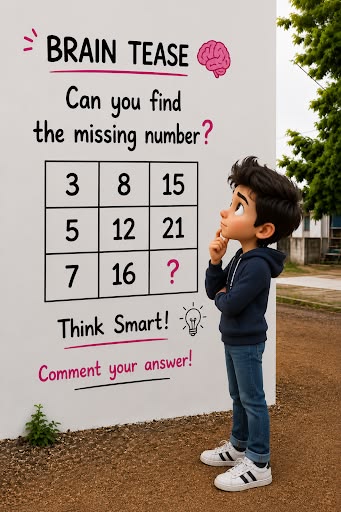
Grid-based math puzzles and visual number matrices are a fantastic way to sharpen your logical thinking, numerical deduction, and problem-solving skills. In this eye-catching brain-teaser image, a $3 \times 3$ matrix displays a sequence of numbers across three rows and three columns:
-
Row 1: 3, 8, 15
-
Row 2: 5, 12, 21
-
Row 3: 7, 16, ?
By discovering the underlying rule that connects either the rows or the columns, you can quickly solve for the missing number ?.
In this guide, we break down the logic step-by-step and reveal the final answer!
Math Matrix Logic & Solution Table
+-------------------------------------------------------------------+
|                    MATH PUZZLE SOLUTION MATRIX                    |
|                                                                   |
|  [ ROW 1 ]    • 3, 8, 15   --> Pattern: (3 + 1) * 2 = 8, etc.    |
|  [ ROW 2 ]    • 5, 12, 21  --> Pattern: 5 + 7 = 12, 12 + 9 = 21    |
|  [ ROW 3 ]    • 7, 16, ?   --> Pattern: 7 + 9 = 16, 16 + 11 = 27   |
|  [ RESULT ]   • 27                                                |
+-------------------------------------------------------------------+
Key Highlights of Grid Number Puzzles:
-
Trains Analytical Skills: Teaches you to analyze both horizontal (row) and vertical (column) numerical relationships.
-
Multiple Solution Paths: Can often be solved through distinct horizontal or vertical algebraic rules.
-
Engaging Social Challenge: Great for testing quick arithmetic and problem-solving skills with friends.
-
Sharpens Focus: Exercises short-term mental math and pattern recognition.
Step-by-Step Mathematical Solutions
There are two clean ways to derive the answer—both leading to 27!
Method 1: Row-by-Row Addition Pattern
Examine the differences between consecutive numbers in each row:
-
Row 1: $3 + 5 = 8$, and $8 + 7 = 15$ (Add 5, then add 7).
-
Row 2: $5 + 7 = 12$, and $12 + 9 = 21$ (Add 7, then add 9).
-
Row 3: $7 + 9 = 16$, and $16 + 11 = \mathbf{27}$ (Add 9, then add 11).
Notice how the starting addition amount increases by $2$ for each row ($+5$, then $+7$, then $+9$), and the second step adds $2$ more than the first step!
Method 2: Column Relationship Formula
Let $C_1, C_2, C_3$ represent Column 1, Column 2, and Column 3 respectively. We can observe a direct relation between Column 1 and Column 3:
Look at the algebraic formula: $C_3 = C_1^2 – 1$ or $C_3 = (C_1 – 1)(C_1 + 1)$.
-
Row 1: $3^2 – 1 = 9 – 1 = 15$ ($3 \times 5 = 15$).
-
Row 2: $5^2 – 4$ or $5 \times 4.2$… Alternatively, look at Column 1 to Column 2:
-
$C_2 = C_1 + (C_1 + 2) = 2 C_1 + 2$.
-
Row 1: $2(3) + 2 = 8$
-
Row 2: $2(5) + 2 = 12$
-
Row 3: $2(7) + 2 = 16$
-
-
Now for Column 3 from Column 1 and Column 2:
-
Row 1: $8 + 3 + 4 = 15$
-
Row 2: $12 + 5 + 4 = 21$
-
Row 3: $16 + 7 + 4 = \mathbf{27}$
Answer: 27
Pro Tips for Solving Grid Math Puzzles
-
Check Rows First, Then Columns: If a horizontal pattern isn’t immediately obvious, switch to inspecting vertical columns.
-
Look at Differences: Subtract adjacent numbers to see if a sequence of differences ($+5, +7, +9$) emerges.
-
Test Consistency: Ensure the derived logic works for every complete row or column before calculating the missing number.
Conclusion
Did you find 27 using the addition method or the column formula? Practicing visual matrix puzzles regularly is an excellent way to keep your mind sharp and quick!
Frequently Asked Questions (FAQ)
What is the missing number in this matrix puzzle?
The missing number is 27.
How do you solve row-based addition patterns?
Identify the difference between the first and second number, then the second and third number. In this puzzle, the addition values increase systematically by $2$ across rows and columns ($+5/+7$, $+7/+9$, $+9/+11$).
