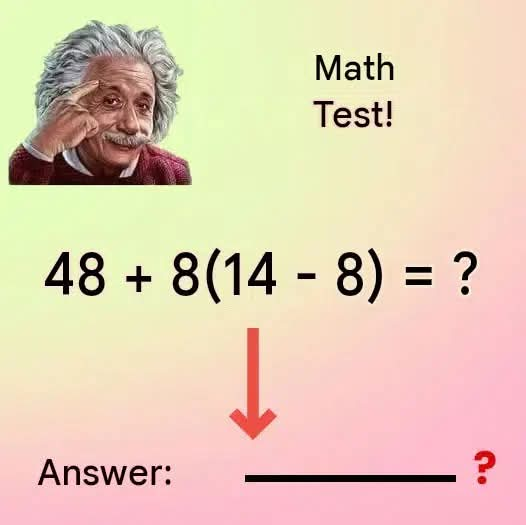
Viral math test puzzles, order of operations challenges, and arithmetic brain teasers frequently capture the attention of millions across social media platforms. A clever graphic featuring Albert Einstein and the equation “$48 + 8(14 – 8) = ?$” instantly sparks intense debate, calculator checks, and thousands of comments. While these playful tests often trip people up, they fundamentally serve as engaging exercises in mathematical rules, grouping symbols, and critical thinking.In this comprehensive guide, we explore the mathematical rules behind the order of operations, how parentheses work, the role of cognitive workouts in maintaining mental sharpness, and how overall lifestyle wellness supports lifelong brain health.The Mathematical Mechanics: Order of Operations (PEMDAS/BODMAS)When presented with a math puzzle involving multiple operations, the human brain often relies on quick intuition rather than strict mathematical sequences, leading to common errors.Parentheses First: According to standard mathematical rules (PEMDAS/BODMAS), operations inside parentheses must be evaluated first. In this equation, $(14 – 8)$ simplifies to $6$.Substitution and Multiplication: Substituting that result back into the equation gives $48 + 8(6)$, which means $48 + (8 \times 6)$. Following the order of operations, multiplication takes precedence over addition.The Final Calculation: Multiplying $8 \times 6$ gives $48$. Adding that to the initial $48$ results in $48 + 48 = 96$.This blend of mathematical rules and structured sequencing is what makes math puzzles such an effective workout for analytical thinking and problem-solving.Cognitive Reserve and Mental AgilityJust as physical workouts build muscle strength and endurance, regularly engaging with visual puzzles, math riddles, and logic challenges builds cognitive reserve. Cognitive reserve acts as a protective buffer for the brain, enhancing problem-solving flexibility and supporting mental sharpness over time.Key Pillars for Maintaining Brain HealthContinuous Challenge: Pushing your brain to solve tricky math problems prevents cognitive stagnation.Balanced Nutrition: Consuming a diet rich in essential vitamins, antioxidants, and healthy fats nourishes neural pathways.Rest and Recovery: Quality sleep is vital for consolidating memories and clearing metabolic waste from brain tissues.Stress Management: Reducing daily anxiety through organized routines and mindfulness allows for sharper focus.Financial, Legal, and Lifestyle StabilityAchieving optimal personal focus and clarity thrives in an environment of overall well-being and stability. Managing life’s major practical responsibilities reduces cognitive fatigue:Smart Financial Planning: Proactive budgeting, investments, retirement accounts, and careful management of loans or mortgages ensure long-term security.Risk Mitigation: Protecting your household and assets with reliable insurance coverage minimizes unexpected stress.Legal Preparedness: Consulting qualified attorneys and utilizing legal services for estate planning or contracts safeguards your rights and interests.When these foundational areas of life are well-organized, individuals enjoy greater peace of mind, freeing up mental energy for creativity, work, and daily problem-solving.Practical Tips for Boosting Problem-Solving SkillsTo improve your analytical speed and mathematical reasoning when tackling trick questions, try applying these strategies:Follow PEMDAS/BODMAS: Always evaluate expressions in the correct sequence—Parentheses, Exponents, Multiplication/Division, Addition/Subtraction.Write Out Each Step: Avoid doing complex multi-step math entirely in your head; writing down intermediate steps prevents careless errors.Practice Logic Games: Regularly solving riddles, math puzzles, and word challenges keeps your brain adaptable.Embrace Curiosity: View challenges as a fun mental exercise rather than a strict test, encouraging flexible and creative thinking.Interesting Facts About Math Puzzles and Online DebateThe Trap of Intuition: Many people make the mistake of adding $48 + 8$ first before multiplying, completely ignoring the proper order of operations.Viral Math Phenomena: Equations with ambiguous or debated order of operations routinely go viral because they invite friendly arguments and high comment engagement.The Dopamine Effect: Successfully figuring out the correct answer to a tricky math puzzle triggers a rewarding release of dopamine in the brain.ConclusionA playful math test puzzle involving parentheses and the order of operations is much more than a social media distraction—it is a fun way to test our attention to detail, mathematical rules, and analytical logic. By combining mental challenges with a balanced lifestyle, proper health habits, and solid long-term planning, you can keep your mind sharp, adaptable, and ready for any challenge.Frequently Asked Questions (FAQ)1. What is the correct answer to $48 + 8(14 – 8)$?
The correct answer is 96. First, solve inside the parentheses ($14 – 8 = 6$), then multiply ($8 \times 6 = 48$), and finally add ($48 + 48 = 96$).2. Why do people get incorrect answers like 336?
People often make the mistake of adding $48 + 8$ first to get 56, and then multiplying by 6, which violates the standard order of operations.3. Do math puzzles provide cognitive benefits?
Yes, engaging with math and logic puzzles stimulates critical thinking, enhances attention to detail, and encourages flexible cognitive processing.4. What is the best way to approach a tricky math puzzle?
Slow down, identify all operations, strictly follow the order of operations (PEMDAS/BODMAS), and double-check your arithmetic step by step.
The Psychology of Math Puzzles: Why Order of Operations Tricks the Internet