
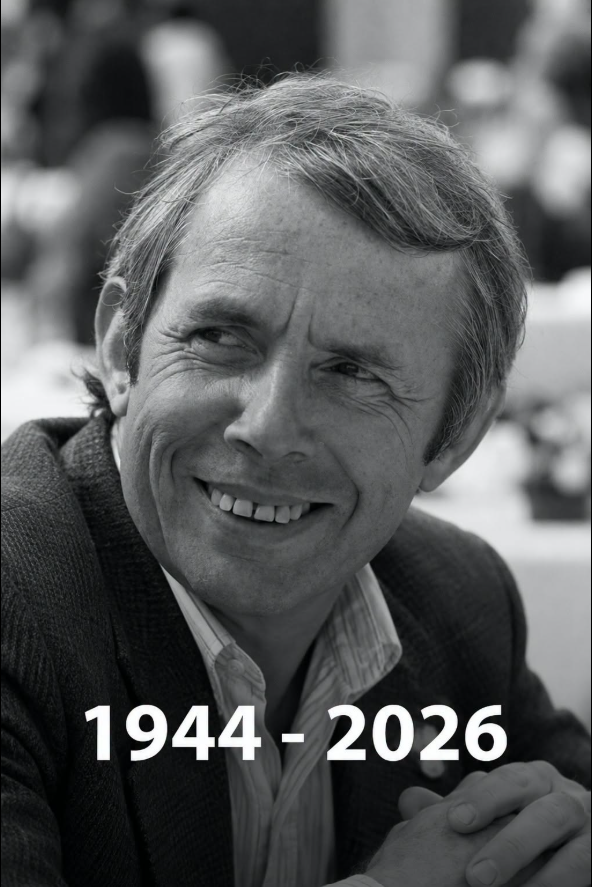
For millions of television viewers, some faces never really disappear. Even decades after a show ends, a familiar character can return through reruns and instantly bring back memories of another time.
That is the kind of connection Richard O’Sullivan built during a career that began when he was still a child and eventually made him one of the recognizable faces of British television comedy. O’Sullivan died on September 4, 2026, at the age of 82, surrounded by close family at Brinsworth House in Twickenham, where he had lived for many years.
ADVERTISEMENT
His death marks the passing of an actor whose career stretched across several generations of British entertainment. But for many viewers, his name will always be connected to one character in particular: Robin Tripp.
The Character That Made Richard O’Sullivan a Household Name
In 1973, O’Sullivan took on the role of Robin Tripp in Man About the House.
ADVERTISEMENT
The sitcom followed Robin, a young cook who shared a London flat with two women, creating the misunderstandings and comic situations that became central to the series.
The show ran from 1973 to 1976 and became one of the major television successes of its era. O’Sullivan’s easygoing screen presence helped make Robin one of the show’s most memorable characters.
But the story didn’t end when Man About the House finished.
Robin Tripp became popular enough to receive his own spin-off.
Then Came Robin’s Nest
In 1977, O’Sullivan returned as Robin in Robin’s Nest.
This time, the character had moved beyond the shared flat and opened a bistro, giving the actor another opportunity to build on the personality audiences had already come to know.
The series continued until 1981 and became another important part of O’Sullivan’s television legacy.
And there was another interesting connection.
The British series and its characters helped inspire the American sitcom Three’s Company, with John Ritter later playing the comparable role of Jack Tripper in the U.S. version.
So a character O’Sullivan helped make famous in Britain eventually became familiar to an entirely different television audience across the Atlantic.
His Career Started Long Before Robin Tripp
What many younger viewers may not realize is that O’Sullivan was already an experienced performer before his biggest television success.
Born in Chiswick, London, in 1944, he began acting as a child. At just eight years old, he appeared in The Yellow Balloon, beginning a screen career that would continue for decades.
His early career also took him into major film productions.
One of his notable appearances came in Cleopatra in 1963, where he played Pharaoh Ptolemy XIII alongside Elizabeth Taylor and Richard Burton. He also appeared in films including The Young Ones and Wonderful Life.
That journey from child performer to television star was not something that happened overnight.
By the time the 1970s arrived, O’Sullivan had already spent years learning his craft.
From Comedy to Adventure
After the success of Man About the House and Robin’s Nest, O’Sullivan took on another role that became closely associated with his name.
He played the title character in Dick Turpin, the period adventure series that ran from 1979 to 1982.
Later came another successful television role in Me and My Girl, where he played Simon Harrap, a widowed father.
His career therefore wasn’t limited to one sitcom or one type of character. He moved between comedy, adventure, film and television throughout his years in entertainment.
The Years Away From the Spotlight
As the years passed, O’Sullivan gradually stepped away from public life.
A stroke in 2003 had a major effect on his later years, and he eventually lived at Brinsworth House, the Royal Variety Charity’s care home for people from the entertainment industry. He had been there for 23 years by the time of his death.
That meant his later life was very different from the years when millions of people regularly saw him on television.
But the distance from the spotlight did not erase his connection with audiences.
His shows continued to be repeated, allowing new viewers to discover performances that were originally made decades earlier.
His Son’s Emotional Tribute
Following his death, O’Sullivan’s son James remembered his father not simply as a television star, but as a person.
He described him as funny and charming in real life, as well as kind-hearted, good-humoured, a devoted grandfather and a wonderful father. He also spoke about watching his father’s old performances through countless reruns.
That detail is particularly fitting for an actor whose work has continued to live through television reruns.
For viewers who knew O’Sullivan primarily as Robin Tripp, seeing those old episodes again can bring back a completely different era of television.
A Career That Outlived the Spotlight
Richard O’Sullivan’s career lasted more than four decades, beginning with childhood appearances and eventually leading to some of the most recognizable British television comedies of the 1970s and 1980s.
His most famous roles were created long before streaming, social media and today’s television landscape existed.
Yet the characters remained familiar because they were preserved through reruns and memories.
The Royal Variety Charity described O’Sullivan as a performer whose charm and comic timing brought warmth and enjoyment to millions of living rooms.
That may be one of the clearest ways to understand his legacy.
He wasn’t simply part of a television show.
For many people, he was part of the background of their lives.
Richard O’Sullivan Leaves Behind More Than Old TV Episodes
O’Sullivan died at 82, but the work he created decades ago remains available to audiences who were not even born when Man About the House first aired.
That is one of the unusual things about television.
An actor can leave the spotlight, stop appearing on new programs and eventually pass away, while the characters they created continue appearing in living rooms around the world.
Richard O’Sullivan’s Robin Tripp is one of those characters.
And for viewers who remember those familiar sitcom years, his passing is more than the loss of an actor. It is another reminder of an era of television that shaped generations of audiences.
