
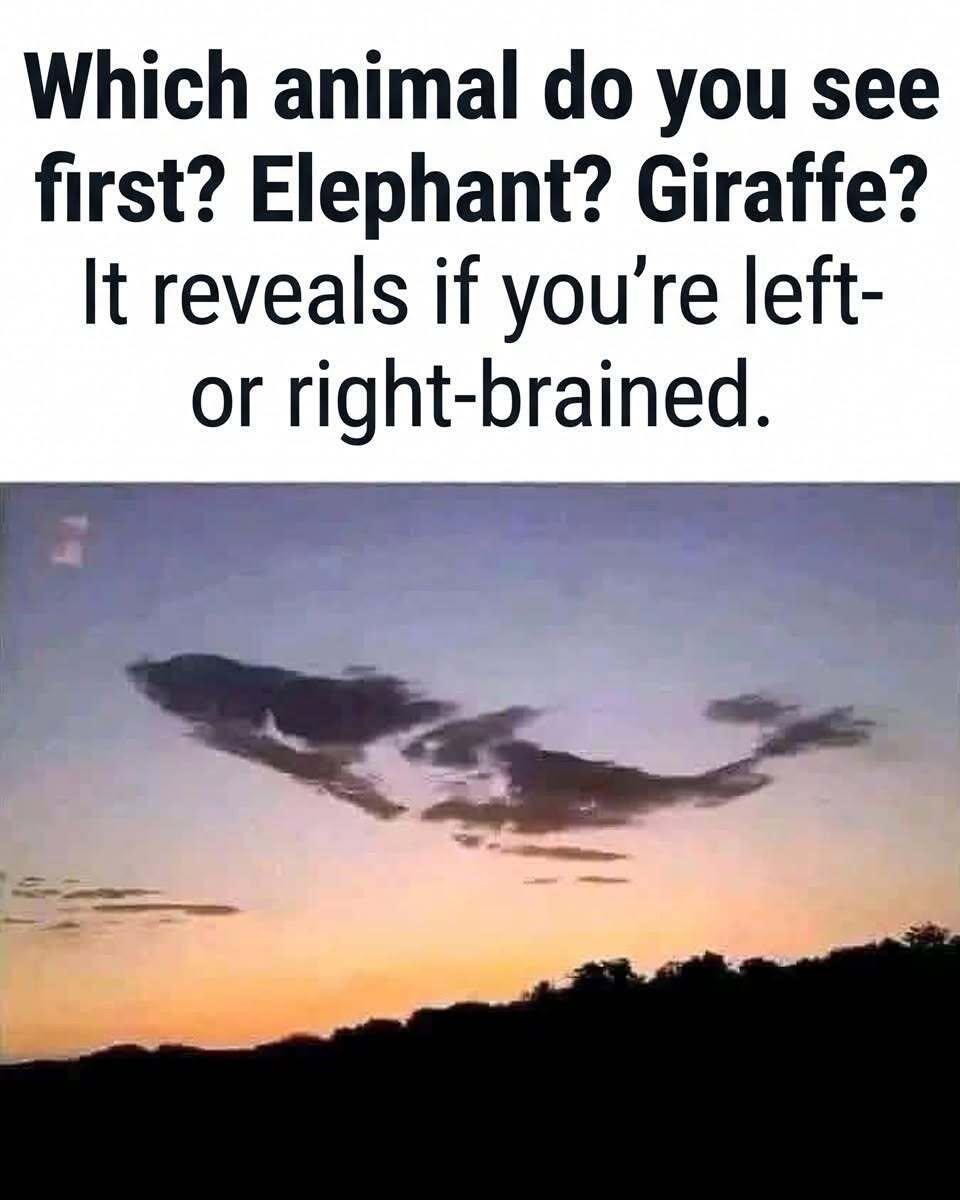
Optical illusions, cloud formations, and personality test images have always captivated internet users across the globe. When presented with an ambiguous photograph—such as a unique cloud shape stretching across a sunset sky—the human brain immediately attempts to interpret the visual data by recognizing patterns, silhouettes, and familiar shapes. In viral social media tests asking whether viewers notice an elephant or a giraffe first, the psychological interpretation is often playfully linked to whether a person is left- or right-brained.
Understanding how visual perception works, why different people interpret the same image in conflicting ways, and how cognitive biases influence our snap judgments reveals fascinating insights into human psychology. Let us explore the science of visual processing, personality categorization, and why ambiguous optical tests capture our collective attention online.
The Science of Visual Perception and Pattern Recognition
When our eyes capture an image, visual signals travel rapidly to the occipital lobe in the brain, where neural networks process shapes, contrast, lighting, and edges. This process, known as pattern recognition, allows humans to identify familiar objects and animals in milliseconds.
1. Pareidolia and the Human Brain
The human tendency to perceive meaningful images, faces, or animals out of random visual patterns—such as rock formations, sunset clouds, or irregularly shaped objects—is called pareidolia. This evolutionary survival mechanism helped our ancestors quickly identify potential predators or familiar shapes in complex environments.
2. Cognitive Interpretation and Personal Bias
When looking at an ambiguous silhouette, individual cognitive frameworks and past experiences dictate what we see first. Someone who focuses on the massive body shape on the left may instantly spot a large land mammal, while another observer scanning the longer contours might perceive a different animal entirely.
What Seeing an Elephant Versus a Giraffe Might Symbolize
In popular personality tests shared across social media networks, visual choices are often playfully tied to distinct cognitive traits:
-
The Elephant Perspective: Often associated with traits such as analytical thinking, logic, practicality, and structured problem-solving (commonly linked to left-brain dominance).
-
The Giraffe Perspective: Frequently linked with creativity, intuition, big-picture thinking, and artistic expression (commonly linked to right-brain dominance).
While these personality categorizations are meant for entertainment rather than clinical psychology, they tap into deeply held archetypes that resonate with millions of internet users.
Digital Engagement and Viral Psychology
Visual quizzes and interactive optical illusion posts consistently drive massive engagement across social media platforms like Facebook.
Why Interactive Posts Go Viral
Posts that challenge users to make a choice—such as identifying a specific animal in a cloud formation—invite immediate participation. By prompting users to comment with their answer, these posts skyrocket comment counts, boost algorithmic reach, and foster vibrant online communities where people compare their unique perspectives.
The Role of Personal Branding and Digital Content
For digital publishers and content creators, understanding audience psychology is vital for growing website traffic and maximizing ad revenue. Crafting engaging social media funnels that lead readers from a quick Facebook question to an in-depth website article helps increase average reading time, page views, and overall user retention.
Financial, Legal, and Strategic Considerations for Content Creators
Building a successful digital publishing platform involves more than just selecting viral images; it requires careful management of business operations and digital assets.
Protecting Intellectual Property and Media Rights
Digital content creators must navigate complex copyright laws regarding image usage, fair use principles, and social media platform policies. Securing proper image licensing or utilizing original photography prevents legal complications and protects digital brands. Consulting with a qualified attorney or specialized legal services provider ensures that content publishing businesses remain fully compliant with intellectual property regulations.
Maximizing Digital Revenue Streams
Just as careful personal finance management secures individual household stability, diversifying digital monetization channels—such as combining social media traffic acquisition with programmatic display ads—strengthens online business sustainability. Monitoring analytics, optimizing page layouts, and improving user engagement metrics help publishers maximize their overall investment returns.
Practical Tips for Improving Visual Literacy and Brain Agility
Engaging with optical puzzles and visual tests can actually provide a fun mental workout for your brain:
-
Practice Mindful Observation: Take time to examine complex images from multiple angles rather than relying solely on your first impression.
-
Challenge Your Assumptions: When discussing visual tests with friends, listen to alternative interpretations to expand your perspective and cognitive flexibility.
-
Engage with Creative Puzzles: Regularly solving optical illusions, riddles, and visual tests helps stimulate neural pathways associated with spatial reasoning and creative problem-solving.
Fascinating Facts About Visual Perception
-
The Speed of Sight: The human eye and brain process visual information in as little as 13 milliseconds, making sight our fastest sensory processing system.
-
Peripheral Vision Limitations: While our central vision is exceptionally sharp, our peripheral vision is largely color-blind and optimized primarily for detecting motion.
-
The Power of Context: The visual context surrounding an object dramatically alters how our brain interprets its color, size, and shape—a principle demonstrated by classic optical illusions.
-
Optical Illusion History: Psychologists have used ambiguous figures, such as the famous duck-rabbit illusion, since the late 19th century to study how the human mind organizes visual data.
Conclusion
Whether you instantly spotted an elephant or a giraffe in the sunset clouds, ambiguous visual tests offer a fascinating glimpse into human perception, pattern recognition, and viral psychology. By understanding how our brains process images and why interactive prompts capture our attention, we can better appreciate the playful ways we connect across digital platforms.
Frequently Asked Questions (FAQ)
Which animal should I see first in this cloud photo?
Viewers often spot either an elephant or a giraffe depending on how their visual cortex interprets the silhouette shapes in the clouds.
Why do visual illusion posts get so many comments on Facebook?
Visual questions invite immediate personal opinions and playful debate, making users eager to share what they see first and compare their results with friends.
Do optical tests accurately measure brain dominance?
While entertaining and engaging for social media, optical personality tests reflect subjective interpretations rather than scientifically validated psychological assessments of left- or right-brain dominance.
How does visual perception affect our daily lives?
Our visual processing systems allow us to instantly evaluate our environment, recognize faces, navigate physical spaces, and interpret complex data in fractions of a second.
