
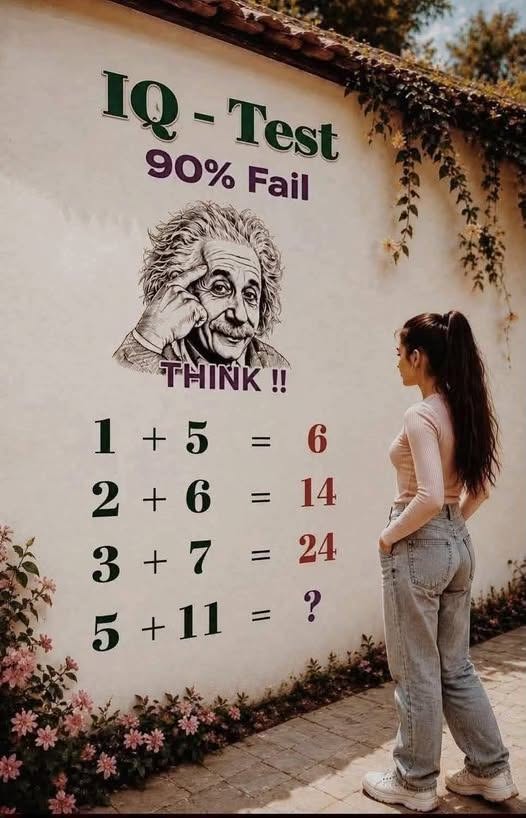
Math sequence puzzles frequently go viral across social media, claiming that only a small percentage of people can solve them. These brain teasers present simple arithmetic equations with seemingly incorrect sums, challenging viewers to decode the hidden mathematical logic behind the numbers.
The viral image presents the following sequence:
- 1 + 5 = 6
- 2 + 6 = 14
- 3 + 7 = 24
- 5 + 11 = ?
In this breakdown, we will reveal the step-by-step solution, explore the pattern mechanics, examine alternative mathematical interpretations, and share practical tips for solving number puzzles.
Step-by-Step Solution Breakdown
To solve $5 + 11$, we must first identify the hidden mathematical formula applied to each line: $A + B = A \times B + A$ (or equivalently, $A \times (B + 1)$).
Let’s test this pattern on the given equations:
- First Line:$1 \times 5 + 1 = 5 + 1 = \mathbf{6}$(Alternatively: $1 \times (5 + 1) = 6$)
- Second Line:$2 \times 6 + 2 = 12 + 2 = \mathbf{14}$(Alternatively: $2 \times (6 + 1) = 14$)
- Third Line:$3 \times 7 + 3 = 21 + 3 = \mathbf{24}$(Alternatively: $3 \times (7 + 1) = 24$)
Applying the Rule to the Final Line:
Using the established formula $A \times B + A$ for $5 + 11$:
- $5 \times 11 + 5 = 55 + 5 = \mathbf{60}$
(Using the alternative method: $5 \times (11 + 1) = 5 \times 12 = \mathbf{60}$)
The primary correct answer is 60.
Alternative Method: Cumulative Addition Pattern
Another common way people solve sequence puzzles is by adding the result of the previous line to the sum of the current line:
- Line 1: $1 + 5 = \mathbf{6}$
- Line 2: $2 + 6 + 6 = \mathbf{14}$
- Line 3: $3 + 7 + 14 = \mathbf{24}$
If the sequence skips numbers (from 3 to 5), filling in the missing line ($4 + 8$) yields:
- Missing Line: $4 + 8 + 24 = \mathbf{36}$
- Final Line: $5 + 11 + 36 = \mathbf{52}$
However, because $5 + 11$ does not follow the standard $+1$ left-hand increment, the direct formula rule (60) is widely accepted as the most mathematically sound single-equation solution.
Why Sequence Puzzles Go Viral
Number puzzles drive massive social media interaction due to key psychological factors:
- Multiple Valid Approaches: Puzzles that allow for different logical interpretations encourage debate in the comment section.
- Instant Cognitive Reward: Finding the hidden pattern triggers a satisfying sense of achievement, prompting users to share the challenge with friends.
Practical Tips for Solving Math Brain Teasers
- Check Multiplication First: When addition results scale up rapidly, test multiplying the inputs ($A \times B$) or multiplying by consecutive integers.
- Look for Variable Patterns: Test if adding or subtracting the first number ($A$) to the product reveals the consistent output across all lines.
Conclusion
By decoding the underlying pattern—multiplying the two numbers and adding the first number back—the final answer to $5 + 11$ is 60.
Frequently Asked Questions (FAQ)
What is the primary answer to 5 + 11 in this puzzle?
The standard logical answer is 60, derived from the formula $A \times B + A$ ($5 \times 11 + 5 = 60$).
Why do some people get 52 as the answer?
People get 52 by using a cumulative addition pattern and accounting for missing sequence lines ($4 + 8 = 12$, added to 24 equals 36; then $5 + 11 = 16$, added to 36 equals 52).
What formula solves this math sequence?
The pattern follows the formula $f(A, B) = A(B + 1)$ or $A \times B + A$.
