
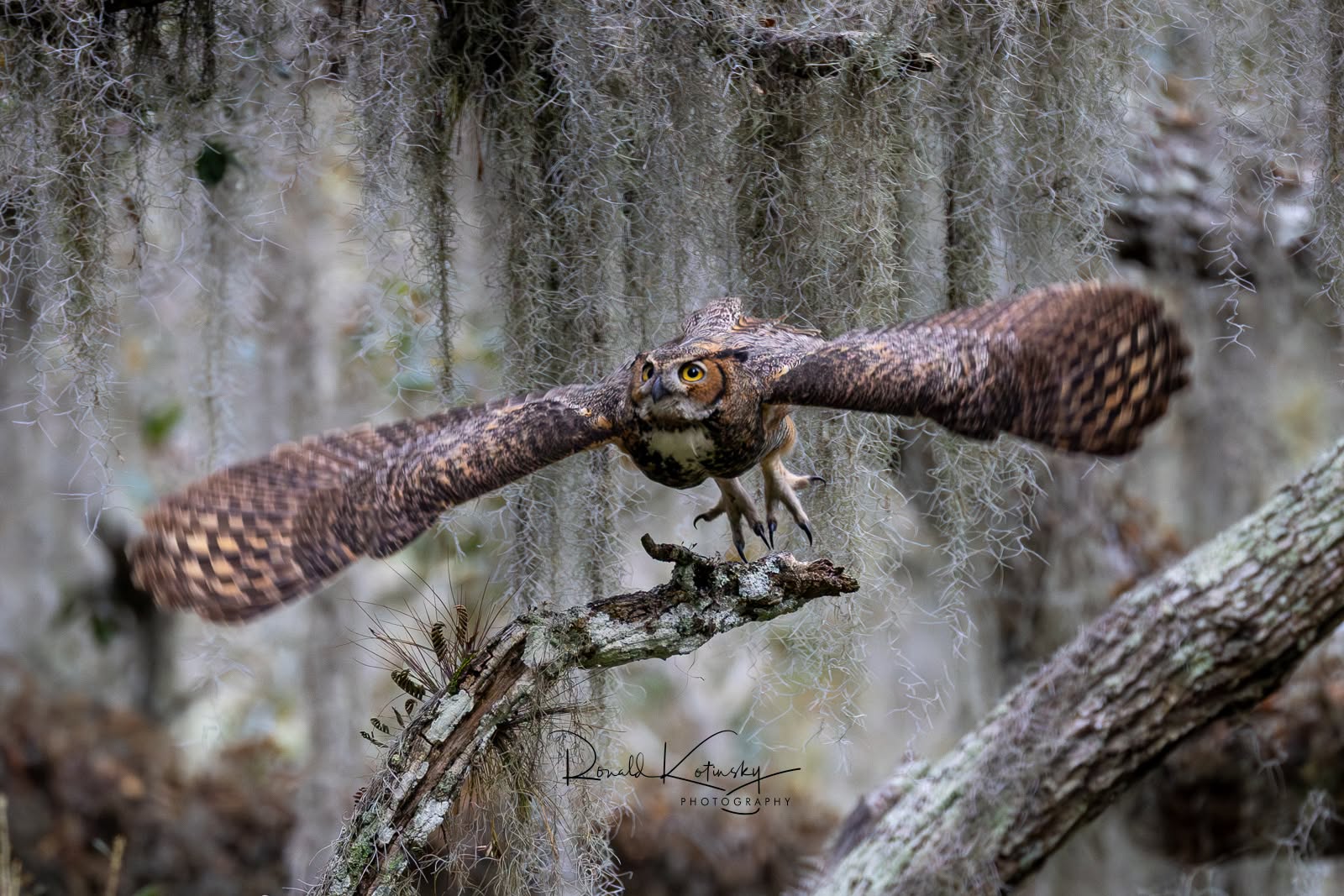
Capturing wildlife in its natural habitat requires incredible patience, skill, and an understanding of animal behavior. A striking photograph by Donald Kotinsky showing a Great Horned Owl spreading its wings as it takes off from a moss-draped branch perfectly showcases the power and beauty of forest raptors.
Known as adaptable nocturnal predators across North America, Great Horned Owls possess remarkable physical adaptations that make them formidable hunters in dense forest environments.
In this natural history and wildlife guide, we explore the silent flight mechanics, hunting strategies, and habitat characteristics of the Great Horned Owl.
Great Horned Owl Species & Flight Matrix
+-------------------------------------------------------------------+
|                  GREAT HORNED OWL SPECIES MATRIX                  |
|                                                                   |
|  [ WINGSPAN ]      • Broad, rounded wings designed for forest flight |
|  [ SPECIAL FEATURE]• Feather serrations for near-silent movement   |
|  [ HABITAT ]       • Woodlands, swamps, and moss-draped trees      |
+-------------------------------------------------------------------+
Key Highlights of Great Horned Owl Adaptations:
-
Near-Silent Flight: Specialized serrations on the primary wing feathers break up air turbulence, allowing the owl to glide silently toward prey.
-
Exceptional Night Vision: Large, fixed eyes surrounded by facial discs channel light and sound directly to the owl’s senses.
-
Powerful Talons: Strong feet equipped with sharp talons deliver the gripping force necessary to secure prey quickly in dense cover.
-
Camouflaged Plumage: Mottled brown and gray feathers blend seamlessly with tree bark and hanging Spanish moss.
How Great Horned Owls Execute Precision Takeoffs
Step 1: Scanning from High Perches
The owl perches on a tree limb or mossy branch, using keen eyesight and hearing to pinpoint subtle movements on the forest floor.
Step 2: Powerful Thrust and Launch
Pushing off strong branches, the owl extends its legs and opens its massive wingspan to generate immediate lift.
Step 3: Low-Sound Gliding Flight
Adjusting wing shape and angle during flight allows the owl to maneuver effortlessly around tree trunks and thick foliage.
Pro Tips for Documenting Nocturnal Wildlife Photography
-
Master Shutter Speed Control: Use high shutter speeds to freeze sudden flight actions while preserving fine feather detail.
-
Respect Natural Habitats: Maintain a safe, respectful distance to avoid disturbing nesting or hunting birds.
-
Focus on Natural Framing: Frame subjects against atmospheric background elements like Spanish moss or textured tree bark for stunning composition.
Conclusion
Great Horned Owls continue to captivate nature lovers and photographers alike with their stealth, strength, and quiet majesty. Moments like these remind us of the rich biodiversity thriving in our forest ecosystems!
Frequently Asked Questions (FAQ)
How do owls fly so silently compared to other birds?
Owls feature soft fringed edges on their wing feathers that break up airflow and eliminate noise, allowing quiet movement during flight.
Where are Great Horned Owls commonly found?
Great Horned Owls inhabit diverse environments across North and South America, including woodlands, swamps, agricultural areas, and suburban parks.
What is the average wingspan of a Great Horned Owl?
An adult Great Horned Owl typically boasts an impressive wingspan ranging between 3.3 to 4.8 feet (1 to 1.4 meters).
