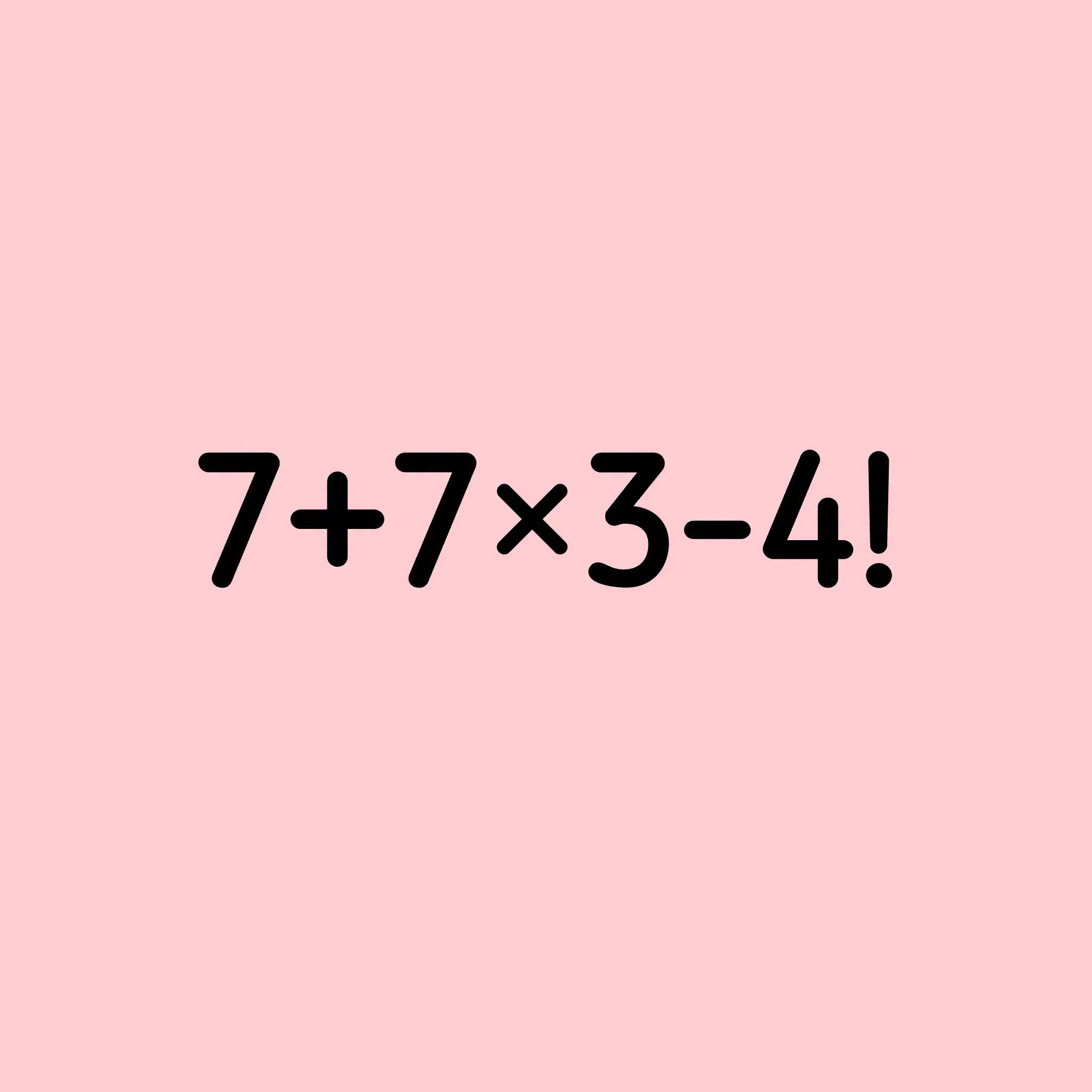
Math puzzles and arithmetic equations frequently go viral across social media platforms, sparking lively debates in comment sections worldwide. While elementary expressions appear deceptively simple at first glance, subtle misunderstandings regarding standard mathematical order of operations—such as evaluating exponents, factorials, and operator precedence—often lead viewers to wildly different conclusions.Why do basic arithmetic puzzles generate such high engagement online? In this comprehensive guide, we explore the step-by-step breakdown of order of operations, the evaluation of factorials, psychological reasons behind common mathematical errors, and practical ways to improve everyday mental math skills.Step-by-Step Mathematical Breakdown of the PuzzleTo solve the expression $7 + 7 \times 3 – 4!$ correctly, we must apply standard mathematical order of operations (PEMDAS/BODMAS), including the factorial operator.Order of Operations RulesUnder standard arithmetic conventions:P / B: Parentheses / Brackets first.E / O: Exponents, Orders, and Factorials (!).MD / DM: Multiplication and Division from left to right as they appear.AS: Addition and Subtraction from left to right as they appear.Step-by-Step SolutionLet’s evaluate $7 + 7 \times 3 – 4!$:Step 1 (Evaluate the factorial first): $4! = 4 \times 3 \times 2 \times 1 = 24$. The expression becomes $7 + 7 \times 3 – 24$.Step 2 (Multiplication next): $7 \times 3 = 21$. The expression becomes $7 + 21 – 24$.Step 3 (Addition and Subtraction from left to right):First, add: $7 + 21 = 28$.Then, subtract: $28 – 24 = 4$.Therefore, the mathematically correct final answer is 4.Why Math Puzzles Cause Social Media DebatesArithmetic brainteasers featuring factorials and mixed operators frequently divide commenters into camps due to common procedural oversights.Misinterpreting the Factorial SymbolThe exclamation point (!) in mathematics represents a factorial, not emphasis! Forgetting to calculate $4! = 24$ and treating it simply as the number 4 leads to incorrect calculations like $7 + 7 \times 3 – 4 = 7 + 21 – 4 = 24$.Ignoring Operator PrecedenceAnother common error is performing addition and subtraction before multiplication, or misjudging the order in which operations are executed. Strictly adhering to PEMDAS/BODMAS ensures mathematical consistency.Cognitive and Psychological Benefits of BrainteasersEngaging in regular mental arithmetic and logical puzzles offers significant long-term cognitive and neurological benefits.Enhancing Working Memory and FocusSolving math problems requires holding intermediate numbers in mind while applying logical rules sequentially. This exercise strengthens working memory, concentration, and executive function in the brain.Boosting Problem-Solving ConfidenceSuccessfully working through logic puzzles triggers dopamine release in the brain’s reward pathways, creating feelings of accomplishment and building overall confidence in analytical problem-solving skills.Practical Ways to Improve Your Mental Math SkillsIf you want to sharpen your speed and precision when tackling everyday calculations or logic brainteasers, consider these practical techniques:Master Advanced Operators: Refresh your understanding of exponents, roots, and factorials (!) so they never catch you off guard in online puzzles.Follow Order of Operations Strictly: Always evaluate brackets, exponents/factorials, multiplication/division, and addition/subtraction in their proper sequence.Practice Daily Logic Games: Spend 5 to 10 minutes daily solving Sudoku, number grid puzzles, or digital mental math challenges to keep your mind sharp.Double-Check Your Steps: Re-read expressions carefully to identify hidden symbols, negative signs, or operator priority before finalizing your answer.Teach Others: Explaining math rules to friends or children reinforces your own conceptual understanding and mastery.Fascinating Facts About Math and Logic HistoryOrigin of the Factorial Symbol: The exclamation mark symbol (!) for factorials was introduced by Christian Kramp in 1808 as a shorthand notation for products of descending integers.Standardizing PEMDAS: Modern order of operations conventions were formally standardized in the late 19th and early 20th centuries as textbook publishing expanded globally.The Power of Brain Games: Studies show that adults who regularly participate in number puzzles retain higher cognitive processing speeds as they age compared to those who do not.ConclusionMath puzzles serve as a fun, engaging way to challenge our analytical thinking and refresh foundational arithmetic skills. By remembering that factorials must be calculated first, followed by multiplication, and finally addition and subtraction from left to right, you can confidently solve expressions like $7 + 7 \times 3 – 4!$ and reach the correct answer of 4 every single time!Frequently Asked Questions (FAQ)1. What is the correct answer to $7 + 7 \times 3 – 4!$?The correct answer is 4. First, $4! = 24$, then $7 \times 3 = 21$, giving $7 + 21 – 24 = 4$.2. What does the exclamation mark (!) mean in math?In mathematics, an exclamation mark represents a factorial. For any positive integer $n$, $n!$ is the product of all positive integers less than or equal to $n$ (e.g., $4! = 4 \times 3 \times 2 \times 1 = 24$).3. Why is multiplication calculated before addition?Under standard order of operations (PEMDAS/BODMAS), multiplication and division take higher precedence than addition and subtraction.4. Why do people get different answers for this puzzle?Different answers usually result from ignoring the factorial symbol and treating $4!$ as the number 4, or performing addition out of sequence.
The Psychology of Math Puzzles: Order of Operations, Factorials, and Viral Logic Brainteasers