
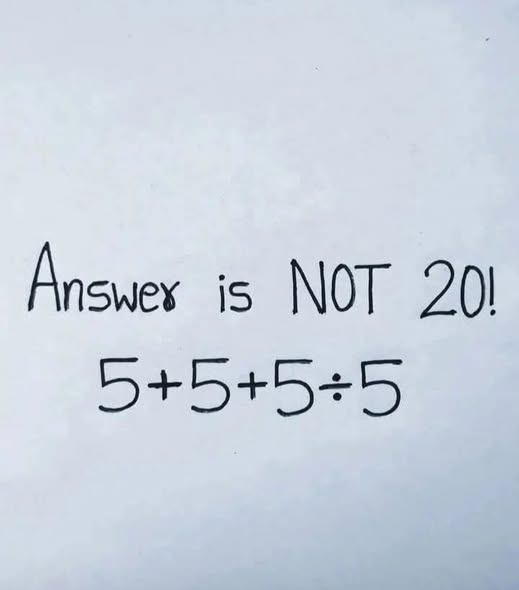
Math puzzles and brain teasers frequently go viral on social media platforms, sparking lively debates in comment sections. While these equations often look simple at first glance, they frequently trick readers who forget standard mathematical rules regarding order of operations.
A viral image circulating online presents a handwritten math puzzle reading: “Answer is NOT 20! $5 + 5 + 5 \div 5$.” This image challenges readers to solve the basic arithmetic expression correctly without falling into common order-of-operations traps.
In this guide, we will break down the step-by-step math evaluation, explain the order of operations (PEMDAS/BODMAS), look at why people get it wrong, and explore why brain teasers are so popular online.
Step-by-Step Mathematical Calculation
To evaluate the mathematical expression $5 + 5 + 5 \div 5$ correctly, we must independently apply the standard mathematical order of operations.
+——————————————————-+
| ORDER OF OPERATIONS (PEMDAS) |
+——————————————————-+
|
+——————–+——————–+
| |
v v
+———————–+ +———————–+
| STEP 1: DIVISION | | STEP 2: ADDITION |
+———————–+ +———————–+
| Evaluate: 5 ÷ 5 | | Evaluate: 5 + 5 + 1 |
| Result = 1 | | Result = 11 |
+———————–+ +———————–+
| |
+——————–+——————–+
|
v
+————————-+
| FINAL RESULT |
| Correct Answer = 11 |
+————————-+
1. Perform Division First
According to international mathematical conventions, multiplication and division take priority over addition and subtraction:
$$5 \div 5 = 1$$
2. Perform Addition Left-to-Right
Now substitute the division result back into the original expression:
$$5 + 5 + 1$$
Adding from left to right:
$$5 + 5 = 10$$
$$10 + 1 = 11$$
Therefore, the correct evaluation of the expression is 11.
Why Do Many People Incorrectly Get 3 or 20?
Math puzzles often yield incorrect answers when people calculate strictly from left to right or misread mathematical punctuation.
Calculated Answer Common Mistake Leading to This Answer Correct Math Rule Applied
3 Adding all three fives first $(5 + 5 + 5 = 15)$ then dividing by 5 $(15 \div 5 = 3)$. Violates PEMDAS: Division must occur before addition.
20 Misinterpreting the exclamation mark in “NOT 20!” as non-factorial text, or confusing basic operations. Text Misreading: The prompt explicitly states the answer is not 20.
11 (Correct) Evaluating $5 \div 5 = 1$ first, followed by adding $5 + 5 + 1 = 11$. Follows PEMDAS/BODMAS: Division precedes addition.
The PEMDAS / BODMAS Rules Explained
Standard order of operations ensures that mathematical expressions have a single, unambiguous correct answer worldwide.
P / B (Parentheses / Brackets): Solve terms inside grouping symbols first.
E / O (Exponents / Orders): Evaluate powers, roots, or indices next.
MD / DM (Multiplication & Division): Evaluate from left to right as they appear.
AS / AS (Addition & Subtraction): Evaluate from left to right as they appear.
Because there are no parentheses around $(5 + 5 + 5)$ in this problem, division must be performed before addition.
Supporting Cognitive Fitness, Education, and Financial Peace
Solving quick brain puzzles is a great way to keep your mind sharp. Pairing mental agility with organized personal planning ensures long-term clarity and security.
Prioritizing Educational and Health Resilience
Engaging in regular problem-solving and cognitive exercises helps maintain mental clarity as we age. Just as cognitive health requires active practice, routine medical checkups maintain physical health. Having reliable health insurance guarantees affordable access to routine checkups, wellness testing, and specialized healthcare when needed.
Protecting Household Security and Stability
Keeping your domestic environment well-organized eliminates stress, allowing you to focus on self-improvement and lifelong learning:
Financial Management: Managing mortgage obligations, tracking personal loans, reducing high-interest credit card debt, and maintaining savings provide long-term stability.
Home Insurance Protection: Securing comprehensive home insurance protects your property assets from unforeseen events.
Legal and Family Planning: Keeping estate documents, legal contracts, and family records current protects your legacy across generations.
Practical Tips for Solving Social Media Math Puzzles
Look for Parentheses: Always check if operations are grouped inside brackets.
Identify Division/Multiplication: Scan the equation left-to-right for high-priority operations before doing any adding or subtracting.
Watch Out for Punctuated Math: In online memes, exclamation points after numbers can indicate factorials (e.g., $3! = 3 \times 2 \times 1 = 6$), though here “NOT 20!” is simply enthusiastic English text confirming the answer is not 20.
Fascinating Historical Facts About Math Symbols
The Division Symbol ($\div$): Known as an obelus, the symbol $\div$ was first introduced for division by Swiss mathematician Johann Rahn in 1659.
Origins of PEMDAS: Formal order of operations rules developed in the late 19th and early 20th centuries as algebraic notation became standardized in textbook publishing.
Viral Math Trends: Simple order-of-operations problems are among the highest-engaging posts on social media because they exploit common errors in left-to-right reading habits!
Conclusion
Evaluating the expression $5 + 5 + 5 \div 5$ using standard mathematical rules yields 11. The claim made in the viral visual—that the answer is not 20—is fully supported by step-by-step arithmetic.
By balancing daily mental exercises with regular health checkups, reliable insurance coverage, and strong financial planning, you build a well-rounded and resilient life. Challenge your friends to solve this puzzle today!
Frequently Asked Questions (FAQ)
Q1: What is the correct answer to $5 + 5 + 5 \div 5$?
The correct answer is 11. Division is performed first ($5 \div 5 = 1$), followed by addition ($5 + 5 + 1 = 11$).
Q2: Why is the answer not 3?
To get 3, you would have to compute $(5 + 5 + 5) \div 5$. Without parentheses, division takes priority over addition.
Q3: What does PEMDAS stand for?
PEMDAS stands for Parentheses, Exponents, Multiplication, Division, Addition, Subtraction.
Q4: Is BODMAS the same as PEMDAS?
Yes! BODMAS (Brackets, Orders, Division, Multiplication, Addition, Subtraction) is simply the British/Commonwealth acronym for the exact same order of operations.
Q5: Why do math puzzles go viral on social media?
Math puzzles trigger active debate because many readers compute strictly from left to right, leading to contrasting answers in comment sections.
