
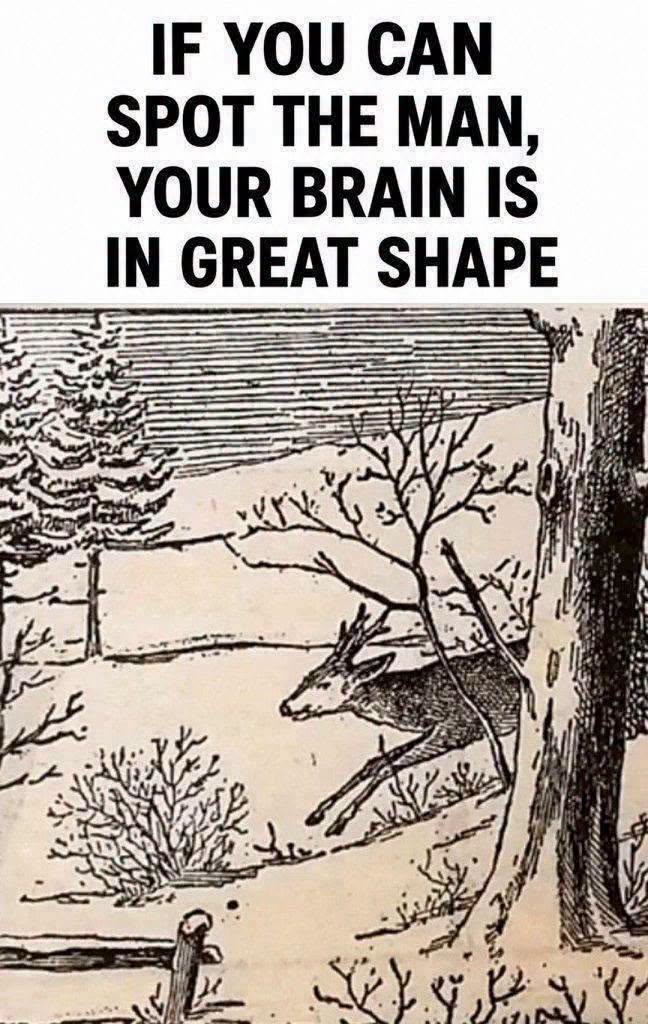
Optical illusions and visual puzzles have fascinated people for generations. Long before social media feeds made visual brain teasers viral overnight, vintage line drawings and hidden-picture puzzles were popular features in 19th-century newspapers, trade cards, and children’s magazines. One classic illustration featuring a running stag in a winter forest has recently resurfaced online, challenging viewers to locate a hidden hunter concealed within the landscape.
Accompanied by bold captions claiming that finding the man proves your brain is in peak shape, the post has sparked lively debates in comment sections. But how do these classic visual illusions actually trick our vision, and where is the hidden man hiding? Here is the solution to this viral brain teaser, along with the fascinating cognitive science behind why our eyes get fooled.
The Solution: Where Is the Hidden Man?
At first glance, the illustration appears to show a peaceful wilderness scene: a majestic deer leaping through a snow-covered field surrounded by pine trees, bare branches, and a large tree trunk on the right.
To find the hidden man, you have to look beyond the obvious subject matter and analyze negative space and line work:
-
Rotate the Image: The easiest way to spot the hidden figure is to turn the picture upside down or tilt your view sideways.
-
Inspect the Deer’s Silhouette: When inverted, the negative space formed by the deer’s body, legs, and surrounding tree branches forms the distinct profile of a man—specifically a hunter aiming a rifle or holding a bow.
-
Observe the Tree Trunk: The natural contours, bark textures, and intersecting branches outline the facial features, hat, and upper torso of the hidden hunter.
How Visual Illusions Work in the Brain
Why is it so difficult for our eyes to spot hidden figures immediately? The answer lies in how the human brain processes visual information.
1. Pareidolia and Pattern Recognition
Our visual cortex is hardwired to identify familiar patterns—especially animals and human faces—in complex environments. This phenomenon, known as pareidolia, allows us to see shapes in clouds, landscapes, or line art.
2. Figure-Ground Perception
Gestalt psychology explains that our brain naturally separates a primary object (the “figure”) from its surrounding background (the “ground”). In this illusion, because your brain instantly categorizes the running deer as the main figure, it ignores the background branches where the hunter’s profile is hidden.
Exercising critical thinking, cognitive problem-solving, and visual analysis plays a great role in everyday mental sharpness, educational enrichment, and lifelong wellness habits.
Benefits of Visual Puzzles for Brain Health
While social media claims that solving a puzzle proves high intelligence are exaggerated, regularly engaging in brain teasers offers real cognitive benefits:
-
Enhances Spatial Awareness: Searching for hidden figures challenges your brain to perceive shapes, angles, and negative space from multiple perspectives.
-
Improves Focus and Attention to Detail: Brain puzzles require sustained concentration, helping train your mind to filter out distractions.
-
Boosts Neuroplasticity: Challenging your visual perception stimulates neural connections, keeping your cognitive faculties active and agile.
Frequently Asked Questions (FAQ)
What is the history behind this vintage illustration?
This image originates from a classic late 19th-century “find the hunter” puzzle card, a popular genre of commercial illustration used in Victorian trade cards and promotional advertisements.
Do optical illusions actually measure IQ?
No. Successfully solving an optical illusion depends on visual perception, lighting, screen angle, and pattern recognition rather than overall intelligence or formal IQ metrics.
Conclusion: A Timeless Visual Challenge
Vintage optical illusions like the hidden hunter remind us of how easily our perception can be tricked by simple lines and shading. Whether you spotted the man instantly or needed to flip the picture upside down, taking a moment to engage with visual puzzles is a fun way to give your brain a quick workout. Share it with friends and family to see who can spot the hidden figure first!
