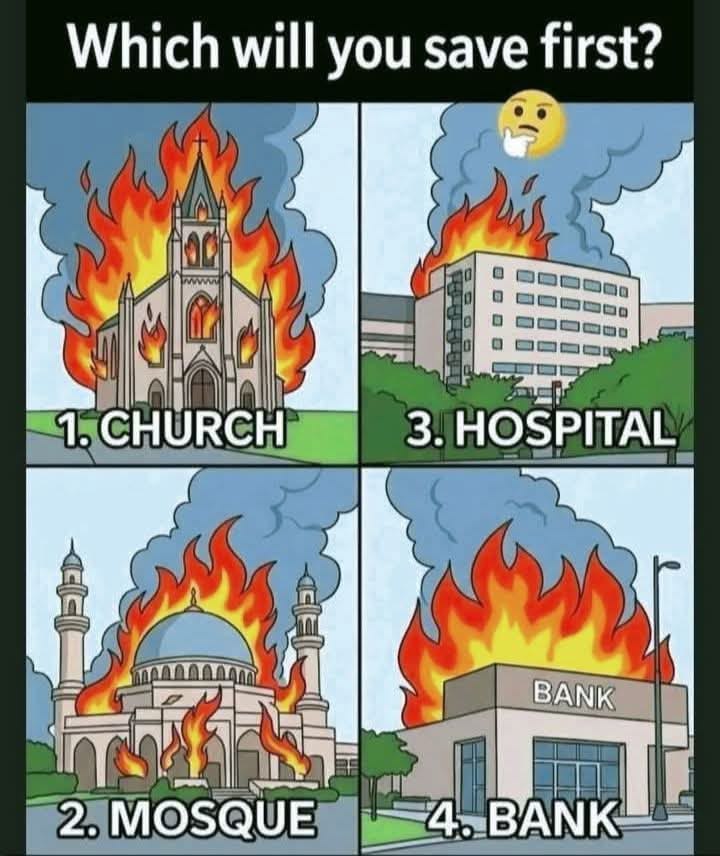
Hypothetical moral dilemmas and choice-based puzzles have become a dominant fixture across social media platforms. When presented with a difficult scenario—such as choosing which of four vital community buildings to save from a fire—users rush to comment, debate, and justify their personal choices. Why do these thought experiments generate intense engagement, viral reach, and passionate discussions online? The answer lies in behavioral psychology, moral philosophy, and our innate desire to express personal values. In this comprehensive guide, we explore the cognitive mechanics behind moral decision-making, the sociological impact of community infrastructure, the role of emergency management systems, and practical ways to foster constructive dialogue in digital spaces.Analyzing the Dilemma: Community Infrastructure and PrioritiesThe puzzle presents four distinct institutions, each representing a cornerstone of modern society: faith, health, and finance. Evaluating which to prioritize forces individuals to weigh ethical, utilitarian, and social values. 1. The Church: Spiritual and Cultural HeritagePlaces of worship serve as spiritual anchors, community gathering spaces, and centers of charitable outreach. For many, preserving a historic church means protecting cultural continuity, spiritual sanctuary, and shared community history.2. The Mosque: Community Sanctuary and FaithSimilarly, mosques are vital centers for communal prayer, spiritual guidance, education, and social support within neighborhoods. Protecting houses of worship reflects a deep commitment to religious freedom and community cohesion.3. The Hospital: Preserving Human Life and HealthFrom a strict utilitarian or life-preservation standpoint, hospitals house vulnerable patients, life-saving medical equipment, and emergency services. Saving a healthcare facility directly minimizes immediate loss of human life and physical injury.4. The Bank: Financial Stability and Economic SecurityBanks safeguard financial assets, manage credit systems, and support local business liquidity. While material wealth can often be insured or recovered, economic stability is essential for the smooth functioning of society.The Psychology of Choice: Utilitarianism vs. DeontologyWhen confronted with forced-choice dilemmas, human decision-making typically follows two primary philosophical frameworks:Utilitarianism (The Greatest Good for the Greatest Number)A utilitarian approach evaluates decisions based on outcomes. From this perspective, prioritizing a hospital is often justified because it directly protects the physical safety and lives of dozens or hundreds of vulnerable patients and medical staff.Deontology and Personal Values (Duty and Ethics)A deontological approach focuses on rules, moral duties, and fundamental rights. Individuals with strong religious or cultural convictions might prioritize saving a house of worship based on sacred duty, arguing that spiritual preservation transcends material or physical outcomes.Emergency Management and Real-World Crisis ResponseWhile online puzzles frame choices as sequential decisions, real-world emergency management operates under completely different protocols governed by professional crisis response teams.Emergency Services PrioritizationIn actual emergencies, professional firefighters and emergency medical services (EMS) do not rely on hypothetical ranking systems. Life safety is always the absolute first priority (saving trapped occupants), followed by incident stabilization and property conservation.Community Resilience and Disaster PreparednessModern cities invest heavily in fire prevention, building codes, sprinkler systems, and rapid-response infrastructure to ensure that communities do not have to choose between saving healthcare facilities, financial institutions, or cultural landmarks during a crisis.Practical Tips for Navigating Online Debates ConstructivelyViral dilemmas often touch on sensitive topics, including religion, finance, and ethics. Here are practical ways to engage in online comment sections positively:Respect Diverse Viewpoints: Recognize that different cultural, personal, and philosophical backgrounds shape how people prioritize choices.Focus on Constructive Dialogue: Use engaging discussions to explore interesting ethical perspectives rather than attacking opposing viewpoints.Promote Empathy: Understand that hypothetical choices reflect individual core values, empathy levels, and life experiences.Verify Information: Ensure that online discussions remain civil and grounded in respectful digital citizenship.Take Digital Breaks: Step away from intense social media comment threads when conversations become unproductive or emotionally draining.Fascinating Facts About Decision-Making and Social PsychologyThe Trolley Problem Origins: Modern moral dilemma puzzles trace their roots back to philosophical thought experiments like the famous “Trolley Problem,” introduced by philosopher Philippa Foot in 1967.Emotional vs. Rational Brain: Neuroimaging studies show that moral decision-making activates both the emotional centers of the brain (the amygdala) and the analytical reasoning centers (the prefrontal cortex).The Power of Framing: How a question is framed visually or textually significantly influences whether people make decisions based on emotional intuition or logical calculation.ConclusionMoral choice puzzles like the four-building fire dilemma are powerful tools that reveal the complexity of human values, ethics, and reasoning. Whether prioritizing human life, spiritual heritage, or economic stability, every perspective highlights what individuals cherish most in society. Engaging with these thought-provoking scenarios keeps our minds active, challenges our assumptions, and sparks fascinating conversations across the digital world. Frequently Asked Questions (FAQ)1. What is the correct answer to the four-building rescue puzzle?There is no single correct answer. The puzzle is designed as a moral dilemma to test personal values, philosophical outlooks, and prioritization frameworks. 2. Why do moral dilemmas generate so much engagement online?They tap into fundamental human emotions, ethics, and identity, prompting users to share their personal reasoning and debate differing viewpoints in the comments.3. How do real firefighters prioritize buildings in a fire?Real-world emergency responders prioritize saving human lives first and foremost, followed by stopping the spread of the fire and protecting property regardless of building type.4. What philosophical theories explain how people make these choices?The two main theories are Utilitarianism (focusing on the greatest good and saving the most lives) and Deontology (focusing on moral duties, ethics, and spiritual or institutional rights).
The Psychology of Moral Dilemmas: Why Social Choice Puzzles Spark Massive Online Debates