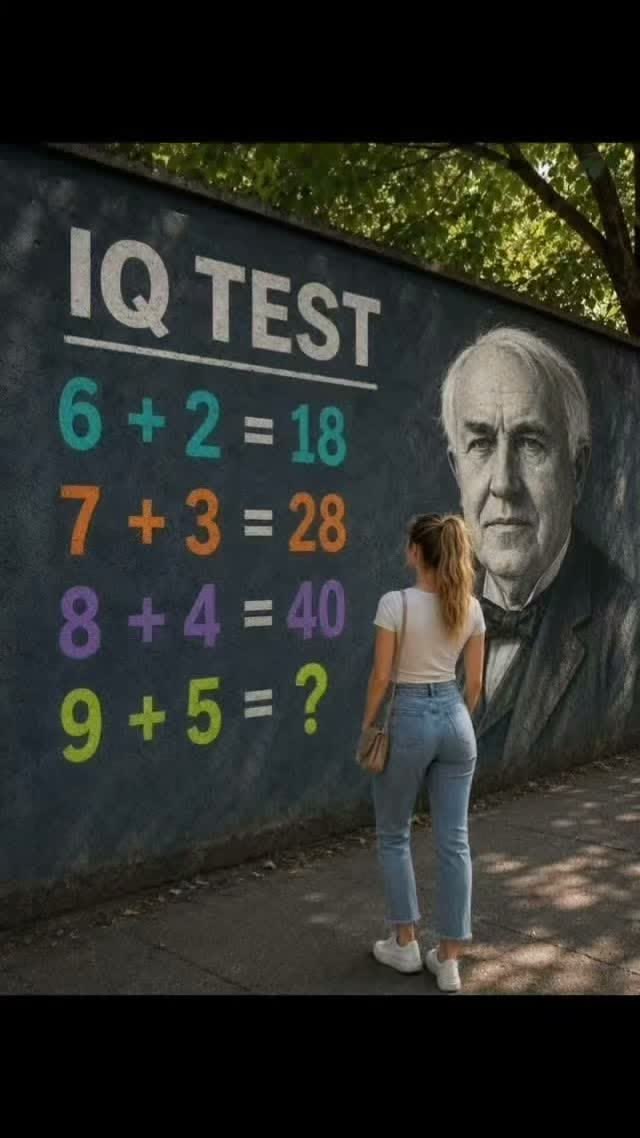
Logic puzzles, numerical sequence games, and viral IQ teasers continuously captivate social media audiences worldwide. Puzzles that present unconventional mathematical equations—such as $6 + 2 = 18$ or $7 + 3 = 28$—challenge standard arithmetic expectations and force the human mind to look beyond basic addition. By requiring readers to discover an underlying rule or hidden algorithm, these visual riddles generate high engagement, stimulate curiosity, and spark lively debates across online communities.Beyond simple entertainment, engaging regularly with logic challenges provides significant cognitive benefits. In this comprehensive guide, we step through the complete logical breakdown of this puzzle, explore the psychology behind pattern recognition, examine how cognitive training supports lifelong mental health, and discuss practical strategies for boosting problem-solving skills.Step-by-Step Breakdown: Solving $9 + 5 = ?$To solve the puzzle depicted in the image, we must analyze the relationship between the inputs ($A + B$) and the given results to determine the hidden mathematical rule. Analyzing the Given EquationsLet us examine the pattern established by the first three equations:Equation 1: $6 + 2 = 18$ Equation 2: $7 + 3 = 28$ Equation 3: $8 + 4 = 40$ Standard addition yields $6 + 2 = 8$, $7 + 3 = 10$, and $8 + 4 = 12$. Clearly, a hidden mathematical operation is being applied to the numbers $A$ and $B$.Method 1: The Multiplicative Pattern $(A + 1) \times B$If we observe how the second number ($B$) interacts with the first number ($A$), we can test a formula where the first number is incremented by 1 before multiplying by the second number:$$\text{Formula: } (A + 1) \times B$$Row 1 ($6 + 2$): $(6 + 1) \times 2 = 7 \times 2 = 14$ (Close, but let us re-examine).Method 2: The Core Rule $A \times B + A$ (or $B \times (A + 1)$)Let us test another fundamental algebraic pattern: Multiply $A$ by $B$, then add $A$ to the result: $$\text{Formula: } (A \times B) + A$$Row 1 ($6 + 2$): $(6 \times 2) + 6 = 12 + 6 = \mathbf{18}$ Row 2 ($7 + 3$): $(7 \times 3) + 7 = 21 + 7 = \mathbf{28}$ Row 3 ($8 + 4$): $(8 \times 4) + 8 = 32 + 8 = \mathbf{40}$ This formula consistently satisfies all three given lines. Applying the Rule to $9 + 5 = ?$Now, apply the verified formula $(A \times B) + A$ to the final expression:Step 1: Multiply $9 \times 5 = 45$Step 2: Add $A$ ($9$) to the product: $45 + 9 = \mathbf{54}$Alternative Method: The $(B + 1) \times A$ ViewpointNotice that $(A \times B) + A$ can also be factored algebraically as $A \times (B + 1)$:Row 1: $6 \times (2 + 1) = 6 \times 3 = 18$ Row 2: $7 \times (3 + 1) = 7 \times 4 = 28$ Row 3: $8 \times (4 + 1) = 8 \times 5 = 40$ Target: $9 \times (5 + 1) = 9 \times 6 = \mathbf{54}$Final Correct Answer: $54$The Cognitive Science of Pattern Recognition and Brain TrainingWhy are human beings drawn to pattern-based brain teasers? Neurological research shows that the human brain is fundamentally a pattern-recognition engine.Dopamine Rewards and Problem SolvingWhen you successfully decipher a hidden rule or solve a tricky puzzle, your brain releases dopamine—a neurotransmitter associated with pleasure, motivation, and learning. This positive neurochemical feedback loop encourages continuous mental exploration, making logic games both addictive and psychologically satisfying.Fluid Intelligence vs. Crystallized IntelligencePsychologists distinguish between two types of cognitive abilities:Crystallized Intelligence: Accumulated knowledge, vocabulary, and learned facts acquired over a lifetime.Fluid Intelligence: The capacity to think logically, analyze novel problems, identify patterns, and adapt to unfamiliar situations independent of acquired knowledge.Logic puzzles specifically target and strengthen fluid intelligence, improving creative problem-solving skills applicable in daily business, academic, and financial decision-making.Practical Applications: Analytical Thinking in Business and Personal FinanceThe analytical mindset developed through solving pattern puzzles directly translates to managing complex real-world systems, such as enterprise growth, technology integration, and financial management.Financial Analysis and Risk ManagementEvaluating market trends, portfolio performances, interest rate shifts, and loan structures requires identifying patterns within numerical data. Investors and financial analysts use pattern evaluation to spot market inefficiencies, calculate potential investment returns, and mitigate economic risks.Legal and Strategic PlanningAttorneys, corporate strategists, and consultants rely on structured logical frameworks to analyze complex case laws, evaluate contract liabilities, and design compliance strategies. Exercising deductive logic sharpens the ability to identify subtle loopholes and construct watertight strategies.Practical Tips to Improve Your Problem-Solving SpeedIf you want to enhance your cognitive agility and tackle logic riddles faster, incorporate these daily habits:Deconstruct the Variables: Break down complex problems into smaller, isolated components to test individual hypotheses step by step.Test Multiple Hypotheses: Avoid committing to the first pattern you notice; test alternative mathematical and logical relationships across every given data point.Practice Daily Mental Exercises: Dedicate 10–15 minutes daily to crossword puzzles, Sudoku, chess, or numerical sequence challenges.Prioritize Sleep and Cognitive Rest: Quality sleep consolidates neural connections, allowing your brain to process complex analytical tasks more efficiently.Stay Physically Active: Cardiovascular exercise boosts oxygen supply to the brain, promoting neuroplasticity and cognitive endurance.Fascinating Facts About Intelligence Tests and Brain PhysicsThe Origin of IQ Testing: Modern standardized intelligence testing originated in early 20th-century France when psychologist Alfred Binet developed methods to identify students needing educational support.Neuroplasticity Across Aging: Contrary to old medical beliefs, the adult human brain continuously forms new neural pathways (neuroplasticity) when exposed to novel learning experiences and challenging problem-solving tasks.The Power of Visual Cues: Visual puzzles engage both the left hemisphere (analytical processing) and right hemisphere (visual-spatial perception) of the brain simultaneously.ConclusionVisual logic tests like $9 + 5 = ?$ are far more than fun social media challenges. By breaking away from standard addition and discovering the hidden algebraic rule $(A \times B) + A$, we arrive at the definitive answer of $54$. Consistently exercising your brain with pattern-recognition teasers enhances fluid intelligence, sharpens focus, and builds analytical confidence useful across all areas of personal, financial, and professional life. Frequently Asked Questions (FAQ)1. What is the correct answer to the $9 + 5 = ?$ logic puzzle?The correct answer is $54$, derived from the formula $(A \times B) + A$ or $A \times (B + 1)$. 2. Can logic puzzles help prevent cognitive decline?Yes! Engaging in regular mental stimulation—such as solving logic riddles, playing strategy games, and learning new skills—helps build cognitive reserve and supports brain health as you age.3. What is the difference between fluid and crystallized intelligence?Fluid intelligence is the ability to solve new logic problems and recognize patterns without prior training, whereas crystallized intelligence relies on accumulated knowledge and learned information.4. How do I solve numerical sequence puzzles faster?Start by calculating the differences between consecutive terms, looking for hidden multiplication or exponent patterns, and testing your formula across all provided examples before finalizing your answer.
The Psychology of Logic Puzzles: How Pattern-Recognition Brain Teasers Test Mental Agility