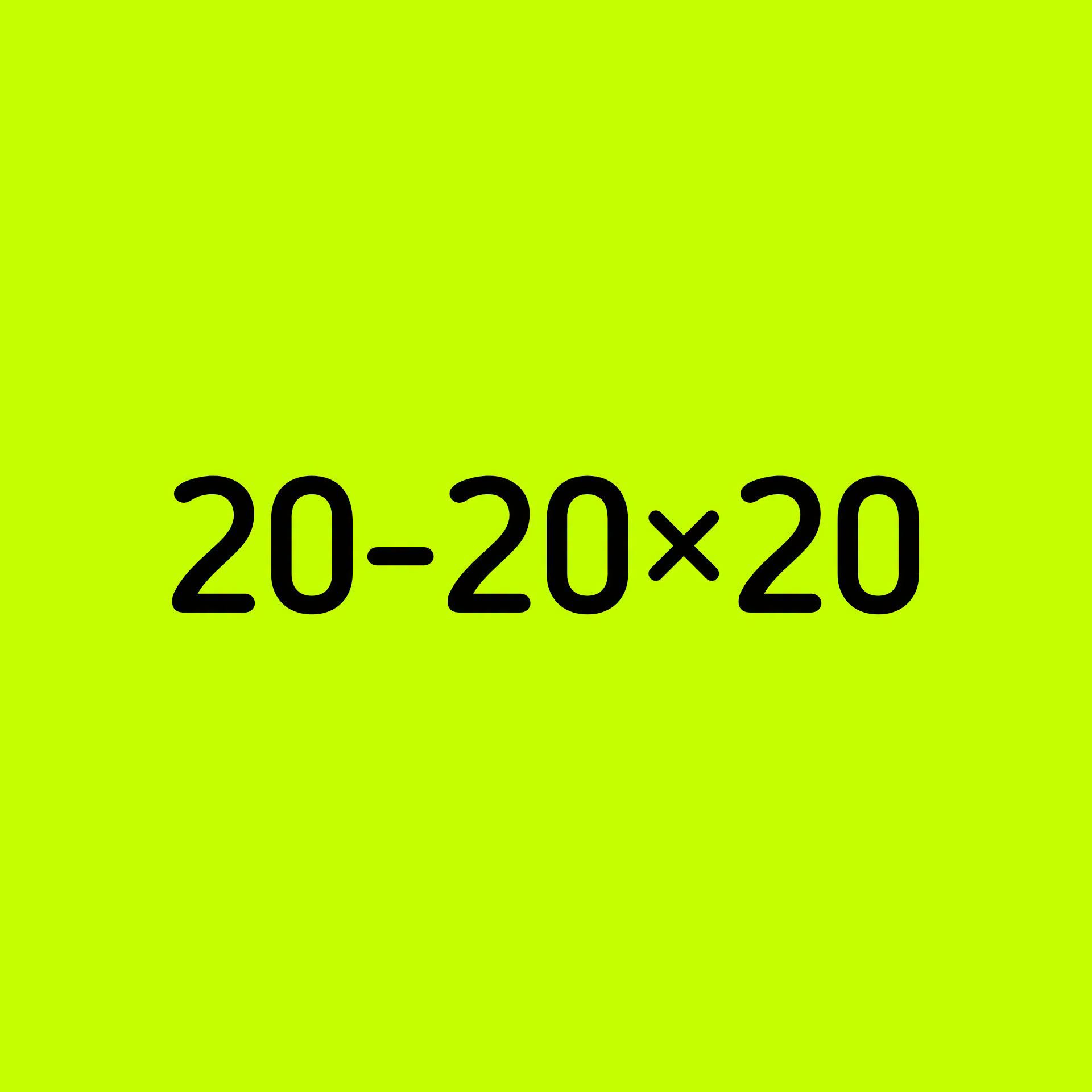
Viral math problems consistently blow up across social media platforms like Facebook, Twitter, and Reddit. Millions of users argue endlessly in comment sections over seemingly simple arithmetic questions that middle school students tackle daily. Why do basic equations—like $20 – 20 \times 20$—generate thousands of conflicting answers, passionate debates, and high levels of user engagement?The answer lies in cognitive science, fundamental mathematical rules, and the way our brains process numerical expressions. In this comprehensive guide, we step through the mathematical solution, examine the principles of the order of operations (PEMDAS/BODMAS), explore why human intuition often fails on basic calculations, and discuss how mental math sharpens long-term cognitive health.Step-by-Step Solution: $20 – 20 \times 20$To solve the equation shown in the image correctly, we must strictly apply the standard order of operations used globally in mathematics.Step 1: Identify the OperationsThe equation contains two distinct mathematical operations:Subtraction ($-$)Multiplication ($\times$)Step 2: Apply the Order of Operations (PEMDAS / BODMAS)Under international mathematical rules, multiplication and division take precedence over addition and subtraction. Therefore, we must perform the multiplication step before any subtraction:$$20 \times 20 = 400$$Step 3: Perform the Remaining SubtractionNow, substitute $400$ back into the original expression:$$20 – 400 = -380$$Final Correct Answer: $-380$Why Do So Many People Get 0? The Cognitive TrapA vast number of people who attempt this problem incorrectly arrive at an answer of 0. Understanding why this mistake occurs highlights fascinating aspects of human psychology and pattern recognition.Left-to-Right Reading BiasHuman beings who read text from left to right naturally tend to evaluate numerical equations in the exact same direction. When processing $20 – 20 \times 20$ sequentially from left to right without applying operational hierarchy, one performs:$20 – 20 = 0$$0 \times 20 = 0$While this left-to-right approach seems natural, it completely ignores the mathematical hierarchy established centuries ago to standardize mathematical language worldwide.Misinterpretation of Mnemonics (PEMDAS vs. BODMAS)In modern education systems, students are taught acronyms to remember operational order:PEMDAS: Parentheses, Exponents, Multiplication & Division (left to right), Addition & Subtraction (left to right).BODMAS: Brackets, Orders, Division & Multiplication (left to right), Addition & Subtraction (left to right).Many people mistakenly believe that multiplication always comes before division, or that operations are carried out strictly in the exact order of the letters in the acronym, leading to confusion when evaluating complex expressions.The Value of Mental Math in Personal Development and Lifelong LearningEngaging regularly with brain teasers, mathematical puzzles, and mental arithmetic provides significant cognitive benefits that extend far beyond classroom settings.Sharpening Cognitive Agility and FocusSolving numerical challenges stimulates the prefrontal cortex—the area of the brain responsible for problem-solving, working memory, and executive decision-making. Regular cognitive exercises help maintain mental flexibility, improve concentration, and build logical reasoning skills.Supporting Financial and Educational LiteracyMastering basic mathematical principles is foundational to overall financial literacy. Managing personal budgets, calculating interest rates on loans, evaluating investment yields, analyzing mortgage options, and estimating retirement growth all rely on a sound understanding of basic mathematics and quantitative analysis.Practical Tips to Never Make an Order of Operations Mistake AgainIf you want to quickly solve viral math problems accurately every time, keep these simple rules in mind:P/B (Parentheses / Brackets First): Always simplify expressions inside parentheses or brackets before doing anything else.E/O (Exponents / Orders Next): Evaluate powers, roots, or exponents second.MD / DM (Multiplication and Division Third): Perform multiplication and division from left to right in the order they appear.AS (Addition and Subtraction Last): Complete addition and subtraction from left to right as the final step.Use Parentheses for Clarity: When writing equations yourself, use parentheses—such as $20 – (20 \times 20)$—to eliminate ambiguity for readers.Fascinating Facts About Mathematics and Brain PhysicsThe Origin of PEMDAS: Operational hierarchy rules were formalized in the late 19th and early 20th centuries as algebraic notation became standardized in textbooks and scientific journals worldwide.Calculator Variance: Older or basic four-function calculators perform operations sequentially as entered, giving an answer of 0, whereas modern scientific calculators and computers automatically apply order of operations to yield -380.Universal Language: Mathematics is widely considered the only universal language on Earth, using standardized symbols and logical frameworks across all cultures and languages.ConclusionWhile $20 – 20 \times 20$ looks like a simple arithmetic trick, it serves as a great reminder of how mathematical conventions keep world calculations consistent and accurate. By performing multiplication before subtraction, we arrive at the definitive answer of $-380$. Embracing these quick mental workouts keeps our brains active, improves analytical skills, and prepares us for complex real-world decisions in finance, business, and everyday problem-solving.Frequently Asked Questions (FAQ)1. What is the correct order of operations?The standard order of operations follows PEMDAS/BODMAS: Parentheses/Brackets, Exponents/Orders, Multiplication & Division (left to right), and Addition & Subtraction (left to right).2. Why does a basic calculator give 0 instead of -380?Basic four-function calculators execute each operation immediately as buttons are pressed without storing previous terms. Scientific calculators, graphing tools, and search engines evaluate the full expression using proper operational hierarchy.3. Is the answer -380 or 0?The mathematically correct answer is $-380$. Arriving at 0 happens only when performing subtraction before multiplication, which violates international mathematical standards.4. How can I improve my mental math speed?Practice daily with math puzzles, use brain-training applications, learn mental arithmetic shortcuts, and break down complex multiplication problems into smaller, manageable additions.
The Psychology of Math Puzzles: Why Order of Operations Tricks Everyone Online