
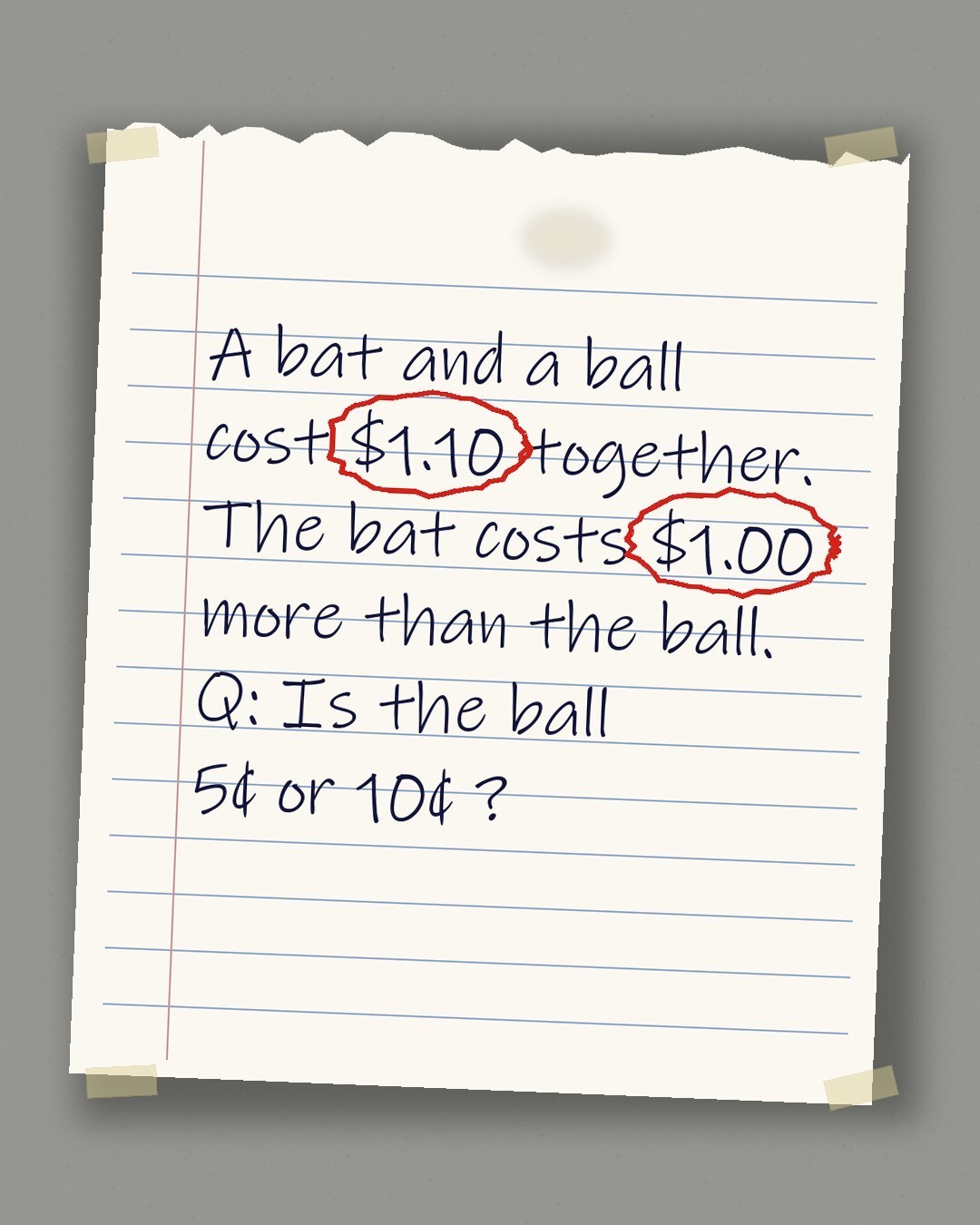
The Bat and Ball Math Puzzle: How Cognitive Bias Tricks Our Brains
Math riddles and psychological brainteasers have a fascinating way of spreading virally across social media. Among the most famous cognitive reflection tests ever created is the classic “Bat and Ball” problem. On the surface, the problem looks like a simple elementary-level math equation that anyone can solve in a split second. Yet, studies show that over 50% of Ivy League students and the majority of adults blurt out the wrong answer when first confronted with this prompt.
Why does such a simple math problem trick so many intelligent people? The answer lies not in our mathematical ability, but in how our brains process information using intuitive heuristics versus slow, deliberate logic.
The Math Breakdown: Solving the Problem Step-by-Step
To see why the intuitive answer fails, we can translate the word problem into a simple algebraic equation.
Defining the Variables
Let $x$ represent the cost of the ball in dollars.
Since the bat costs $1.00 more than the ball, the cost of the bat is represented as $(x + 1.00)$.
Setting Up the Equation
The problem states that the combined cost of the bat and the ball equals $1.10:
$$\text{Bat} + \text{Ball} = \$1.10$$
$$(x + 1.00) + x = 1.10$$
Solving for $x$
Combining like terms gives:
$$2x + 1.00 = 1.10$$
$$2x = 0.10$$
$$x = 0.05$$
Thus, the ball costs 5 cents ($0.05), and the bat costs $1.05 ($0.05 + $1.00). Together, $1.05 + $0.05 equals $1.10, satisfying all conditions perfectly.
+---------------------------+-----------------------------------+-----------------------------------+
| Solution Attempt          | Ball Cost vs. Bat Cost Calculation| Total Combined Result             |
+---------------------------+-----------------------------------+-----------------------------------+
| Intuitive Trap Answer     | Ball: 10¢ | Bat: $1.00            | $1.10 Total (Bat is ONLY 90¢ more)|
| Mathematically Correct    | Ball: 5¢  | Bat: $1.05            | $1.10 Total (Bat is $1.00 more)   |
+---------------------------+-----------------------------------+-----------------------------------+
Dual-Process Theory: Why the Brain Falls into the Trap
In behavioral economics and cognitive psychology, Nobel laureate Daniel Kahneman introduced the framework of System 1 and System 2 thinking to explain how human decisions are made.
- System 1 (Fast & Intuitive): Operates automatically, quickly, and with little to no effort. When reading “$1.10 total” and “$1.00 more,” System 1 instantly subtracts $1.00 from $1.10 to yield 10 cents. It prioritizes speed over precision.
- System 2 (Slow & Analytical): Allocates attention to effortful mental operations, including complex computations. To solve the riddle correctly, System 2 must suppress the knee-jerk “10 cents” response generated by System 1 and double-check the math.
Fascinating Facts About Cognitive Reflection Tests
- The Cognitive Reflection Test (CRT): Formulated by professor Shane Frederick in 2005, the Bat and Ball problem is the flagship question of a 3-item test designed to measure a person’s tendency to suppress an incorrect intuitive response.
- Ivy League Statistics: When tested at top universities including Harvard, Princeton, and MIT, over half of the student participants gave the wrong intuitive answer of 10 cents!
- Impulsivity vs. Intelligence: Giving the wrong answer doesn’t mean a person lacks math skills; rather, it indicates high cognitive impulsivity—relying on intuition before analytical verification kicks in.
Conclusion
The Bat and Ball riddle remains a brilliant demonstration of human psychology and cognitive bias. It serves as a lighthearted reminder that our first impression or quick intuition isn’t always accurate. Taking a pause, overriding quick assumptions, and double-checking facts before reaching a conclusion is a valuable skill both in math puzzles and in everyday decision-making.
Frequently Asked Questions (FAQ)
What is the correct answer to the Bat and Ball riddle?
The correct answer is 5 cents (5¢). The ball costs 5 cents and the bat costs $1.05, making the total $1.10 while ensuring the bat costs exactly $1.00 more than the ball.
Why is 10 cents the wrong answer?
If the ball cost 10 cents, a bat costing $1.00 more would cost $1.10. Added together ($1.10 + $0.10), the total cost would be $1.20, which violates the $1.10 total given in the problem!
Who invented the Bat and Ball problem?
The problem was popularized by Shane Frederick in 2005 as part of the Cognitive Reflection Test (CRT), published in the Journal of Economic Perspectives.
