
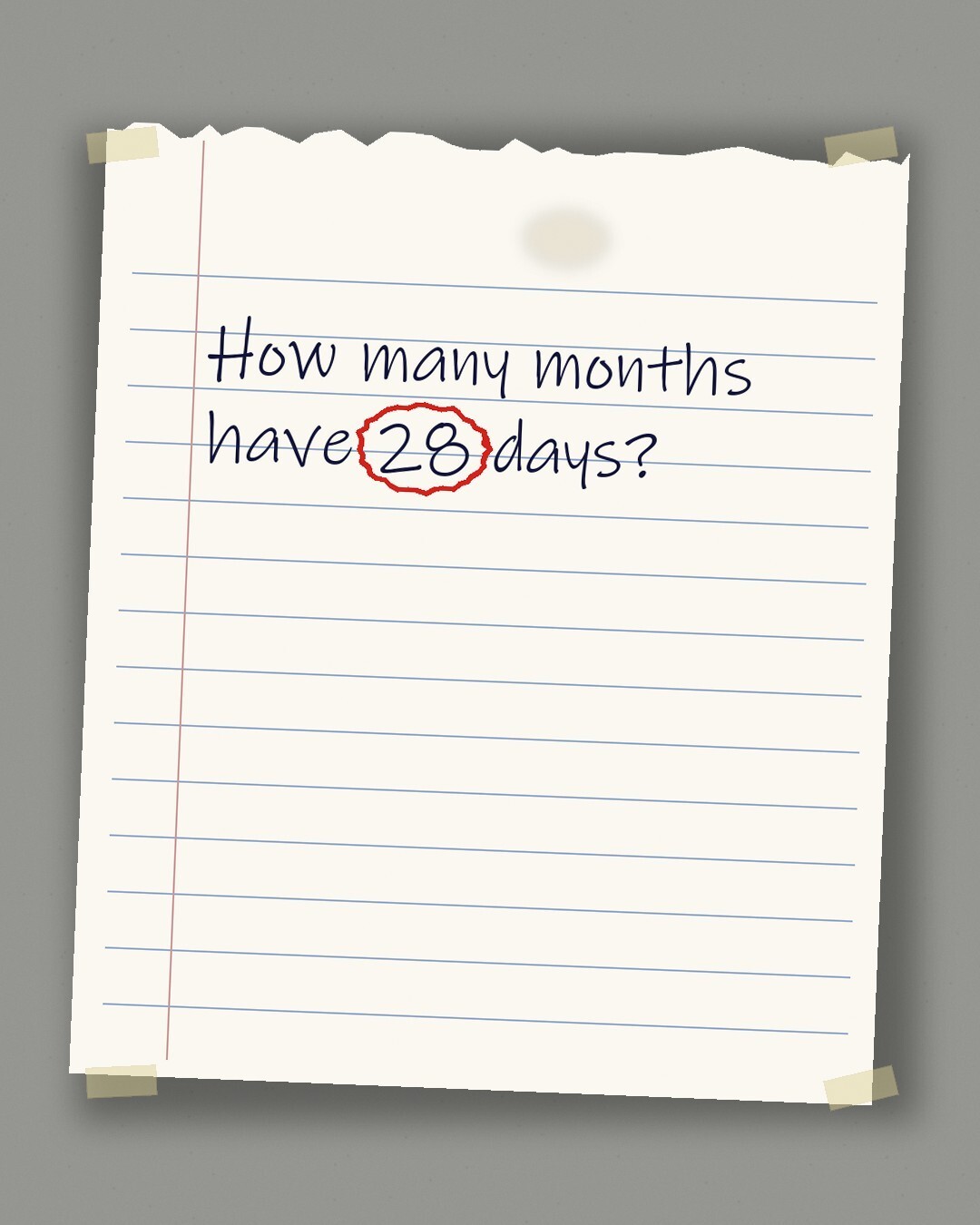
Word puzzles, trick riddles, and lateral thinking teasers have been a staple of popular culture and social media engagement for years. Among the most enduring classics is the deceptively simple question: “How many months have 28 days?” While most people’s immediate impulse is to answer “one”—referring to February—the true solution relies on stepping back from literal assumptions and re-evaluating the semantics of the sentence.
Beyond serving as a quick, fun brainteaser, lateral thinking riddles offer intriguing insights into cognitive psychology, linguistic framing, and how our brains process visual and textual information under pressure.
Deconstructing the Riddle: The Power of Semantic Framing
To understand why this classic riddle stumps so many people on first glance, it helps to examine how human cognition interprets word phrasing.
The Immediate Brain Trap: Category Association
When presented with the number “28” alongside the word “months,” the human brain instantly searches its mental database for a direct calendar match. Because February is uniquely famous for having 28 days (or 29 in a leap year), the mind quickly anchors onto February and overlooks the broader phrasing of the prompt.
The True Solution: Cumulative Days
The riddle does not ask which month has only 28 days; it asks how many months have 28 days. Every single month in the Gregorian calendar—January through December—contains at least 28 days before continuing on to 29, 30, or 31. Therefore, the mathematically and semantically accurate answer to the puzzle is all 12 months.
+---------------------------+-----------------------------------+-----------------------------------+
| Interpretation Type       | Cognitive Assumption              | Resulting Answer                  |
+---------------------------+-----------------------------------+-----------------------------------+
| Literal / Exclusive       | Looks for month with ONLY 28 days | "1" (February)                    |
| Inclusive / Semantic      | Counts months containing 28 days  | "12" (All Months)                 |
+---------------------------+-----------------------------------+-----------------------------------+
Why Lateral Thinking Puzzles Boost Cognitive Agility
Lateral thinking—a term coined by psychologist Edward de Bono in 1967—refers to solving problems through an indirect and creative approach rather than standard step-by-step logic.
- Breaking Mental Rigidity: Classic riddles force us to challenge assumed constraints and read statements with critical attention to exact word choice.
- Encouraging Mindful Pause: Pausing before reacting helps improve impulse control and logical reasoning in daily decision-making.
- Driving Social Engagement: Because trick questions create friendly debates over interpretation, they remain among the most viral and shared content categories online.
Fascinating Calendar Facts About Months and Days
- The Leap Year Anomaly: February only has 28 days during standard years. Every four years (during a leap year), an extra intercalary day is added to align our calendar with Earth’s astronomical orbit around the Sun, giving February 29 days.
- The Origin of the 12-Month Calendar: The modern Gregorian calendar evolved from the ancient Roman calendar, which originally consisted of only 10 months starting in March before January and February were added later.
- Knuckle Calendar Trick: A classic physical mnemonic for remembering which months have 31 days involves counting months across the knuckles and gaps of your fist!
Conclusion
The “28 days” riddle is a timeless example of how language and cognitive assumptions shape our understanding of everyday concepts. By challenging our minds to look past immediate instincts, simple word puzzles keep our critical thinking sharp, entertaining, and always ready for the next challenge.
Frequently Asked Questions (FAQ)
What is the correct answer to “How many months have 28 days?”
The correct answer is all 12 months. Every month on the calendar contains at least 28 days!
Why do most people answer “February” first?
People usually answer February because it is the only month that ends at 28 days (during non-leap years), leading the brain to associate “28 days” exclusively with February.
What is lateral thinking?
Lateral thinking is a problem-solving strategy that involves looking at a situation from new, unexpected angles rather than relying on traditional step-by-step logic.
