
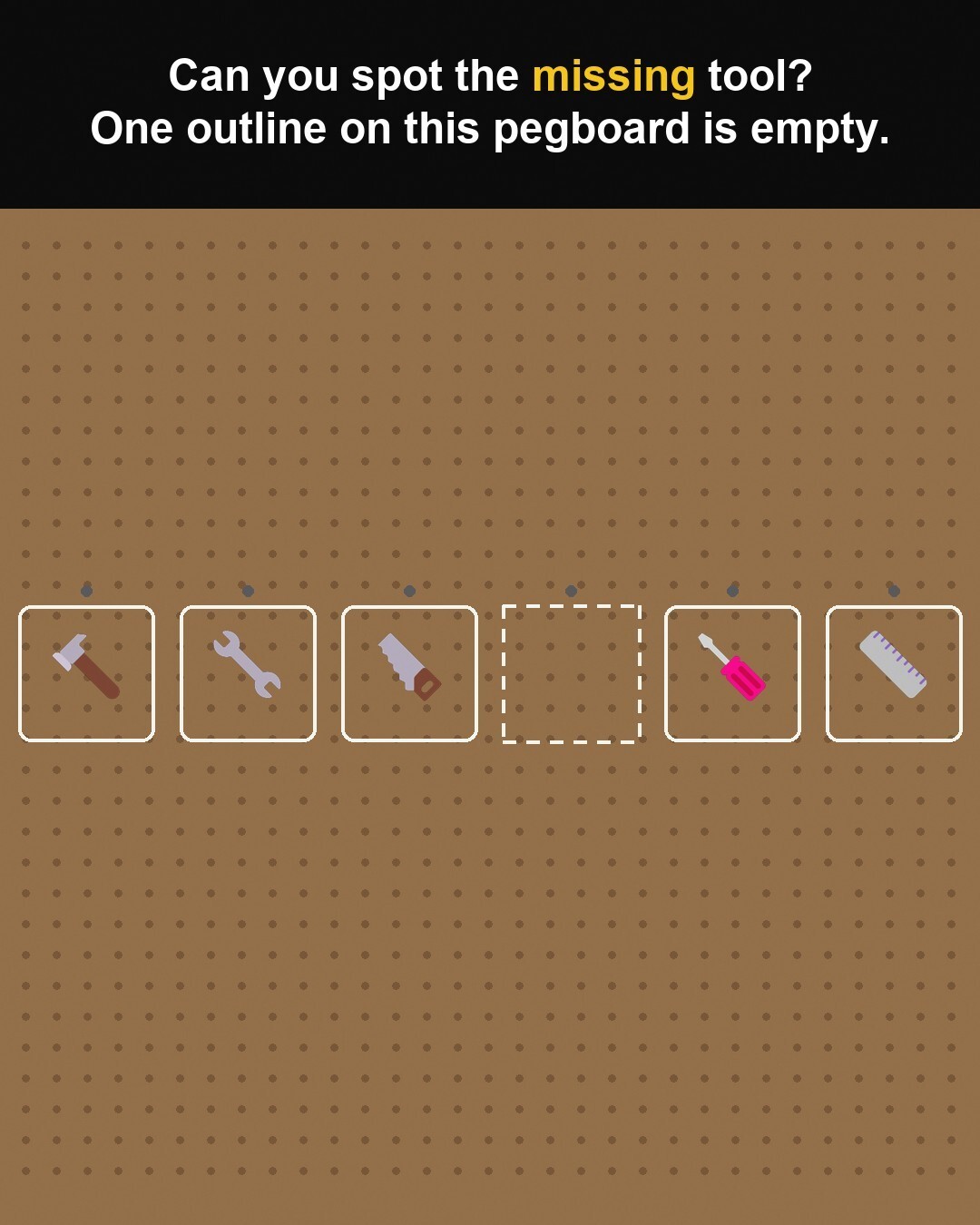
Visual discrimination puzzles, brainteasers, and “find the missing object” challenges have exploded in popularity across social media platforms, online gaming communities, and cognitive training applications. Featuring clean graphical layouts—such as a pegboard filled with common workshop tools—these visual games engage our perception, pattern recognition, and working memory. While they seem like simple, quick entertainment, visual puzzles actually test fundamental aspects of human cognitive processing and visual spatial reasoning.
Understanding how our eyes scan complex images, how the brain recognizes missing elements, and how visual organization tools like pegboards work in real life offers a fascinating look into human perception and home organization.
Visual Processing: How the Brain Identifies Missing Patterns
When you look at a row of items with one empty space, your brain automatically performs several micro-cognitive operations in milliseconds to solve the puzzle.
Object Recognition and Feature Analysis
The human visual cortex immediately analyzes shapes, colors, and angles. When looking at a pegboard filled with common tools—such as a claw hammer, an open-ended wrench, a hand saw, a screwdriver, and a ruler—your brain creates a visual inventory. When it hits an empty dashed box, it attempts to predict what missing shape or tool category naturally fits into the sequence.
Pattern Completion and Spatial Awareness
Our minds naturally seek order and symmetry, a concept known in psychology as Gestalt principles. When a sequential array of tools is disrupted by a blank dashed outline, the brain experiences a brief cognitive friction, driving the urge to “fill in the blank” and restore visual balance to the board.
+—————————+———————————–+———————————–+
| Puzzle Element | Cognitive Function Engaged | Practical Benefit |
+—————————+———————————–+———————————–+
| Identifying Tool Shapes | Visual Object Discrimination | Sharpens detail-oriented focus |
| Spotting Empty Outlines | Spatial Pattern Recognition | Enhances problem-solving speed |
| Tool Sequence Matching | Working Memory & Categorization | Boosts visual processing agility |
+—————————+———————————–+———————————–+
The Art of the Pegboard: Shadow Outlines in Real-World Workshops
The concept of drawing outlines around tools on a pegboard isn’t just a clever puzzle design; it is a real-world organizational system used in workshops, manufacturing plants, and home garages worldwide.
The 5S Organizational Methodology
In industrial lean management, drawing visual outlines (often called “shadow boards”) around tools stems from the Japanese 5S methodology (Sort, Set in Order, Shine, Standardize, Sustain). By painting or taping tool silhouettes directly onto a pegboard:
Instant Inventory Checks: Anyone can spot a missing tool in less than a second simply by looking for an exposed silhouette.
Effortless Tool Returns: Every hammer, pair of pliers, or screwdriver has an exact, non-negotiable home, preventing clutter and lost equipment.
Streamlined Workflow: Mechanics and craftsmen waste zero time searching through cluttered drawers, keeping focus entirely on the task at hand.
Benefits of Solving Daily Visual Puzzles and Brainteasers
Engaging with visual brainteasers daily offers several cognitive and mental health benefits for adults and children alike.
Enhanced Attention to Detail: Regularly solving spot-the-difference or missing-item puzzles trains your eyes to observe fine details rather than skimming past visual information.
Stress Reduction and Mindful Focus: Short brain games provide a fast mental break from daily stressors, anchoring your full attention in a simple, satisfying task.
Boosting Cognitive Agility: Challenging your spatial reasoning keeps mental pathways active, supporting healthy cognitive longevity across all ages.
Workshop Essentials: The Most Common Pegboard Tools
In traditional workshop setups, pegboards typically display a core set of multi-purpose hand tools designed for everyday repairs, woodworking, and home maintenance.
Claw Hammer: Used for driving nails into wood or pulling stubborn fasteners during construction or demolition.
Adjustable or Combination Wrench: Essential for gripping, tightening, and loosening nuts, bolts, and mechanical fasteners.
Hand Saw: Designed for precise manual cutting of wooden boards, trim, or PVC piping.
Pliers (Slip-joint or Needle-nose): Ideal for holding small hardware firmly, bending wires, or gripping smooth metal objects.
Screwdriver (Flathead or Phillips): Crucial for driving screws into wood, plastic, or metal assemblies.
Standard Ruler or Measuring Tape: The fundamental precision tool for accurate layout work, drafting, and measuring materials.
Fascinating Facts About Puzzles and Workshop History
Invented in the 1950s: The modern pegboard system (often made of perforated hardboard) gained massive popularity during the post-WWII American suburban home building boom, becoming the ultimate DIY garage accessory.
The Gestalt Effect: Psychologists in the early 20th century proved that the human brain automatically perceives whole shapes before individual parts, which is why your eyes instantly identify an empty box as a “missing piece” rather than just isolated lines.
Viral Puzzle Engagement: Simple image-based puzzles generate higher audience interaction on social media than complex text posts because they trigger an immediate, natural desire to solve and share results.
Conclusion
Whether you are organizing your workshop using a shadow-board system or testing your mental quickness on a visual brainteaser, identifying the missing piece taps into our fundamental desire for order and logic. Puzzles featuring workshop tools combine nostalgic DIY themes with satisfying visual logic, offering a fun and quick mental workout for your brain.
Frequently Asked Questions (FAQ)
What tool is missing in the empty box on the pegboard?
In traditional tool line-ups featuring a hammer, wrench, saw, screwdriver, and ruler, the most common classic workshop tool missing from the set is a pair of pliers (or a utility knife/level)!
What is a tool shadow board?
A tool shadow board is an organizational system where the exact outline or silhouette of a tool is painted or taped onto a pegboard. If a tool is in use or missing, its exposed outline immediately signals what needs to be returned.
How do visual puzzles improve visual spatial skills?
Visual puzzles force your visual cortex to analyze geometric shapes, spatial relationships, and visual patterns, strengthening the neural connections responsible for spatial orientation and memory recall.
Why are pegboards so popular in workshop organization?
Pegboards offer modular, customizable, and vertical storage solutions that keep tools off work surfaces, prevent clutter, and allow users to rearrange hooks easily as their tool collection grows.
