
Riddles, brain teasers, and logic puzzles have captivated human minds for generations. Whether shared around a campfire, printed in puzzle books, or scrolling across social media feeds, a well-crafted riddle challenges our standard way of thinking. Instead of relying on straightforward calculations, trick questions often test our attention to detail, reading comprehension, and ability to look past obvious numbers.
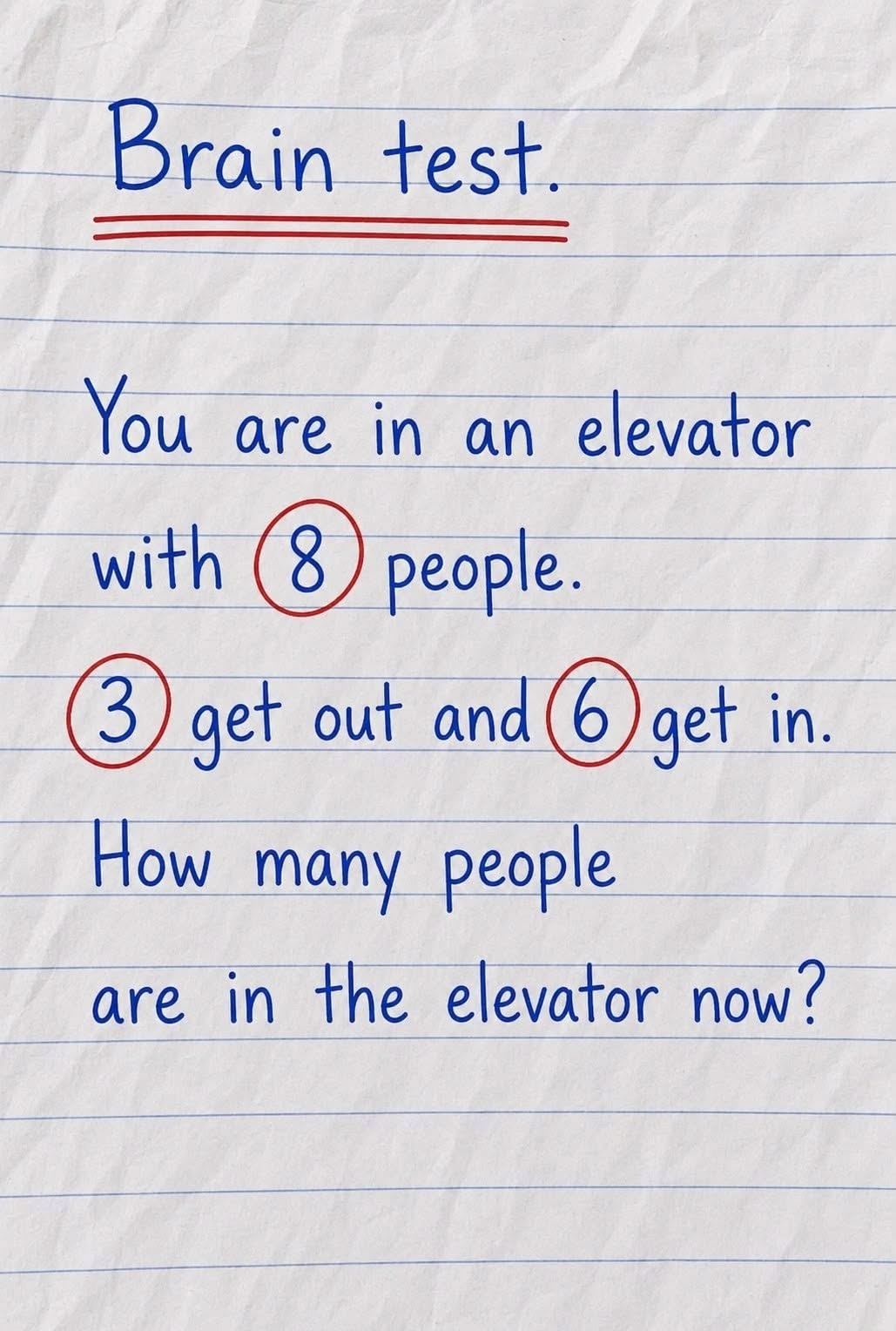
Consider a classic brain test presented on lined paper: “You are in an elevator with 8 people. 3 get out and 6 get in. How many people are in the elevator now?” At first glance, our brains naturally jump into automatic math mode, grabbing the numbers 8, 3, and 6 to crunch the arithmetic. However, taking a closer look at the wording reveals a hidden catch that trips up most people on the internet. Let us explore the psychology of logic puzzles, how our brains process trick questions, and the correct way to solve this viral brain teaser.
The Psychology of Automatic Math vs. Critical Reading
When confronted with numbers in a sentence, human cognitive processing tends to default to mathematical equations rather than deep semantic analysis.
1. The Trap of Arithmetic Conditioning
From early childhood education onward, our brains are trained to solve word problems by identifying numerical values and applying basic addition and subtraction. When people see “8 people,” “3 get out,” and “6 get in,” they immediately perform the calculation: $8 – 3 + 6 = 11$. This reflexive reaction bypasses the most important word in the entire prompt.
2. The Power of Perspective and Semantics
The riddle begins with a crucial phrase: “You are in an elevator…” Most readers overlook the word “You” when tallying up the occupants. If you are inside the elevator, you must be counted in the initial total alongside the other 8 people. Alternatively, if the prompt implies 8 other people plus yourself, or if you evaluate the exact headcount shift carefully, analyzing every word changes the outcome.
Step-by-Step Breakdown of the Elevator Riddle
Let us break down the sequence of events step by step to see how the numbers unfold:
-
Initial Count: You step into an elevator already containing 8 people (or you plus 8 others), making a total of 9 occupants inside the cabin.
-
The Subtraction: At the next floor, 3 people get out of the elevator ($9 – 3 = 6$).
-
The Addition: Afterward, 6 new people step into the elevator ($6 + 6 = 12$).
-
The Alternative Perspective: If the phrase “with 8 people” means you and 7 others, or if you exclude yourself from the initial count, the math shifts differently—which is precisely why this puzzle sparks endless friendly debate in comment sections.
Digital Engagement and Viral Puzzle Psychology
Puzzles like this elevator brain test are purposefully designed to drive viral engagement across social media platforms like Facebook.
Why Logic Puzzles Go Viral
When a trick question has an ambiguous phrasing or a hidden trap, readers quickly rush to the comment section to post their answers. Because many people fall for the initial math trap ($8 – 3 + 6$), others eagerly step in to correct them, creating a cascade of replies, reactions, and debates. This high volume of interaction pushes the post higher in algorithmic feeds.
Building Interactive Content for Digital Publishers
For content creators and digital publishers, incorporating interactive quizzes, riddles, and visual tests is an effective strategy to boost user retention, average reading time, and page views. To maintain a thriving digital publishing business, creators must also balance audience engagement with sound financial management, strategic content investment, and adherence to digital copyright and media regulations, often consulting with an attorney or specialized legal services provider.
Practical Tips for Sharpening Your Logic and Problem-Solving Skills
Engaging with brain teasers and lateral thinking puzzles offers a fun mental workout that enhances cognitive flexibility:
-
Read Every Word Carefully: Never skim sentences that contain numbers; pay close attention to pronouns like “you,” “exclusive,” or “total.”
-
Look for Hidden Assumptions: Challenge your first instinct and ask yourself if the question is testing math or testing your attention to detail.
-
Discuss Puzzles with Others: Comparing solutions with friends and family exposes you to different perspectives and improves your critical reasoning skills.
Fascinating Facts About Brain Teasers and Logic Riddles
-
Ancient Origins: Written riddles date back thousands of years, appearing in ancient Mesopotamian cuneiform tablets, Egyptian papyri, and classical Greek literature.
-
The Sphinx Riddle: One of history’s most famous mythological riddles—presented by the Sphinx to Oedipus—focused on a life stage creature walking on four legs in the morning, two at noon, and three in the evening.
-
Cognitive Flexibility: Solving lateral thinking puzzles helps stimulate neural pathways associated with creative problem-solving and mental agility.
-
The Internet Phenomenon: Simple text-based and handwritten riddles frequently outperform complex infographics on social media because they invite immediate, personal participation from every reader.
Conclusion
The elevator brain test is a classic reminder that things are not always as simple as they appear at first glance. By tricking our brains into focusing on basic arithmetic rather than semantic details, the riddle demonstrates the power of careful reading and critical thinking. The next time a viral puzzle crosses your screen, take a moment to look closer before jumping to conclusions!
Frequently Asked Questions (FAQ)
How many people are in the elevator according to the strict math?
If you start with 8 people, subtract 3, and add 6, the basic arithmetic equals 11—though accounting for “you” in the cabin changes the total headcount.
Why do people get this riddle wrong?
Most people fall into the trap of automatic arithmetic, focusing solely on the numbers while overlooking pronouns and contextual wording like “You are in an elevator”.
Why do logic riddles perform so well on social media?
Logic riddles encourage immediate participation, leading users to comment with their answers, debate solutions, and share the post with friends.
Do brain teasers improve cognitive function?
Yes, engaging with puzzles and lateral thinking exercises helps stimulate neural connections, improve attention to detail, and enhance overall problem-solving agility.
