
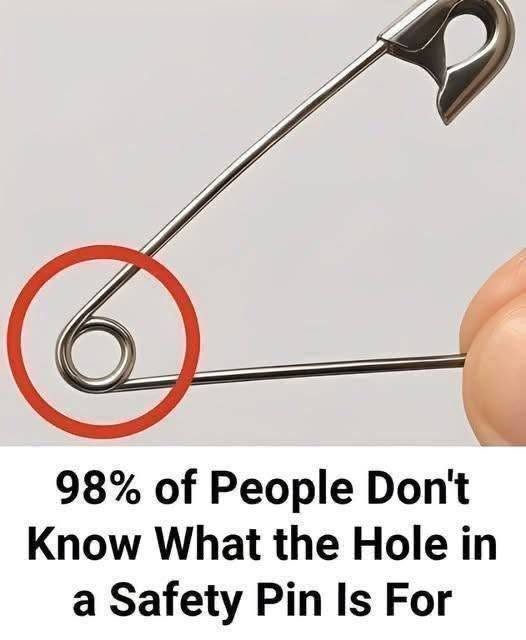
Every household has a drawer, sewing kit, or emergency first-aid pouch stocked with safety pins. We rely on these simple, clever metal fasteners for quick wardrobe emergency fixes, securing tailored garments, pinning marathon race bibs, or holding delicate fabrics in place during sewing projects. Despite their ubiquity, few people ever stop to consider why the base of a safety pin features a circular coiled loop or hole instead of a simple flat bend.
While many assume the circular hole at the bottom of a safety pin is merely a decorative element or a byproduct of cheap manufacturing, it actually serves crucial engineering and practical functions. Designed nearly two centuries ago, this tiny metal spiral plays a fundamental role in mechanical physics, material durability, sewing craftsmanship, and everyday functionality. Unlocking the true purpose behind this everyday object reveals a masterclass in elegant industrial design that continues to impact our daily lives.
The Ingenious Mechanics Behind the Safety Pin Loop
To appreciate the purpose of the circular hole or loop at the bottom of a safety pin, it helps to understand the physical mechanics of spring steel. The safety pin is far more than a simple piece of bent wire with a latch; it is a self-contained spring mechanism engineered to store mechanical potential energy and maintain constant tension.
1. Functioning as a Torsion Spring
The circular loop at the bottom is actually a specialized coil known as a torsion spring. When you compress the two open arms of a safety pin together to lock the sharp end inside the protective clasp, the circular coil absorbs and stores elastic tension.
Without this coiled loop, a simple U-shaped bend in rigid metal wire would quickly fatigue, bend out of shape, or snap under repeated pressure. The coiled hole acts as a flexible joint that distributes mechanical strain evenly around the entire circumference of the metal wire, allowing the pin to spring back open automatically whenever the clasp is released.
2. Preventing Fabric Snagging and Material Damage
In traditional sewing, tailoring, and garment manufacturing, the circular coil serves an additional practical role. When fabric is held under tension by a safety pin, the coiled loop acts as a cushioned stop. Because the wire forms a smooth, continuous circle rather than an abrupt angle, thin threads and delicate textiles are far less likely to become caught or frayed in the corner of the pin.
In specialized tailoring applications, seamstresses and tailors occasionally thread fine string, safety threads, or tagging lines through this exact loop to keep multiple pins organized or anchored in place while draping heavy fabrics over dress forms.
The Fascinating History and Invention of the Safety Pin
The modern safety pin as we know it today was invented in 1849 by American mechanic and prolific inventor Walter Hunt. The story behind its creation is a classic tale of necessity, financial pressure, and brilliant problem-solving.
A Debt Paid in Fifteen Minutes
In the spring of 1849, Walter Hunt found himself in debt to a colleague for the sum of fifteen dollars. Lacking the ready cash to settle the debt, Hunt sat at his workbench twisting a short length of brass wire between his fingers while pondering a solution. Within fifteen minutes, he conceived the idea of a spring-loaded pin equipped with a protective clasp to cover the sharp point and protect fingers from painful pricks.
Hunt immediately filed for a patent on April 10, 1849 (U.S. Patent No. 6,281). To clear his $15 debt, he sold the patent rights to the W.R. Grace and Company for a lump sum of $400. While Hunt earned enough to clear his debt and pocket a modest profit, his patented safety pin went on to generate millions of dollars in revenue as an indispensable global commodity.
Evolution from Ancient Fibulae
Before Walter Hunt’s spring-loaded design, ancient civilizations—including the Greeks, Romans, and Etruscans—used similar fasteners called fibulae. However, these ancient brooches lacked an integrated torsion spring loop and required manual bending or external catches to stay shut, making them far less convenient and prone to loosening over time.
Unexpected Everyday Uses for the Safety Pin Hole
Beyond its structural role as a spring mechanism, the circular hole at the base of a safety pin opens up a wide array of practical life hacks and household solutions.
-
Threading Drawstrings with Ease: When a drawstring slips out of a pair of sweatpants, a hoodie, or a swim trunk waistband, attach a safety pin through the fabric casing. If you pass a secondary guide string through the circular loop at the pin’s base, you can easily maneuver the pin through the fabric tunnel without losing hold of the trailing cord.
-
Creating Custom Keychain Extensions: The small loop provides an ideal attachment point for small keyrings, split rings, or lanyard clips, allowing you to create compact emergency multi-tool kits.
-
Organizing Sewing Supplies and Buttons: Slide loose spare shirt buttons or safety pins onto a single large pin by threading the open point directly through the circular end loops of smaller pins, keeping sewing drawers neatly organized.
-
Securing Zippers on Luggage for Travel Safety: For added security while commuting or traveling through busy transit terminals, thread a small safety pin through zipper pulls on backpacks or bags, using the looped base to anchor the pin tightly against foreign movement.
Financial Efficiency, Intellectual Property, and Product Design
The safety pin serves as a timeless case study in industrial efficiency, manufacturing technology, intellectual property protection, and commercial viability. Understanding how simple designs drive global markets reveals important lessons for modern entrepreneurship and consumer product development.
The Value of Simple Innovation in Business
In the realm of product engineering and corporate investment, simplicity often triumphs over complex machinery. Walter Hunt’s invention required minimal manufacturing equipment, low raw material costs, and scalable production methods. Modern companies in the manufacturing, consumer goods, and fashion hardware sectors continue to optimize simple wire-forming processes to produce billions of fasteners at microscopic unit costs.
Intellectual Property and Patent Law
Hunt’s original patent filing highlights the importance of intellectual property management for inventors and small business owners. Seeking expert guidance from a specialized attorney or legal services provider can ensure that early-stage inventions are properly protected prior to public disclosure or commercial licensing. Protecting physical designs, utility mechanisms, and material innovations remains a core pillar of modern corporate business strategy.
Clever Household Life Hacks Using Safety Pins
To maximize the practical value of safety pins around your home and daily routine, keep these versatile tips in mind:
-
Eliminate Static Cling in Garments: Pin a small metal safety pin to the inside hem of a skirt, dress, or pair of pants. The metal conducts away static electrical charges, keeping fabrics from sticking uncomfortably to your legs.
-
Prevent Robbery or Pickpocketing: When traveling through crowded tourist areas, pin your jacket’s internal pocket zipper to the inner lining fabric. This subtle barrier discourages pickpockets from accessing your wallet, passport, or smartphone unnoticed.
-
Emergency Hemline Repair: If a dress shirt hem or pant cuff unravels right before an important business meeting or formal event, turn the garment inside out and pin the fabric horizontally from the interior side for an invisible quick fix.
-
Anchor Loose Bed Sheets: If fitted bed sheets continuously slip off the corners of your mattress, place a heavy-duty safety pin diagonally across the underside corner elastic to lock the sheet firmly in place.
-
Keep Pairs of Socks Together: Pin matching pairs of socks together at the cuffs before throwing them into the laundry hamper. This simple step prevents lost socks in the washing machine and saves sorting time during laundry day.
Surprising Facts About Safety Pins
-
Dating Back to Antiquity: The oldest known bronze fibulae (predecessors to safety pins) date back to the 14th century BCE in Mycenaean Greece.
-
Symbol of Solidarity: Throughout modern history, safety pins have been worn pinned to lapels as non-verbal political symbols representing unity, safety, and support for vulnerable communities.
-
Punk Rock Fashion Staple: In the 1970s, punk rock culture popularized wearing safety pins as expressive body jewelry, piercing accessories, and raw visual elements on leather jackets and torn clothing.
-
Precision Wire Manufacturing: High-quality safety pins are crafted from nickel-plated high-carbon steel or brass to withstand moisture and resist rusting over long periods.
Conclusion
The circular hole at the base of a safety pin is far more than a simple visual accent; it is a masterfully engineered torsion spring that gives the pin its mechanical flexibility, strength, and durability. Conceived in a stroke of genius by Walter Hunt to clear a fifteen-dollar debt, this tiny coiled loop prevents wire fatigue, protects delicate garment fabrics from snagging, and provides endless utility in everyday household hacks. The next time you pick up a safety pin, you can appreciate the ingenious 1849 physics lesson resting right between your fingertips.
Frequently Asked Questions (FAQ)
What is the primary purpose of the circular loop at the bottom of a safety pin?
The circular loop functions as a mechanical torsion spring. It stores potential energy when the pin is latched shut, preventing the metal wire from snapping or deforming while allowing it to spring open automatically when released.
Who invented the modern safety pin?
The modern spring-loaded safety pin was invented by American mechanic Walter Hunt in April 1849, who patented the design and sold the rights for $400 to pay off a $15 debt.
Can safety pins damage delicate fabrics?
If applied incorrectly or under extreme tension, the sharp point can snag fine fabrics. However, the smooth circular coil at the base helps reduce strain on material threads compared to sharp angular wire bends.
Why do people pin safety pins to their clothes for static cling?
The metal alloy of the safety pin acts as a conductor that helps discharge built-up static electricity between synthetic fabric fibers and body surface moisture, preventing clothes from sticking.
