
Introduction: The Fun of STEM-Inspired Riddles
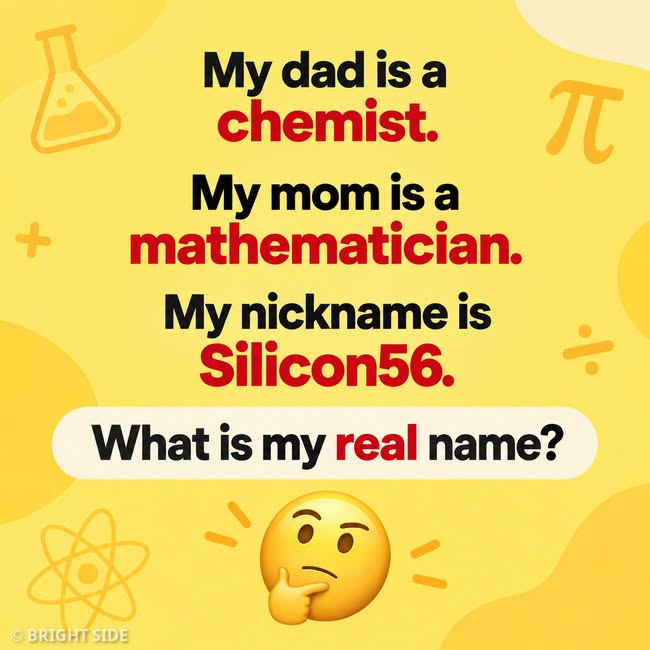
Puzzles and riddles that blend science, mathematics, and wordplay have a unique way of capturing our attention and giving our brains a playful workout. Whether it’s a clever chemistry pun or a mathematical word puzzle, these brain teasers test how we combine logic with lateral thinking. A popular viral riddle currently making the rounds asks a seemingly simple question: “My dad is a chemist, my mom is a mathematician, my nickname is Silicon56. What is my real name?”
As educational puzzles and brain teasers circulate widely across digital media, they intersect with various sectors, including digital technology, online entertainment business, user engagement models, and educational investment. This article explores the logic behind scientific riddles, the mechanics of wordplay, and how interactive content shapes modern media trends.
The Logic Behind the Riddle: Breaking Down “Silicon56”
To solve a science-based riddle, one must carefully examine the clues provided in the premise, combining both chemical symbols and mathematical elements.
1. Chemistry and Element Symbols
In the periodic table, elements are represented by one- or two-letter symbols. “Silicon” is represented by the chemical symbol Si.
2. Mathematics and Roman Numerals
The second part of the nickname incorporates a number—56. In Roman numerals, the number 56 is represented by combining L (which stands for 50) and VI (which stands for 6), forming LVI.
3. Putting the Puzzle Together
When you combine the chemical symbol for Silicon (Si) with the Roman numeral for 56 (LVI), you get Silvia (Si + LVI). This clever mashup bridges the father’s profession (chemistry) with the mother’s profession (math/numbers).
Practical Ways to Boost Cognitive Agility
Engaging in riddles and logical brain games offers several engaging mental benefits:
-
Enhancing Lateral Thinking: Practicing looking at words, numbers, and symbols from unconventional angles.
-
Quick Mental Resets: Using short logic puzzles as a refreshing brain break during a busy workday.
-
Social Engagement: Sharing clever riddles with friends and family to spark friendly competition and conversation.
Aligning Digital Content with Business and Technology
While science riddles feel like simple entertainment, their distribution relies on complex digital frameworks. For content creators and digital publishers, designing viral engagement campaigns requires strategic investment in web platforms, social media algorithms, and mobile optimization technology. Furthermore, managing digital rights, privacy regulations, and liability insurance is essential for maintaining a secure online publishing business. Whether you are a digital media attorney reviewing platform terms, an online creator scaling traffic, or a puzzle enthusiast enjoying a quick challenge, understanding the digital landscape adds valuable context.
Interesting Facts About Scientific Puzzles and Wordplay
-
The Origin of Periodic Table Puns: Using chemical symbols to spell out names or words (known as element scrambles) has long been a favorite pastime among science educators and puzzle creators.
-
Cognitive Agility: Regular engagement in lateral thinking puzzles helps stimulate neural pathways associated with creative problem-solving.
-
The Power of Shareability: Interactive riddles that require a moment of realization boast significantly higher comment and share rates on social media than standard text posts.
-
Merging Disciplines: Puzzles that combine disparate fields like chemistry and mathematics encourage cross-disciplinary thinking.
Conclusion: Putting Your Puzzle-Solving Skills to the Test
Scientific riddles like the Silicon56 challenge remind us how creative wordplay can bridge different fields of study. Whether you figured out the Roman numeral connection instantly or had to puzzle over it for a minute, brain teasers offer a fun way to exercise your mind. Balancing digital entertainment with sound business and media awareness ensures that online content remains both engaging and rewarding. A clever mind is the best tool for the job.
Frequently Asked Questions (FAQ)
Q: What is the answer to the Silicon56 riddle? A: The real name is Silvia (derived from the chemical symbol for Silicon, Si, plus the Roman numeral for 56, LVI).
Q: Why are math and science riddles so popular on social media? A: They provide a satisfying “aha!” moment, encourage friendly debate in the comments section, and offer a quick, low-stress form of interactive entertainment.
Q: Do logic puzzles help improve cognitive function? A: Yes, regularly engaging in problem-solving and lateral thinking tasks can help improve concentration, memory, and cognitive flexibility.
Q: How do creators design effective word and symbol riddles? A: Creators typically look for intersections between standardized systems—such as element abbreviations, Roman numerals, or calendar dates—to build clever double-meanings.
Q: Where can I find more puzzles like this? A: They are widely shared across puzzle blogs, social media discovery feeds, dedicated brain-teaser websites, and educational puzzle apps.
