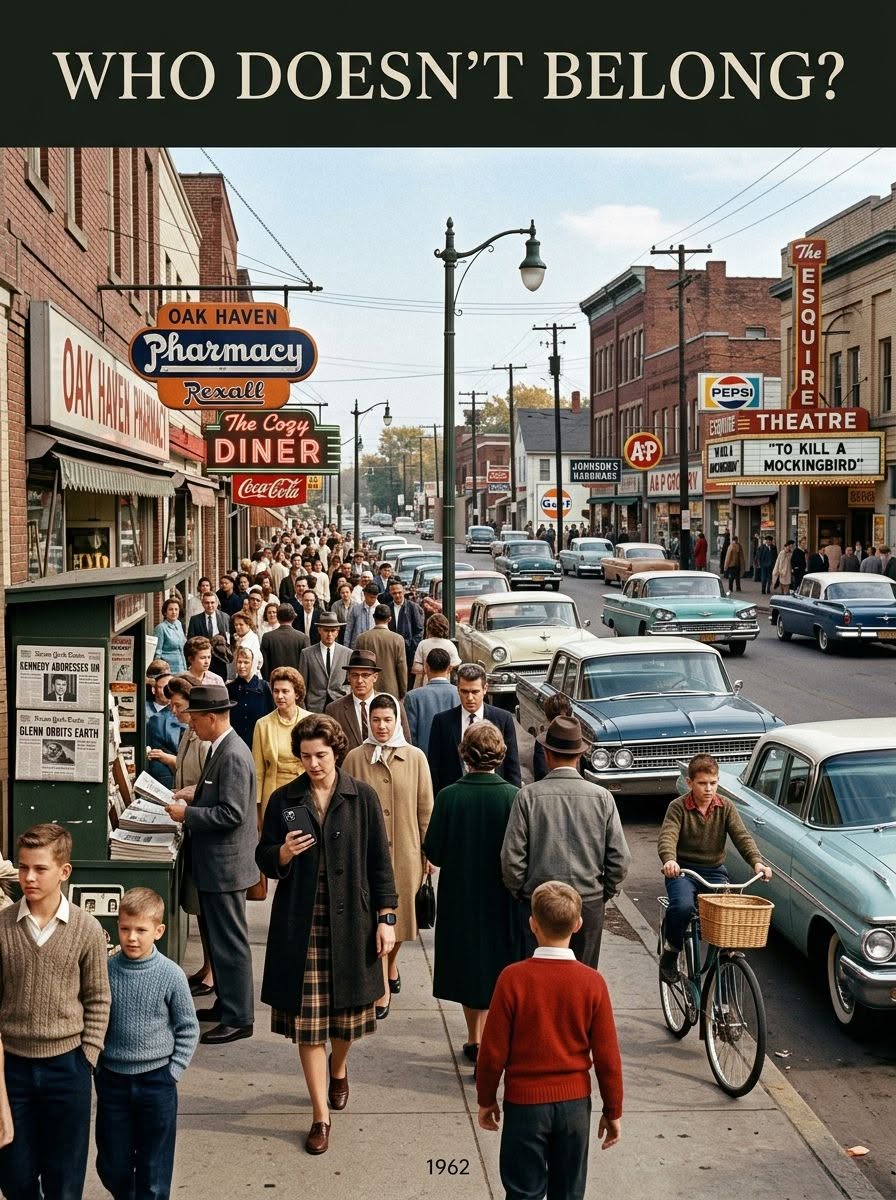
Historical visual puzzles, photo riddles, and anachronism challenges have captured the imagination of millions across social media platforms. The vintage-style illustration presented here—titled “WHO DOESN’T BELONG?” and dated 1962—transports viewers back to a bustling mid-century American main street. Complete with classic vintage automobiles, a retro movie theater marquee advertising To Kill a Mockingbird, storefronts like Oak Haven Pharmacy and Rexall, and pedestrians dressed in 1960s coats and hats, the scene looks like an authentic historical snapshot. However, hidden within this vibrant period-accurate street scene is a glaring anachronism—a modern electronic device that was physically impossible to exist in 1962. Observational challenges like this do far more than provide a quick moment of social media entertainment; they actively engage our visual processing centers, test our historical knowledge, and encourage meticulous attention to detail. In this comprehensive article, we will analyze the vintage backdrop of the scene, reveal the exact modern intruder hidden in the crowd, explore the cultural history of 1960s small-town life, and discuss how visual puzzle exercises benefit cognitive health and focus.The Visual Puzzle Explained: A Scene Out of TimeAt first glance, the artwork immerses viewers directly into a busy downtown sidewalk during the autumn of 1962. Pedestrians are strolling past newspaper stands, vintage storefronts, and classic cars while children walk home or ride bikes along the curb. The warm color palette, vintage signage for Coca-Cola and Pepsi, and period-correct clothing all contribute to a convincing historical atmosphere. Yet, upon scanning the central pedestrians, a striking modern anomaly breaks the historical continuity of the scene. Detailed Solution: Who Doesn’t Belong in 1962?If you have spent time scanning the photo and want to verify your answer—or if you need help finding the hidden modern element—here is the complete breakdown of the intruder visible in the image:The Smartphone User in the ForegroundWalking prominently down the center of the sidewalk is a woman wearing a plaid skirt and dark coat who is looking down and holding a modern, sleek handheld smartphone with a multi-lens camera module. Why it doesn’t belong: In 1962, mobile cellular technology, pocket-sized touchscreen computers, and digital mobile cameras did not exist. Telecommunications relied entirely on landline phones connected through copper wire networks, and photography required physical film rolls and manual cameras. A modern smartphone is an impossible anachronism for this era. The Culture and Commerce of 1962 American TownsTo appreciate the intentional contrast of the puzzle, it helps to examine the genuine historical details accurately captured throughout the streetscape.+——————————————————————-+
| 1962 STREETSCAPE VS. MODERN TECHNOLOGY |
+——————————————————————-+
| Authentic 1962 Elements | Modern Anachronisms in Scene |
+—————————-+————————————–+
| Classic Tailored Coats & Hats| Handheld Multi-Lens Smartphone|
| Vintage Automobile Designs | None (Vehicles match 1962 models) |
| Retro Movie Marquee | None (To Kill a Mockingbird)|
| Newspaper Stand Headlines | None (Kennedy & Glenn headlines)|
+—————————-+————————————–+
Historic Signage and Media ReferencesThe illustration incorporates wonderful historical easter eggs, such as the newspaper stand headlines referencing early 1960s news events and the movie theater marquee displaying To Kill a Mockingbird, which premiered in late 1962. These authentic touches make the sudden appearance of a modern smartphone even more striking. The Cognitive Benefits of Visual Anachronism PuzzlesEngaging with complex visual brain teasers offers proven cognitive benefits for individuals of all ages.1. Enhancing Visual Search and Selective AttentionWhen reviewing a complex crowd scene filled with period-accurate details, your visual cortex must rapidly process patterns, filter out familiar distractions, and isolate contradictory shapes. This visual scanning strengthens selective attention and spatial reasoning. 2. Stimulating Critical Thinking and Historical AwarenessAnachronism puzzles require active cross-referencing between visual stimuli and historical timelines. Recognizing why pocket-sized computers violate a 1962 setting engages long-term memory and analytical problem-solving. 3. Providing Stress Relief Through Playful FocusImmersing yourself in a visual puzzle serves as an effective form of mindfulness. By focusing entirely on discovering hidden errors, daily worries fade into the background, offering a refreshing mental break.Practical Strategies for Solving Crowd PuzzlesIf you want to sharpen your observation skills and spot hidden anomalies faster, try applying these structured techniques:Scan Central Figures First: Creators of photo puzzles often place modern intruders among primary subjects in the foreground where viewers naturally look first. Look for Technology Discrepancies: Handheld electronics, digital displays, and modern synthetic materials immediately stand out against vintage drawings.Examine Accessories and Items: Check what characters are holding in their hands, as historical props (like newspapers or shopping bags) should match the designated era. Financial, Insurance, and Business Considerations in Main Street EvolutionThe dramatic evolution from 1960s downtown commerce to today’s digital economy offers fascinating parallels in commercial development, risk management, and asset investment.Downtown Commercial Real Estate InvestmentIn 1962, main street storefronts like Oak Haven Pharmacy and local cinemas served as the economic heartbeat of American towns. Over the decades, commercial real estate investors have had to adapt to suburban shopping centers, big-box retail, and e-commerce by revitalizing downtown districts into mixed-use cultural and dining hubs. Small Business Insurance and Risk ManagementOperating a traditional retail store or downtown business requires robust commercial liability insurance, property protection, and business interruption coverage to safeguard physical assets and inventory against unexpected events.ConclusionThis 1962 town street puzzle is a clever blend of nostalgic artistry and modern science fiction. By hiding a smartphone user within a bustling mid-century crowd, the illustration provides a delightful test of observation and wit. Did you manage to spot the modern time-traveler right away? Share this puzzle with your friends and family to see who has the sharpest eyes! Frequently Asked Questions (FAQ)Who doesn’t belong in this 1962 street scene?The out-of-place person is the woman walking in the foreground holding a modern smartphone in her hands[cite: 16].What movie is featured on the theater marquee?The theater marquee on the right advertises the classic film To Kill a Mockingbird[cite: 16].Why are anachronism puzzles so popular online?They combine historical nostalgia with a fun challenge, encouraging viewers to inspect every detail of an image to uncover hidden modern mistakes[cite: 16].
1962 Town Street Scene Visual Puzzle: Can You Spot the Modern Intruder Hidden in Plain Sight?