
Fine jewelry, family heirlooms, and everyday silver pieces gradually lose their brilliant luster as dirt, body oils, lotions, and environmental tarnish accumulate. Over time, rings, necklaces, and bracelets can look dull, dark, or lifeless.
While commercial jewelry cleaning solutions and professional sonic cleaning devices are widely available, you do not need to spend money on expensive chemical cleaners to restore the dazzling shine of your favorite pieces. With a few safe, non-toxic household ingredients—such as mild dish soap, warm water, baking soda, and aluminum foil—you can make an effective DIY jewelry cleaner at home.
In this comprehensive guide, we explain the science of tarnish, outline safe home cleaning methods for different metals and gemstones, highlight key precautions for delicate jewelry, and share essential long-term storage tips.
The Chemistry of Tarnish: Why Fine Jewelry Loses Its Shine
To clean jewelry safely without damaging precious metals or stones, it helps to understand why metal discolors over time.
Oil, Dust, and Biofilm Accumulation
Gold, platinum, and diamond jewelry rarely tarnish in the traditional sense. Instead, daily exposure to skin oils, cosmetics, hand lotions, hairspray, and soap residue forms a dull film over metal surfaces and behind gemstone settings, preventing light from reflecting cleanly.
Chemical Oxidation on Silver
Sterling silver ($925$ parts pure silver mixed with copper) reacts chemically with hydrogen sulfide in ambient air and moisture, creating a dark coating of silver sulfide ($Ag_2S$). This chemical reaction is known as tarnish.
Safe DIY Homemade Jewelry Cleaner Recipes
Different materials require specific cleaning formulas to achieve a bright shine safely without etching metals or loosening gemstone settings.
+———————————–+———————————–+———————————–+
| Jewelry Type | Recommended DIY Solution | Cleaning Mechanism |
+———————————–+———————————–+———————————–+
| Gold, Platinum & Diamonds | Warm Water + Mild Dish Soap | Emulsifies oils and grime |
| Sterling Silver (Tarnished) | Hot Water + Baking Soda + Foil | Electrochemical ion transfer |
| Costumes & Plated Jewelry | Damp Microfiber Cloth Only | Surface wiping (prevents peeling) |
+———————————–+———————————–+———————————–+
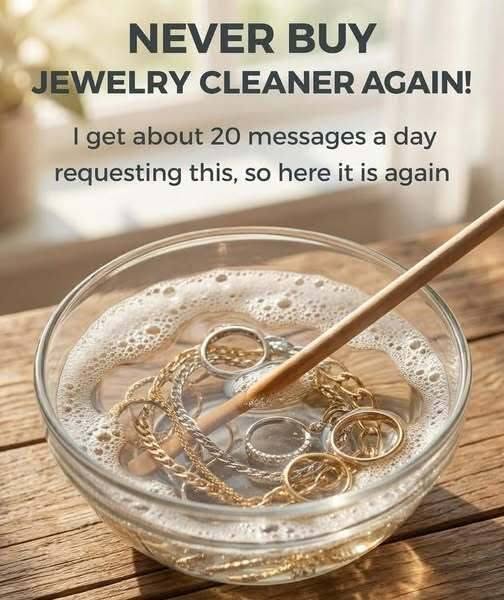
1. The Gentle Soapy Bath (Best for Gold, Platinum, and Hard Gems)
This basic technique gently lifts accumulated oils, dust, and grime without harsh chemicals.
Ingredients: $1$ cup warm water, $2$ to $3$ drops of gentle liquid dish soap.
Instructions:
Mix warm water and mild dish soap in a glass or ceramic bowl.
Submerge gold rings, chains, or diamond jewelry in the solution for $10$ to $15$ minutes.
Gently brush behind stone mounts and intricate chain links using a soft-bristled toothbrush.
Rinse thoroughly in clean water and pat dry with a lint-free microfiber cloth.
2. The Electrochemical Aluminum Foil Method (Best for Tarnished Silver)
This brilliant chemical process reverses silver tarnish without abrasive scrubbing or scratching.
Ingredients: $1$ glass bowl lined with aluminum foil (shiny side up), $1$ cup boiling water, $1$ tablespoon baking soda, $1$ teaspoon salt.
Instructions:
Line a heat-safe bowl with aluminum foil and place tarnished sterling silver pieces inside so they directly touch the foil.
Sprinkle baking soda and salt over the jewelry.
Pour boiling water into the bowl. A slight sulfur smell will release as an electrochemical reaction transfers the tarnish sulfur atoms directly from the silver onto the aluminum foil!
After $3$ to $5$ minutes, remove the pieces using plastic tweezers, rinse in cool water, and buff dry.
Critical Precautions: Protecting Sensitive and Soft Gemstones
Not all gemstones can tolerate DIY cleaning solutions or water immersion. Exercising caution with delicate stones prevents costly damage.
Soft and Organic Gems: Pearls, opals, turquoise, emeralds, coral, and amber are porous or delicate. Never soak soft gems in baking soda, hot water, vinegar, or soapy solutions, as moisture can weaken settings, cause internal cracking, or strip natural lusters. Wipe them gently with a dry or barely damp microfiber cloth.
Glued Costume Jewelry: Fashion or costume jewelry often uses foil-backed stones held in place by water-soluble adhesives. Soaking costume pieces in liquid can dissolve the glue and loosen stones.
Financial Considerations: DIY Value vs. Professional Services
Cleaning jewelry at home is highly cost-effective, but professional jewelers play an important role in long-term maintenance.
Household Savings: Making home cleaning solutions costs pennies per batch compared to $15$ to $40$ for specialty commercial dip solutions or ultrasonic machines.
Professional Inspection Value: Having a certified jeweler inspect your fine jewelry once a year is a worthwhile investment. Jewelers check for loose prongs, worn claws, and weakened chain clasps that DIY cleaning cannot repair, preventing the tragic loss of valuable stones.
Fascinating Facts About Metals and Jewelry
The Karat System: Pure gold ($24K$) is too soft for everyday jewelry fabrication, so it is alloyed with copper, silver, or nickel to create durable $10K$, $14K$, or $18K$ gold pieces.
Ancient Cleaning Methods: Ancient Egyptians cleaned gold and silver adornments using mixtures of plant ash, clay, and natron salts!
Rhodium Plating: White gold jewelry is typically electroplated with rhodium—a precious metal in the platinum family—to give it a bright white mirror finish and protect against scratches.
Practical Daily Tips for Long-Lasting Jewelry Shine
Simple daily habits preserve your jewelry’s beauty between cleanings:
Follow the “Last On, First Off” Rule: Put on your jewelry after applying lotion, perfume, makeup, and hairspray to prevent buildup, and take it off before washing dishes, swimming, or sleeping.
Avoid Chlorine Pool Water: Chlorine chemically attacks gold alloys and copper, causing microscopic pitting and structural weakness in ring bands.
Store Pieces Separately: Store necklaces, rings, and silver items in individual soft cloth pouches or anti-tarnish strips to prevent scratches.
Conclusion
Keeping your jewelry collection sparkling clean does not require expensive commercial products. Using simple, non-toxic household items like mild dish soap and baking soda, you can easily restore the brilliant shine of gold, platinum, diamonds, and sterling silver right at home. By identifying your jewelry materials and taking special care with delicate gems, you can enjoy clean, radiant jewelry for a lifetime.
Frequently Asked Questions (FAQ)
1. Can I use toothpaste to clean my gold or silver jewelry?
No! Toothpaste contains abrasive particles designed to clean tooth enamel, which can easily scratch gold, sterling silver, and polished metal surfaces. Stick to mild soap or baking soda foil baths instead.
2. Is vinegar safe for cleaning silver and gold?
While mild vinegar solutions can clean pure silver, vinegar is acidic and can harm certain metal alloys or permanently dull soft, porous gemstones like pearls, opals, and turquoise.
3. How often should I clean my everyday rings and necklaces?
A quick soak in warm soapy water once every 2 to 4 weeks keeps everyday dirt, skin oils, and soap buildup from dulling your pieces.
4. Can ultrasonic cleaners damage gemstone settings?
Yes. High-frequency sound waves in ultrasonic machines can shake loose cracked or improperly set stones (such as emeralds or pavé diamonds). Always inspect settings carefully before using ultrasonic devices.
