
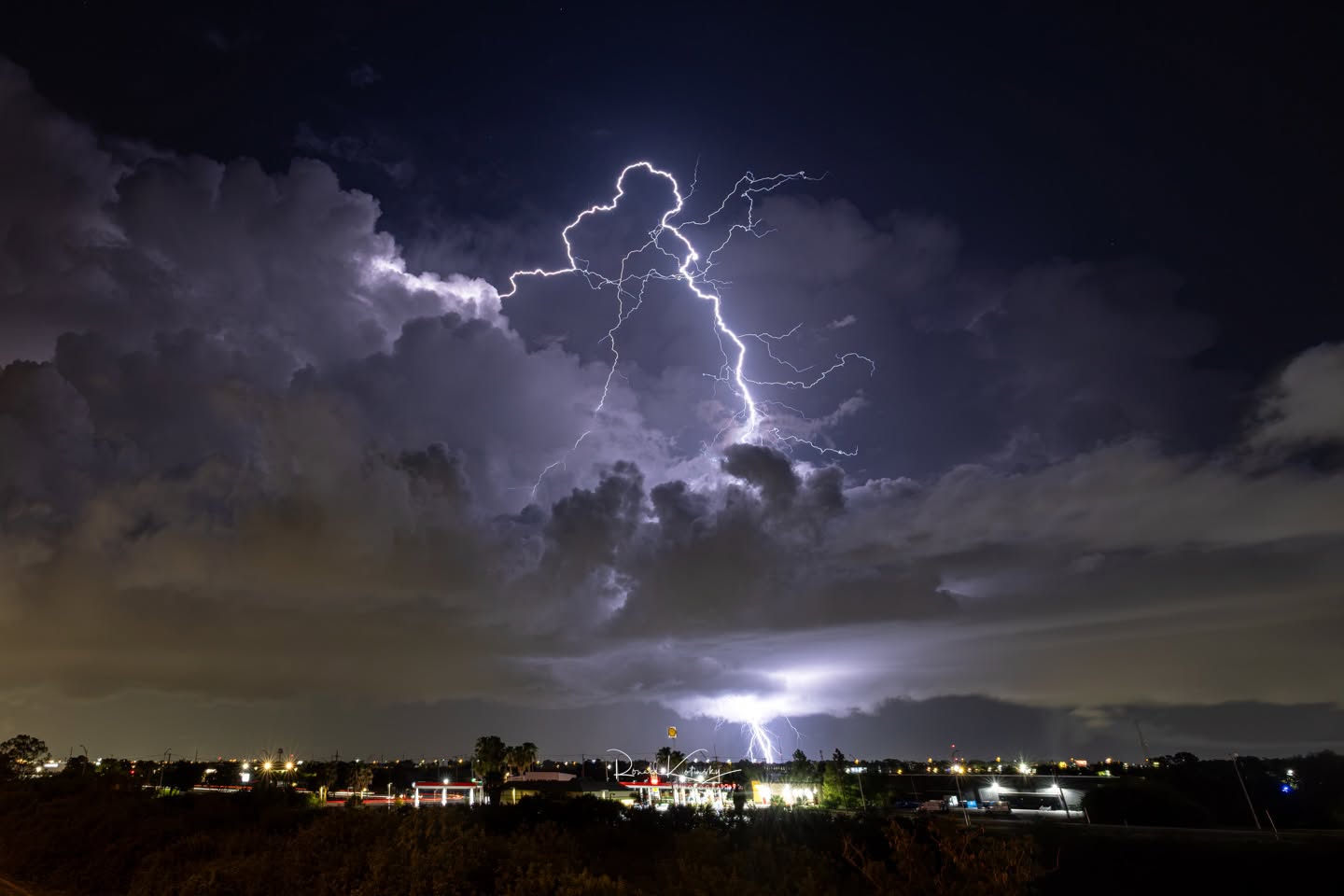
Severe weather offers some of the most dramatic visual displays on Earth. A captivating photograph by Donald Kotinsky captures a powerful lightning bolt cutting through towering thunderstorm clouds, illuminating the night sky above a glowing town skyline.
Lightning is a massive electrostatic discharge that occurs between electrical regions within clouds or between a storm cloud and the surface of the Earth. Understanding how these dramatic natural occurrences form helps us appreciate both the awe-inspiring beauty and the immense power of nature.
In this science and weather photography breakdown, we explore the physics of thunderstorm formation, storm safety, and how photographers capture dramatic lightning strikes safely.
Severe Weather & Lightning Dynamics Matrix
+-------------------------------------------------------------------+
|                   LIGHTNING DISCHARGE MATRIX                      |
|                                                                   |
|  [ DISCHARGE TYPE ] • Cloud-to-Ground & Intra-Cloud Lightning     |
|  [ ILLUMINATION ]   • High-voltage arc lighting storm clouds      |
|  [ VISUAL FEATURE ] • Intricate branching plasma channels         |
+-------------------------------------------------------------------+
Key Highlights of Severe Weather Photography:
-
Intricate Channeling: Lightning bolts branch out into complex fractal patterns as electrical energy finds the path of least resistance through the atmosphere.
-
Cloud Illumination: The intense light emitted during a strike reflects off surrounding cumulus and cumulonimbus clouds, creating high-contrast night skies.
-
Horizon Contrast: Bright city lights and highway glow along the horizon provide a striking visual ground reference for severe weather photography.
-
Natural Energy Output: A single cloud-to-ground lightning stroke carries up to one billion joules of energy and heats the surrounding air to temperatures hotter than the surface of the sun.
How Lightning Strikes Form Step-by-Step
Step 1: Charge Separation
Updrafts within a severe thunderstorm cause ice crystals and water droplets to collide, building up positive charge at the top of the cloud and negative charge near the base.
Step 2: The Stepped Leader
When the electrical charge difference becomes strong enough, an invisible stream of negative electrons (a stepped leader) surges downward toward the ground in discrete steps.
Step 3: Return Stroke and Flash
As the leader approaches the earth, a positive streamer shoots upward from high ground objects. When they connect, a brilliant flash of light and energy travels rapidly back up to the cloud.
Pro Tips for Capturing Lightning Photography Safely
-
Maintain a Safe Distance: Always monitor severe weather using radar apps and capture lightning from inside a enclosed vehicle or safe building structure.
-
Use Long Exposures at Night: Set your camera on a sturdy tripod with shutter speeds ranging between 2 to 10 seconds to catch sudden flashes without a trigger.
-
Employ a Lightning Trigger for Daytime: Using an optical lightning trigger automatically fires the shutter when it detects a sudden change in light intensity.
Conclusion
Lightning remains one of nature’s most stunning visual phenomena, blending scientific precision with unpredictable raw power. With the right equipment and safety protocols, photographers can record these brief, incredible moments for the world to see!
Frequently Asked Questions (FAQ)
What causes the sound of thunder during a lightning strike?
Thunder is created by the rapid expansion and immediate collapse of air that has been superheated by the intense electrical channel of a lightning bolt.
How hot is a bolt of lightning?
A lightning strike can reach temperatures around 50,000 degrees Fahrenheit (27,700 degrees Celsius), which is roughly five times hotter than the surface of the sun.
What is the safest location during a severe lightning storm?
The safest place during a lightning storm is inside a fully enclosed, grounded building or inside a hard-topped metal vehicle with the windows closed.
