
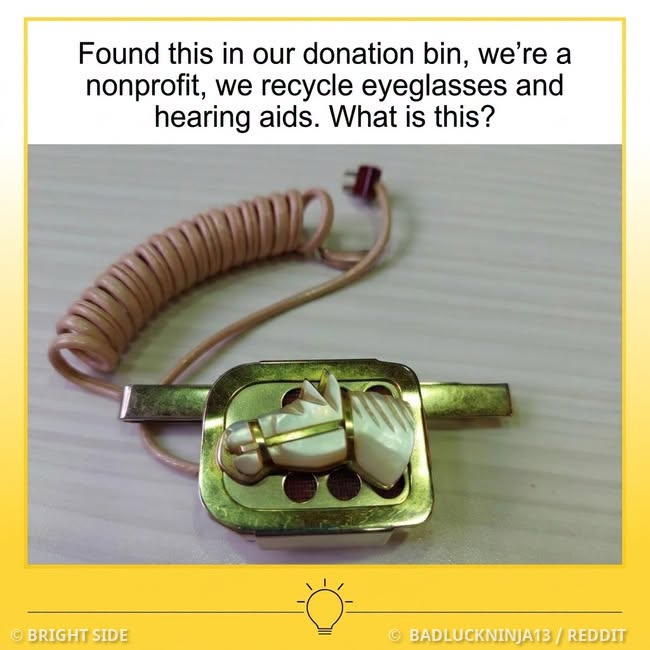
Unusual objects found in donation bins and thrift shops frequently spark curiosity across social media. A photograph featuring a metallic tie clasp decorated with a carved horse head motif—connected to a coiled flesh-colored wire—asks a mystery question from a non-profit volunteer: “Found this in our donation bin, we’re a nonprofit, we recycle eyeglasses and hearing aids. What is this?”
While it resembles a piece of decorative men’s vintage jewelry, the attached coiled wire and two-pin connector reveal its true functional identity. It is actually a vintage tie-clip microphone (or body-worn transmitter microphone) for an early 1950s–1960s body-worn hearing aid.
In this historical object analysis, we explain how body-worn hearing aids worked, how decorative discreet microphones helped users hide medical technology, and how hearing aid technology evolved into the discreet devices used today.
The Answer: What Is This Object?
The object is a decorative tie-clip microphone for a vintage body-worn hearing aid (typically produced from the late 1940s through the mid-1960s).
+-------------------------------------------------------------------+
|                     MYSTERY ITEM IDENTIFICATION                   |
|                                                                   |
|  [ DECORATIVE ELEMENT ] → Carved Mother-of-Pearl Horse Head Motif |
|  [ FUNCTIONAL BODY ]   → Microphone Housing (Grille Windows)      |
|  [ FASTENER ]          → Gold-Tone Metal Tie Bar / Clip           |
|  [ CONNECTOR WIRE ]    → Coiled Cord with 2-Pin Hearing Aid Plug  |
+-------------------------------------------------------------------+
How It Functioned:
-
Discreet Camouflage: In the mid-20th century, hearing aid manufacturers created decorative accessories—such as tie clips, tie bars, brooches, or tie pins—to conceal the bulky microphone unit required for early hearing devices.
-
The Wire Connection: The flesh-toned coiled wire ran under the user’s shirt to a pocket-sized battery and amplifier unit carried in a breast pocket, while the small plug connected to the receiver/earpiece.
The History & Evolution of Body-Worn Hearing Aids
Before modern microchips and invisible in-the-ear hearing aids existed, hearing technology required larger, heavier components:
1. The Body-Worn Era (1940s–1960s)
-
Early vacuum-tube and early transistor hearing aids were too large to fit behind or inside the ear.
-
Users wore the main battery case in an inner pocket or harness, while a wired external microphone was clipped externally to clothing near the chest to pick up ambient sound clearly.
2. Camouflage Design
-
To lessen the social stigma around hearing loss during the era, manufacturers like Zenith, Beltone, and Sonotone partnered with jewelry makers to disguise microphones as tie clips for men and brooches or pendant necklaces for women.
What Should Non-Profits Do with Vintage Hearing Aids?
-
Historical Collectibles: Vintage body-worn hearing aids and decorative microphone clips are prized items for medical history collectors, audiologists, and historical museums.
-
Recycling & Restoration: While modern donation programs focus on digital behind-the-ear (BTE) units, vintage mechanical accessories can often be donated to historical societies or sold to collectors to fund non-profit initiatives.
Conclusion
What initially looked like a classic western horse-head tie clip turned out to be an ingenious piece of mid-century medical design! Disguising hearing aid microphones as stylish fashion accessories allowed wearers in the 1950s to stay connected while maintaining confidence and style.
Frequently Asked Questions (FAQ)
What is the wire attached to the tie clip for?
The wire connected the decorative chest microphone to the battery-powered amplifier pack carried in the user’s pocket.
Why were early hearing aid microphones disguised as jewelry?
During the mid-20th century, manufacturers used tie clips, pins, and brooches to hide bulky microphone grilles and minimize social stigma associated with wearing a hearing device.
Are vintage body-worn hearing aids still used today?
No. Modern hearing aids use micro-digital technology that fits comfortably inside or behind the ear, rendering body-worn wired units obsolete except as historical artifacts.
