
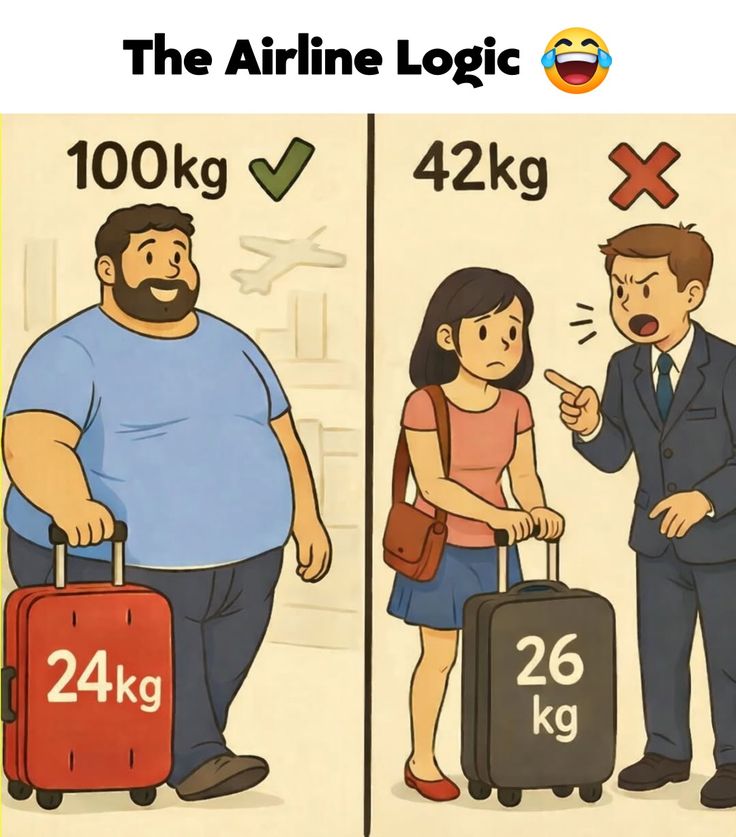
The Hilarious Absurdity of Airline Baggage Logic and Passenger Weights
Few things unite modern travelers in shared frustration quite like airport check-in counters. A popular viral meme titled “The Airline Logic” humorously compares two airport scenarios: on one side, a heavy passenger weighing 100 kg carrying a 24 kg suitcase sails through with a checkmark, while on the other side, a passenger and luggage totaling 42 kg are confronted by an angry airline agent with a red “X” because their individual suitcase weighs 26 kg.
While the cartoon is designed to provoke a laugh, it strikes a chord because it highlights a long-standing debate in commercial aviation: why do airlines strictly regulate luggage weight while ignoring passenger body weight, even though both contribute equally to the total aircraft payload? Examining the history, physics, and economics of commercial flight reveals the fascinating reasoning behind airline baggage policies.
The Physics of Aircraft Payload and Fuel Calculations
To understand why airlines enforce strict bag limits regardless of passenger weight, one must look at how commercial aviation calculates flight metrics. Aircraft fuel burn depends heavily on total weight, which includes the aircraft hull, fuel, passengers, cargo, and checked baggage.
However, regulatory aviation authorities—such as the Federal Aviation Administration (FAA)—utilize standardized average passenger weights rather than weighing individual travelers at the gate.
Standardized Estimates: Airlines calculate total passenger weight using standard demographic averages set by aviation safety authorities, which periodically update to reflect general population trends.
Baggage Compartment Logistics: Checked luggage is handled separately by baggage teams and loaded into specific cargo holds. Heavy single bags pose ergonomic and safety hazards for ground crew members who lift hundreds of heavy suitcases every day.
Center of Gravity: Distributing cargo weight evenly within the aircraft cargo hold is critical for maintaining aerodynamic stability during takeoff, cruising, and landing.
The Economics of Airline Baggage Fees
Beyond safety and weight distribution, baggage fees have evolved into a core revenue stream for modern commercial airlines. Over the past few decades, the airline industry transitioned toward “unbundled pricing,” where basic ticket prices are kept artificially low to attract budget-conscious consumers, while optional services—such as checked bags, seat selection, and extra legroom—generate auxiliary profits.
When an airline agent flags an overweight suitcase at the counter, it is rarely just about fuel calculations; it is often enforced to comply with strict workplace health regulations for baggage handlers and to capture additional baggage fee revenue.
Financial Wisdom: Smart Strategies for Avoiding Airport Fees
Navigating modern airline baggage policies without getting hit by surprise fees requires careful planning and strategic packing. Mastering travel logistics can save considerable money on your next trip:
Weigh Your Bags at Home: Invest in a compact, portable digital luggage scale to weigh your suitcases before leaving for the airport, ensuring they stay safely below standard limits (typically 23 kg or 50 lbs for international economy flights).
Distribute Weight Wisely: If one bag is overweight, shift denser items into a carry-on or personal item where weight restrictions are often less rigidly enforced.
Know Airline Policies: Different airlines enforce vastly different rules for carry-on dimensions, personal items, and weight caps. Reviewing these guidelines ahead of time prevents expensive gate check fees.
Leverage Loyalty Status: Frequent flyer programs and airline-branded credit cards often include free checked baggage benefits, saving money on frequent trips.
Practical Tips for Stress-Free Airport Check-Ins
Traveling smoothly through airport security and check-in desks becomes effortless when you adopt a few simple habits:
Pack Lightweight Luggage: Choose durable, ultra-light suitcases to maximize your allowable weight limit for actual clothing and gear rather than heavy hardware.
Wear Bulky Items: If you are traveling with heavy boots, thick jackets, or bulky sweaters, wear them through the airport terminal instead of packing them in your suitcase.
Arrive Early: Giving yourself plenty of time prevents rushed mistakes at the ticket counter and ensures a calm start to your vacation.
Fascinating Facts About Commercial Aviation History
The Evolution of Baggage Limits: In the early days of commercial jet travel during the mid-20th century, baggage allowances were significantly more generous because ticket prices included all operational amenities.
Standard Passenger Weights: Following updated safety studies, aviation authorities periodically raise official standard average passenger weights to account for demographic changes in society.
Automated Baggage Systems: Modern mega-airports utilize miles of automated conveyor belts, laser scanners, and computerized sorting systems to route checked bags across terminals in minutes.
Conclusion
The viral meme poking fun at airline baggage logic resonates because it highlights the funny contradictions of modern travel. While the math behind passenger and luggage weight might seem unbalanced at first glance, understanding the operational, safety, and economic factors behind airline policies helps travelers navigate check-in counters with a smile.
FAQ Section
Why do airlines charge extra for bags over 23 kg (50 lbs)?
Airlines enforce a standard 23 kg (50 lbs) limit primarily to protect airport baggage handlers from repetitive strain injuries and back trauma caused by lifting overly heavy luggage.
Do airlines ever weigh passengers before boarding?
While standard commercial airlines do not routinely weigh passengers, a few international carriers have occasionally conducted voluntary or mandatory passenger surveys at boarding gates to update average weight safety data.
How can I avoid paying overweight baggage fees?
You can avoid overweight fees by weighing your bags with a portable scale at home, distributing heavier items between multiple bags, or upgrading your ticket class to include higher baggage limits.
