
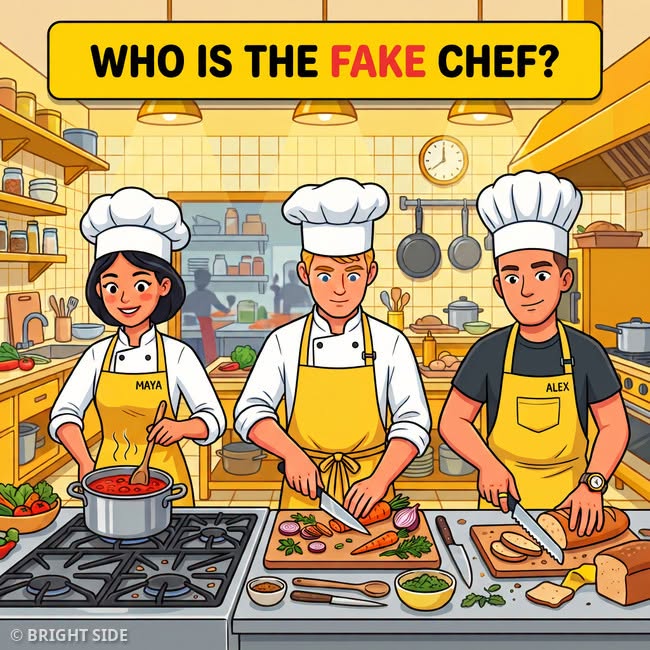
Who Is The Fake Chef? Test Your Brain With This Tricky Kitchen Detective Riddle
Visual detective riddles, brain teasers, and spot-the-fake puzzles are among the most engaging cognitive challenges on the internet today. Designed to test your powers of observation, deductive reasoning, and attention to detail, these illustrations force you to look beyond the surface. At first glance, three professional-looking chefs—Maya, the middle chef, and Alex—are hard at work in a bustling restaurant kitchen preparing delicious meals. However, upon closer inspection, one of them is clearly an amateur imposter who doesn’t belong in a professional culinary environment!
In this comprehensive guide, we will reveal the solution to this viral puzzle, break down the subtle clues hidden in the kitchen image, examine the visual science behind detective riddles, and explore how sharpening your analytical thinking skills can benefit your everyday life.
Solving the Puzzle: Who Is the Fake Chef?
To solve visual logic puzzles effectively, you must examine every detail methodically. Let’s analyze each character in the kitchen to identify the clues.
Analyzing Chef #1: Maya (On the Left)
Uniform & Attire: Maya is wearing a double-breasted professional chef jacket, a clean apron, and a traditional chef hat (toque).
Technique & Safety: She is stirring a hot pot of soup on the stovetop using a wooden spoon. Her sleeves are properly rolled up, and her hair is tied up neatly inside her hat to maintain kitchen hygiene.
Verdict: Maya demonstrates standard professional kitchen protocol.
Analyzing Chef #2: The Middle Chef
Uniform & Attire: He is wearing a classic double-breasted chef uniform with a high collar and a traditional toque.
Technique & Safety: He is standing over a cutting board, chopping fresh vegetables with a sharp chef knife. His focus is entirely on his prep work, and he follows proper posture.
Verdict: He looks and acts like a seasoned prep chef.
Analyzing Chef #3: Alex (On the Right)
Now let’s turn our attention to Alex on the right side of the counter. When you observe Alex’s appearance and technique carefully, several major red flags immediately stand out:
Improper Kitchen Attire: Alex is wearing a basic casual t-shirt under his apron instead of a double-breasted professional chef jacket, which is essential for protecting cooks against hot oil splatters and burns.
Wearing Jewelry: Alex is wearing a wrist watch and a ring while slicing bread. Professional health regulations and culinary hygiene standards strictly forbid wearing wrist watches, rings, or hand jewelry during food prep because they trap bacteria and pose serious hygiene hazards.
Flawed Slicing Technique: Alex is using a bread knife, but he is placing his hand dangerously close to the blade while cutting, reflecting a total lack of professional knife safety training.
The Answer: Alex is the fake chef! His lack of proper chef attire, violation of kitchen hygiene rules by wearing a watch and ring, and unsafe knife hand placement give him away completely.
The Psychology of Visual Riddles and Spot-the-Imposter Puzzles
Why do detective riddles and imposter puzzles captivate millions of readers online? Psychologists and cognitive scientists explain that these puzzles tap directly into human curiosity and problem-solving instincts.
1. The Joy of Detective Deduction
When presented with a visual puzzle, your brain enters an active problem-solving state. Searching for subtle inconsistencies—such as improper safety gear or out-of-place objects—triggers an intrinsic desire to solve the mystery. When you finally spot the correct clue, your brain releases a burst of dopamine, delivering instant mental satisfaction.
2. Selective Attention and Inattentional Blindness
Most people fail to identify the fake chef immediately because our brains tend to process the overall scene rather than individual components. We see three people wearing aprons and chef hats in a kitchen, so our initial assumption is that all three are real chefs. Overcoming this “inattentional blindness” requires deliberately shifting from global visual processing to micro-detail inspection.
3. Pattern Recognition and Rule Enforcement
Visual imposter puzzles test your real-world domain knowledge. In this case, knowing basic kitchen safety rules, hygiene standards, or occupational safety norms allows you to spot what doesn’t belong much faster than relying on visual scanning alone.
Cognitive Benefits of Regular Brain Teasers and Logic Exercises
Engaging with visual logic puzzles is more than just fun entertainment—it is a workout for your brain that offers lasting benefits across critical cognitive areas:
Sharper Critical Thinking: Logic puzzles train you to cross-examine evidence, question assumptions, and avoid jumping to premature conclusions.
Enhanced Visual Focus: Regularly scanning detailed images strengthens your visual search speed and spatial awareness, skills that are invaluable when driving, reading, or analyzing complex data.
Deterrence of Cognitive Aging: Intellectual challenges stimulate neural pathways and support cognitive flexibility, helping to keep your memory sharp throughout life.
Stress Reduction and Mindfulness: Concentrating fully on solving a self-contained riddle creates a state of flow, offering a brief, healthy mental break from daily stress.
How Analytical Skills Translate to Daily Life, Career, and Business
The same observation skills used to spot the fake chef apply to complex real-world situations. Whether you are navigating personal finance, evaluating legal services, making investment decisions, or managing a business, paying attention to small details makes all the difference.
1. Risk Management and Fraud Detection
Just as Alex’s watch and t-shirt gave him away, small details in contracts, loan agreements, or financial documents can signal potential risks. Cultivating an eye for detail helps you protect your assets, evaluate insurance policies carefully, and make sound credit choices.
2. Professional Standards and Quality Control
In industries ranging from healthcare and technology to legal services and education, adherence to safety protocols and quality standards is paramount. Recognizing when someone or something deviates from established procedures protects businesses from costly legal liabilities.
3. Informed Decision-Making
Taking time to verify facts before acting prevents hasty missteps. Whether you are choosing a career path, enrolling in an educational program, or investing in real estate, adopting a step-by-step analytical mindset leads to superior outcomes.
Interesting Facts About Culinary History and Professional Kitchens
The Origin of the Chef Hat (Toque Blanche): Legend has it that the height of a traditional chef’s hat originally represented the chef’s rank, and the number of pleats on the hat (often 100) signified the number of different ways the chef knew how to cook an egg!
The Brigade De Cuisine System: Formulated by legendary French chef Auguste Escoffier, the modern commercial kitchen hierarchy organizes staff into specialized stations to maintain efficiency and safety under intense pressure.
Strict Hygiene Standards: Modern health regulations in most developed countries strictly prohibit food handlers from wearing wristwatches or jewelry (except a plain wedding band) because small crevices harbor bacteria that cannot be easily sanitized.
Double-Breasted Jackets Are Functional: The classic double-breasted white chef jacket was specifically designed with two layers of heavy cotton to insulate cooks against high kitchen heat and allow them to reverse the flaps to hide stains.
Conclusion
Visual detective riddles like “Who Is The Fake Chef?” serve as an entertaining reminder of how easily our eyes can overlook vital details when we make quick assumptions. While all three figures look like chefs at a glance, Alex’s casual t-shirt, wrist watch, ring, and unsafe knife handling reveal that he is an amateur in disguise!
Practicing visual deduction and detail orientation not only makes solving online puzzles a breeze, but also sharpens the critical thinking skills needed to make smart, well-informed choices in your education, career, and personal life.
Frequently Asked Questions (FAQ)
1. Who is the fake chef in the image?
Alex (the chef on the right) is the fake chef. He is wearing a casual t-shirt instead of a chef jacket, wearing a wristwatch and a ring while preparing food (a major hygiene violation), and using unsafe knife technique.
2. Why is wearing a watch or ring a safety violation in a kitchen?
Jewelry and watches collect dirt, food particles, and bacteria that cannot be sanitized easily during routine handwashing. They also pose physical hazards if caught on kitchen equipment.
3. What are the best strategies to solve visual riddles quickly?
Break the image down systematically into individual components. Rather than scanning randomly, inspect each person or region top-to-bottom, focusing on attire, tools, hands, and environmental details.
4. How can regular puzzle-solving improve everyday memory and focus?
Solving logic puzzles exercises your working memory and visual search capabilities, building neural resilience and training your brain to filter out distractions during complex tasks.
